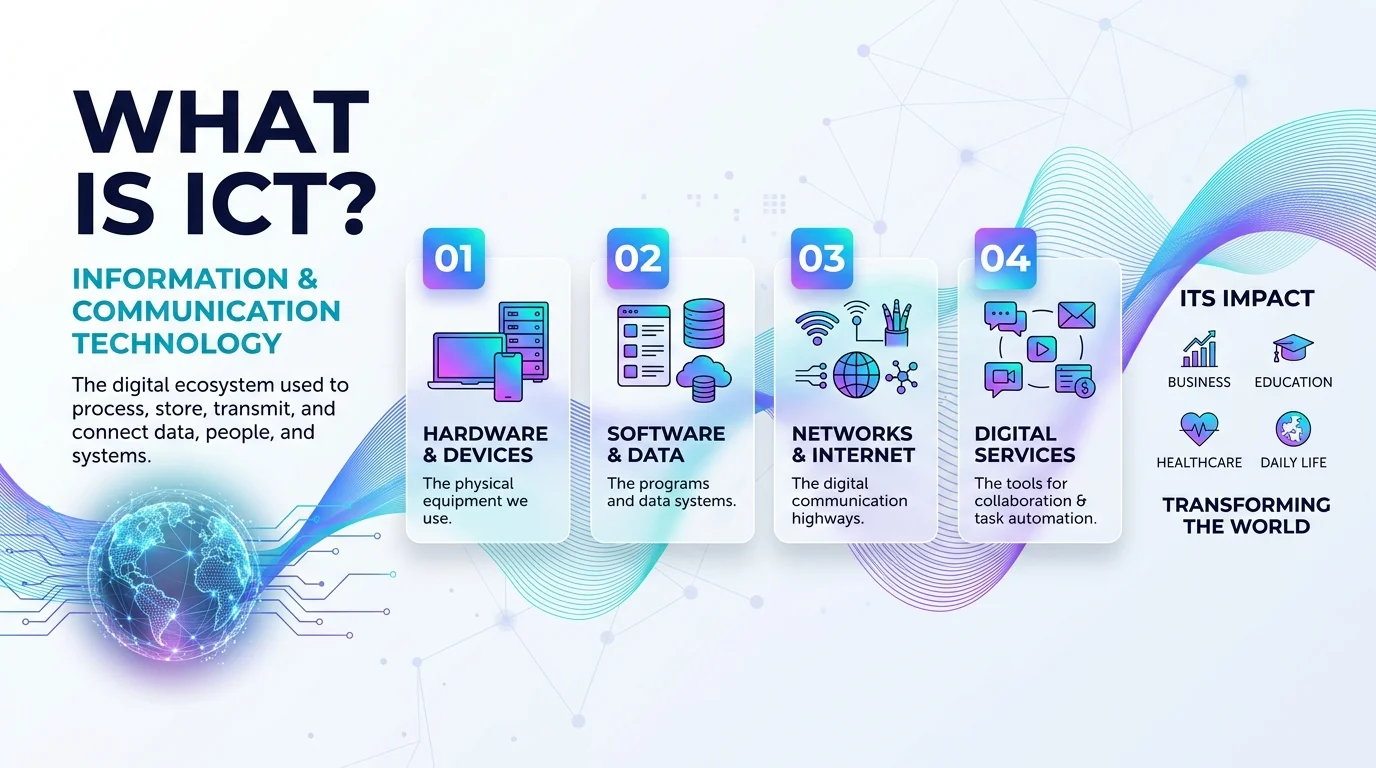
What Is ICT? ICT stands for information and communication technology. It means all the digital tools and systems used to create, store, share and manage information, including computers, the internet, phones, networks and broadcasting. It is a broader version of IT because it adds the communication side.
You have probably seen "ICT" on a job ad, a school syllabus or a government report.
You nodded along. You still could not explain it.
I get it. I will fix that in the next few minutes. Below, you will get a clear definition, a comparison table, fresh 2026 stats, a five step action plan and an FAQ.
What Is ICT, Exactly?
ICT covers every technology that handles information and communication. Think laptops, smartphones, WiFi, radio, TV and cloud computing. In short, if it captures, processes or moves information digitally, it is ICT.
Here is the catch. ICT has no single universal definition, because the field changes constantly. Researchers used the phrase in the 1980s, and it spread widely after a 1997 report to the UK government.
(Side note: "ICT" can also mean Islamabad Capital Territory or Inner Circle Trader. This guide covers the tech meaning.)
The Core Components of ICT
Before you go further, you need the building blocks. Every ICT setup is a mix of these parts, and they only work when they work together.
Hardware: computers, servers, routers, smartphones
Software: operating systems, apps, cloud platforms (if you are comparing options, see this cloud storage services comparison)
Networks: WiFi, fibre, mobile broadband, telecommunications infrastructure
Data and storage: databases, backups, data management
Media: broadcasting, digital media, video conferencing
Everyday Examples of ICT
You already use ICT all day long. That is the surprising part.
Video calls with a colleague
Online banking and mobile payments
Learning platforms and e books
Smart home devices
Email, messaging apps and social media
ICT vs IT: What Is the Difference?
People mix these up all the time. Both deal with technology, but the scope is different. Information technology (IT) focuses on computers, software and data. ICT adds the communication layer, such as phones, networks and unified communications. So IT is essentially a subset of ICT.
Feature | IT | ICT |
|---|---|---|
Full form | Information Technology | Information and Communication Technology |
Main focus | Computers, software, data | IT plus communication systems |
Typical tools | Servers, databases, apps | Servers, networks, phones, broadcasting, video conferencing |
Scope | Narrower | Broader |
Example | Processing a spreadsheet | Video calling a client with that spreadsheet |
Why ICT Matters in 2026
ICT is not a nice to have any more. It is the engine under the global economy, and the numbers show it.
Stat | Figure | Source |
|---|---|---|
People online worldwide (2025) | Almost three quarters of the population | ITU Facts and Figures 2025 |
People still offline (2025) | 2.2 billion | |
5G population coverage (2025) | More than half of the world | ITU |
ICT sector growth, 2013 to 2023 | About 6.3% a year, roughly 3 times the total economy (27 OECD countries) | OECD Digital Economy Outlook 2024 |
ICT sector growth in 2023 | 7.6% on average | OECD |
ICT firms using AI (2023) | About 28% | OECD |
Global ICT Development Index (2025) | 78.2 out of 100 across 164 economies | ITU IDI 2025 |
That is not a trend. That is a shift.
Benefits of ICT
So what do you actually gain? In practice, the benefits fall into four buckets.
Faster communication across borders
Wider access to education and services (see UNESCO's work on ICT in education)
Higher productivity through automation and digital transformation, including smarter AI use (start with this prompt engineering guide)
New business models, from ecommerce to remote work
Risks and the Digital Divide
Now the flip side. The digital divide is the gap between people with good connectivity and people without it. According to the ITU's 2025 index, 20 economies still score below 50 out of 100. Fixed broadband affordability scored 90 in high income countries and just 23 in low income ones.
Other risks you should plan for:
Cybersecurity threats and data breaches (learn how keyloggers steal passwords)
Privacy concerns
Job disruption from automation
How to Get Started With ICT: 5 Steps
Here is the exact process I would follow if you asked me to get you up to speed this week. Do these in order.
Audit your tools. List every device, app and service you use. You will find overlaps and gaps in your IT infrastructure.
Fix your connectivity. Test your internet speed and upgrade slow broadband. If your signal is weak, these tips on how to improve WiFi signal will help. Everything else depends on it.
Secure everything. Turn on two factor authentication, use a password manager and back up your data. For safer connections on public networks, read what an IPsec VPN is. Information security is cheaper than recovery.
Build your skills. Pick one area, like data analytics, cloud services or network administration, and go deep with focused training. That builds your digital literacy.
Automate and measure. Use AI tools and dashboards to cut repetitive work. Keep what saves time and drop the rest.
ICT Careers
Wondering whether this is worth your time? ICT skills transfer across industries, so you are not locked into one path. For scale, ICT made up about 4% of total value added in the EU (2020 figures). Popular roles include:
Network engineer
Cybersecurity analyst
Cloud architect
Data analyst
IT support specialist
Software developer
Frequently Asked Questions About ICT
What does ICT stand for?
ICT stands for information and communication technology. It covers all digital tools used to create, store, share and manage information.
What is the difference between ICT and IT?
IT focuses on computers, software and data. ICT includes IT and adds communication technologies such as networks, phones and broadcasting.
What are examples of ICT?
Smartphones, laptops, the internet, email, video conferencing, radio, television, cloud services and learning platforms.
Why is ICT important?
It speeds up communication, widens access to education and services, and drives economic growth. The OECD found the ICT sector grew about three times faster than the wider economy between 2013 and 2023.
What is the digital divide?
It is the gap between people who have good access to technology and the internet and people who do not. The ITU reports that 2.2 billion people were still offline in 2025.
How can I learn ICT skills?
Start with the five steps above. Then choose one focus area, such as cybersecurity, cloud or data analytics, and follow a structured course.
Ready to Take the Next Step?
I will be straight with you. Reading about ICT is a good start, but action is what changes your results.
The people who win here are not the smartest. They start early, stay consistent and invest in the right resources.
That is why I recommend you get our ICT course or toolkit today instead of "someday." You will get a clear path, practical skills and a head start on everyone who is still just reading.
Why wait? Start now.