A keylogger (or keystroke logger) is software or hardware that secretly records every key you press on a keyboard — including passwords, messages, and card numbers — and sends that data to a third party without your knowledge. Keyloggers can be software-based, hardware-based, or even acoustic, and while some uses are legal (employee or parental monitoring), unauthorized use is illegal in most jurisdictions.
If you've ever typed a password, sent an email, or logged into your bank account online, this guide is for you. I'll walk you through how keyloggers work, the different types you need to know, whether they're legal, and exactly how to detect and protect yourself from one — step by step.
What Is a Keylogger?
A keylogger is a type of surveillance software or hardware that records every keystroke you make, often without any visible sign that it's running.
Here's what makes keyloggers different from typical malware: they don't damage your device or corrupt files. Instead, according to CrowdStrike, the real danger is data theft — your passwords, financial details, and private conversations, captured silently in the background.
Modern keyloggers often go further than just keystrokes. Many also capture clipboard data (so copy-pasting a password doesn't help — and if you've ever hit clipboard paste restrictions on a managed device, you know how closely clipboard activity can be monitored), take periodic screenshots, and log browsing behavior and app usage, as noted by Proofpoint.. This broader activity is sometimes classified under spyware or general endpoint security threats rather than keylogging alone.
A Brief History of Keylogging
Keyloggers aren't a modern invention. Surveillance of this kind dates back to the Cold War, when Soviet intelligence reportedly used devices that measured tiny magnetic-field changes from an electric typewriter's print head to reconstruct typed text — which is why Soviet embassies preferred manual typewriters for classified work, per Cyble.
Commercial keylogger products entered the market in the mid-to-late 1990s. Since then, the space has grown from simple home-user fraud tools into a much bigger concern — including state-sponsored keylogging and phishing campaigns that target employees to gain access to entire corporate networks.
How Do Keyloggers Work? (Step-by-Step)
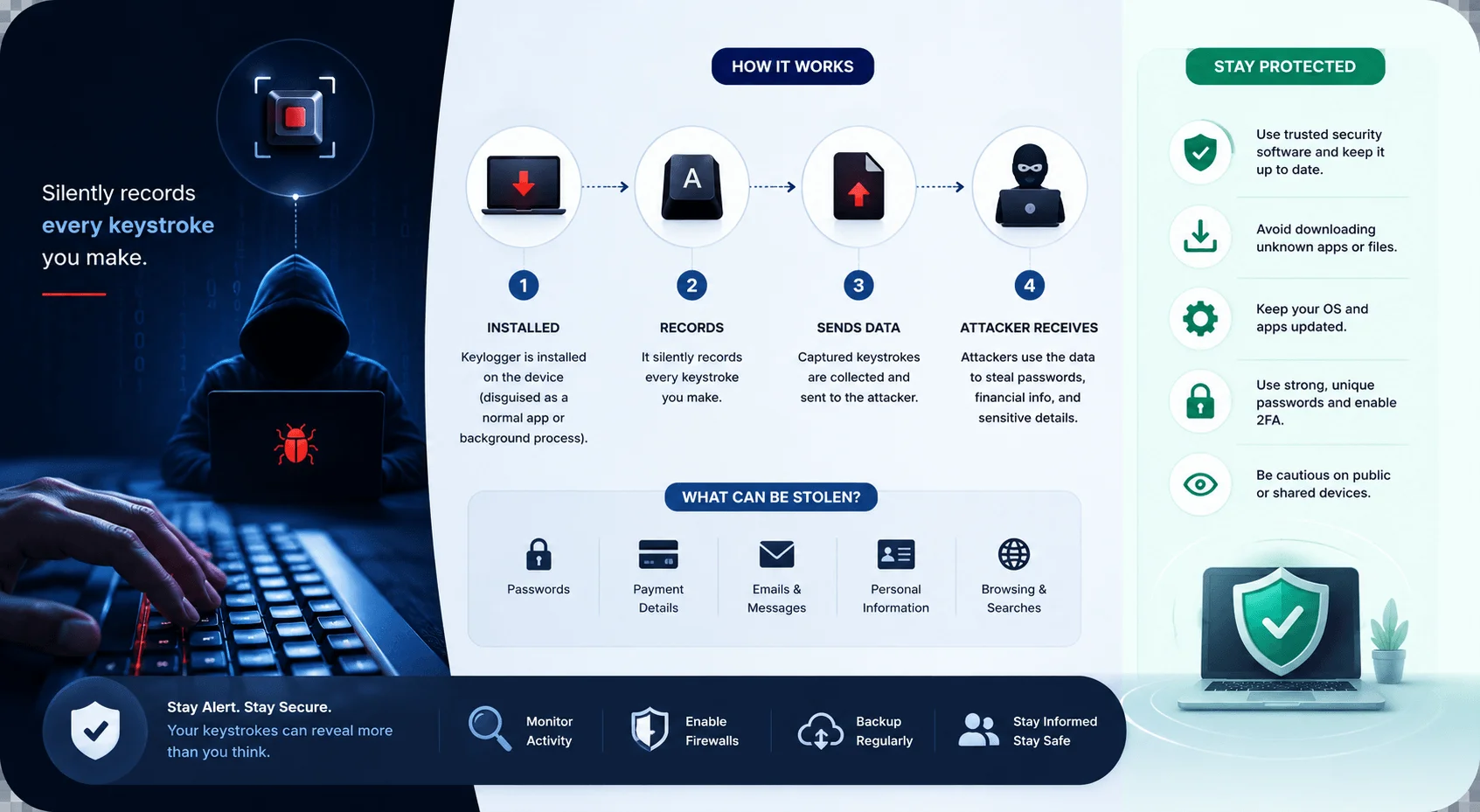
Understanding the attack chain is one of the best ways to protect yourself. Here's how a typical keylogger attack unfolds, from infection to data theft.
Infection — The keylogger reaches your device through a phishing email, a malicious download, a drive-by install, or physical installation of hardware.
Interception — It hooks into your operating system's keyboard driver, a kernel-level rootkit, or — for hardware versions — sits physically between your keyboard and computer.
Recording — Every keystroke gets logged, often with timestamps, active app names, and screenshots for context, according to Sophos.
Exfiltration — Captured data is sent to a remote command-and-control (C2) server, by email, or over Wi-Fi.
Evasion — The keylogger hides its process, avoiding task managers and basic antivirus detection.
This process is also central to digital forensics investigations, where security teams reconstruct the same chain in reverse to identify how a breach happened.
Types of Keyloggers You Should Know
Not all keyloggers work the same way. Below is a breakdown of the main categories, followed by a quick comparison table you can reference at a glance.
Software Keyloggers
Software keyloggers are programs installed directly on a device. Per McAfee, they're generally harder to detect than hardware versions since no physical access is needed.
Kernel-level keyloggers — operate deep inside the OS core, often bypassing antivirus entirely.
API/hook-based keyloggers — intercept keystrokes through the OS messaging system.
Browser-based keyloggers — target web forms, sometimes via injected JavaScript. Learning how to block suspicious websites on Chrome is one practical way to reduce your exposure to these.
Screen/clipboard loggers — capture screenshots or clipboard content alongside keystrokes.
Hardware Keyloggers
Hardware keyloggers are physical devices that require no software install. Per Norton:
USB/inline keyloggers — small devices plugged between keyboard and computer.
Firmware/keyboard-embedded keyloggers — built into the keyboard itself, very hard to detect.
Wireless keyboard sniffers — intercept radio signals between a wireless keyboard and receiver.
Acoustic and Visual Keyloggers
Acoustic keyloggers use microphones and machine learning to reconstruct keystrokes from typing sounds, per Zimperium. Visual keyloggers use hidden cameras to watch someone type, often deployed at kiosks or ATMs. Both fall under a broader field known as keystroke dynamics — the study of typing patterns for identification or surveillance.
Comparison Table: Keylogger Types at a Glance
Type | Detection Difficulty | Delivery Method | Common Use |
|---|---|---|---|
Software (kernel-level) | Very hard | Phishing, malicious downloads | Credential theft, corporate espionage |
Software (browser-based) | Moderate | Malicious scripts, compromised sites | Web form/login theft |
Hardware (USB/inline) | Easy (visual inspection) | Physical access required | Targeted surveillance |
Hardware (firmware-embedded) | Very hard | Supply chain, physical tampering | Long-term covert monitoring |
Acoustic | Hard | Microphone/audio access | Emerging attack vector |
Visual | Moderate | Hidden camera | ATM/kiosk PIN theft |
Is Keylogging Legal?
Keyloggers themselves aren't inherently illegal — legality depends on ownership, consent, and jurisdiction, per Kaspersky and Avast.
Generally legal:
Employers monitoring company-owned devices (typically requires disclosure)
Parents monitoring minors' devices
Law enforcement, with a warrant
IT departments troubleshooting managed systems
Illegal:
Installing on a device you don't own without consent
Using captured data for identity theft or fraud
Monitoring a partner or spouse's device without knowledge
This is also an insider threat consideration for businesses — internal misuse of monitoring tools can create legal liability even when the tool itself is legal.
How to Detect a Keylogger
Watch for these warning signs:
Typing lag — a delay between a keypress and it appearing on screen.
Unusual crashes in normally stable apps.
High CPU usage from an unrecognized process.
Unexpected outbound network traffic when you're not uploading anything.
Unfamiliar hardware between your keyboard and computer.
How to Protect Yourself From Keyloggers (Step-by-Step)
Install anti-malware software with dedicated anti-keylogger protection, such as Zemana AntiLogger, SpyShelter, or KeyScrambler.
Use a password manager so you rarely type credentials manually.
Enable two-factor authentication (2FA) as a second barrier if a password is ever captured.
Use a virtual keyboard for sensitive logins to defeat hardware keyloggers.
Keep software updated to patch vulnerabilities keyloggers commonly exploit.
Physically inspect shared devices — check cables and ports on public or shared computers.
Secure your home network — wireless keyboard sniffers can intercept data on unsecured networks, so it's worth knowing how to change your Wi-Fi password regularly.
Stay alert to phishing — the top delivery method for keylogger malware.
Comparison Table: Popular Anti-Keylogger Tools
Tool | Best For | Key Feature |
|---|---|---|
Zemana AntiLogger | General users | Real-time keystroke encryption |
SpyShelter | Advanced/business users | Behavior-based detection |
KeyScrambler | Browser-heavy use | Encrypts keystrokes at driver level |
(Feature details should be verified against current vendor documentation, as pricing and capabilities change frequently.)
Frequently Asked Questions
Can antivirus software detect a keylogger?
Standard antivirus can catch many software keyloggers, but kernel-level and rootkit-based versions often evade detection — dedicated anti-keylogger tools offer stronger protection.
Is keylogging illegal?
It depends on consent and ownership. Monitoring your own child's device or a company-owned computer (with disclosure) is generally legal; installing one on someone else's device without consent is not.
Can a keylogger be installed remotely?
Yes — software keyloggers are frequently delivered through phishing emails, malicious downloads, or compromised websites, requiring no physical access to the device.
Do keyloggers work on smartphones?
Yes, mobile keyloggers exist and can capture touchscreen input, app usage, and messages, often disguised as legitimate apps.
What's the difference between a keylogger and spyware?
A keylogger specifically records keystrokes, while spyware is a broader category that can include keyloggers, screen capture, location tracking, and more.
Final Thoughts
Keyloggers range from decades-old surveillance concepts to modern acoustic tools that reconstruct typing from sound alone. Understanding how they infect a device, what type you're dealing with, and how legality depends on consent puts you in a much stronger position.
The most effective defense combines a password manager, two-factor authentication, updated software, and awareness of phishing — layered together rather than relied on individually. Building these habits now is far easier than recovering from a breach later.