A final grade calculator tells you the minimum exam score you need to reach your target grade. You enter your current grade, your final exam weight and the grade you want. The formula is: required score = (target minus current × (1 minus weight)) ÷ weight.
For example, if you have an 85, the final is worth 40% and you want a 90, you need a 97.5%.
What Is a Final Grade Calculator?
Think of it as a tiny math assistant that never gets tired.
You give it three numbers, and it gives you the score you need on your final. Some tools, like the Pearson final grade calculator, also let you run what if scenarios.
I use that feature the most. Honestly, it beats guessing every time.
Why It Beats Guessing
Your gut is a terrible mathematician.
You might feel safe when you're actually at risk, or panic when you're fine. A calculator replaces the drama with a number, so you stop wasting study hours.
The Final Grade Formula
Don't worry, this isn't scary algebra.
It's one short equation built on the weighted average. Once you see it, you'll remember it. The same formula appears on RogerHub and CalculatorSoup.
Required score = (Target grade minus Current grade × (1 minus Final weight)) ÷ Final weight
Write the weight as a decimal, so 40% becomes 0.40.
Worked Example
Say your current grade is 85, you want a 90, and the final is worth 40%.
Multiply 85 × 0.60 to get 51.
Subtract 51 from 90 to get 39.
Divide 39 by 0.40 to get 97.5%.
Tough? Yes. Impossible? No.
Predicting Your Grade After the Exam
You can also run the formula in reverse: final grade = current grade × (1 minus weight) + exam score × weight.
Walk in with a 91, score an 88.6 on a 15% final, and you finish with 90.64. CalculatorSoup shows the same example.
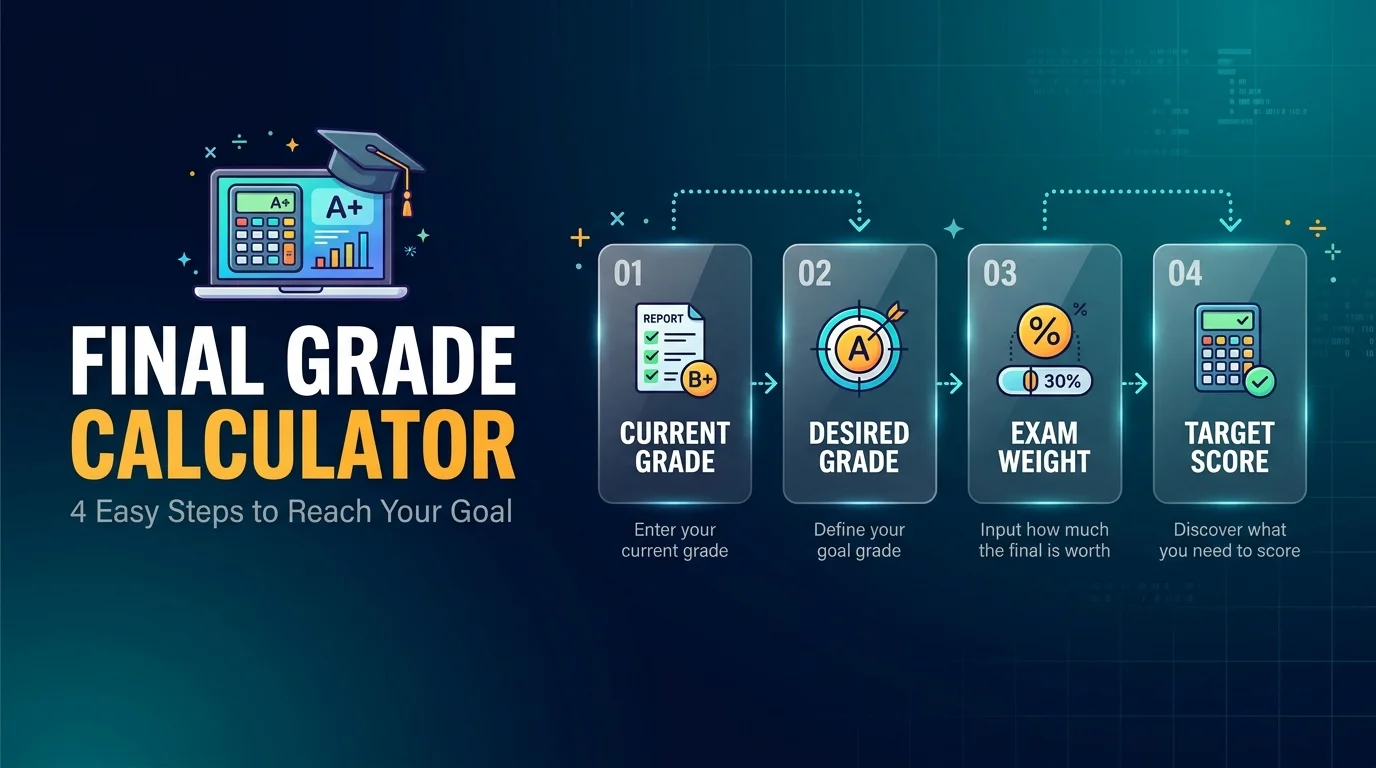
How to Use a Final Grade Calculator, Step by Step
Let's get practical.
Follow these four steps in order and you'll have your answer in about two minutes. Skip a step and the result may be wrong.
Find your current grade. Check Canvas, Brightspace or your school portal. The University of Dayton's guide explains how weighted and points based gradebooks differ.
Confirm your final exam weight. Check the syllabus. If your exam category is 60% and holds four equal tests, your final is really 15%.
Set a realistic target grade. Convert your letter grade to a percentage using your school's scale. The Longwood University chart is a common reference.
Run the numbers. If the result is over 100%, the exam alone can't get you there. Look for extra credit or lower the target.
How Much Does the Final Exam Weight Change Your Required Score?
Here's the part most guides skip.
The weight of the final changes everything. Below is my own calculation for a student with a current grade of 85 who wants a 90.
Final exam weight | Score needed on the final | Verdict |
|---|---|---|
10% | 135% | Not possible without extra credit |
20% | 110% | Not possible without extra credit |
30% | 101.7% | Barely out of reach |
40% | 97.5% | Very hard |
50% | 95% | Hard but realistic |
So the same 5 point gap is a long shot with a 10% final and a real target with a 50% final.
Weighted Grades vs. Points Based Grades
Why isn't your grade just the average of your scores?
Because not every assignment counts equally. In a weighted grading system, you multiply each category's score by its weight and add the results. The Knox College guide walks through this with real category weights. Wikipedia's weighted average entry covers the theory.
In a points based system, you divide total points earned by total points possible. Check which one your instructor uses before you calculate anything.
Tricky Situations: Dropped Scores, Extra Credit and Rounding
Real classes are messy.
Professors drop quizzes, give bonus points and round up. Your result can drift from the gradebook if you ignore those rules.
Dropped lowest score: Update your current grade first. The UVA gradebook help page explains how a dropped score shrinks the points possible.
Extra credit: Some instructors cap grades at 100%, and others don't. Ask before you count on it.
Rounding: GPACalculator.net lists rounding rules, dropped scores and missing assignments as the usual reasons a result differs from the gradebook.
Which Final Grade Calculator Should You Use?
Several free tools do the job, and each has a different strength.
Here's how the ones I reviewed compare, based on the features listed on their own pages.
Tool | Standout feature | Best for |
|---|---|---|
Pearson | What if mode plus predicted course grade | Testing different exam scores |
RogerHub | Advanced mode for dropped tests, extra credit and missing work | Complicated syllabi |
CalculatorSoup | Formula plus worked examples | Learning the math |
Software Testing Help | Basic, advanced and reverse modes | Switching between planning and results |
From Course Grade to GPA
Your course grade is only half the story.
It feeds your GPA, and that's what scholarships and graduate programs look at. After you know your course result, check how it moves your cumulative GPA. The College of Charleston's GPA calculator handles both semester and cumulative GPA.
Planning to apply to grad school or a scholarship? A strong grade is only part of the package. This letter of recommendation template helps you or your professor put together the other part.
Common Mistakes to Avoid
I see the same errors every finals week.
Using the wrong final exam weight, usually by ignoring sub weights.
Entering weights as whole numbers instead of decimals in a formula.
Forgetting to update your current grade after a dropped score.
Counting extra credit your instructor hasn't approved.
Aiming for the bare minimum with no buffer.
How to Prepare Once You Know Your Number
A number alone won't earn you an A.
You still have to study, but now you can study with a plan. One instructor at MiraCosta College notes that students often score 7 to 10% lower on the final than on earlier exams. That's one teacher's experience, not a study, but it's a good reason to build a cushion.
So if you need 85%, train like you need 92%. Focus on high point topics, use active recall and take old practice exams. Organized notes make that much easier, and these best iPad note taking apps can help you keep everything in one place. Sleep matters too.
Frequently Asked Questions
How do I calculate what I need on my final exam?
Use the formula (target minus current × (1 minus weight)) ÷ weight, with the weight as a decimal. A final grade calculator does this for you in seconds.
What if the score I need is over 100%?
Your target isn't reachable through the exam alone. Look for extra credit or choose a lower target grade.
How do I find my final exam weight?
Check your syllabus. If the final sits inside a larger category, multiply the category weight by the final's share of that category.
Does a final grade calculator work with points based grading?
Yes. Convert your points to a percentage first, or convert the final's points into its share of the total points.
Why does my result differ from my teacher's gradebook?
Usually because of rounding rules, dropped scores, missing assignments or extra credit. Update your current grade to match the gradebook before you calculate.
Stop Guessing and Run Your Numbers
Doing this math by hand invites mistakes, and mistakes at exam time cost you grades.
A good final grade calculator is fast, accurate and calming. It shows your minimum score, your best case and your realistic middle.
So here's what I'd do in your shoes. Open the calculator now and enter your numbers. Write the result on a sticky note and put it above your desk.
You've already put in the semester. Run your numbers today and walk into that exam knowing exactly what you need.