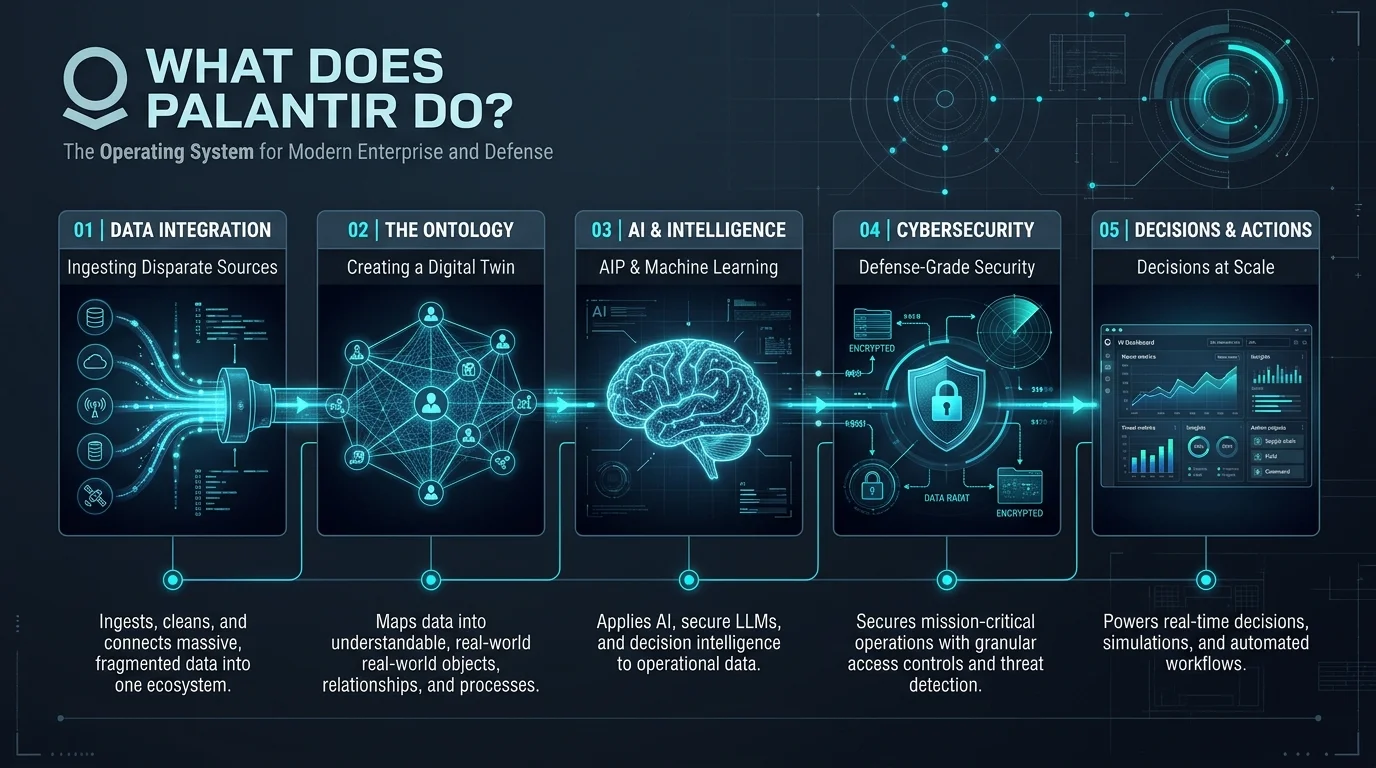
What Does Palantir Do? Palantir builds software that helps organizations integrate their data, decisions, and operations at scale. It sells four platforms: Gotham, Foundry, AIP and Apollo. Governments use them for defense and intelligence. Companies use them for supply chains, healthcare and insurance.
You've heard the name everywhere. Stock chatter, Pentagon headlines, privacy fights.
But what does Palantir actually do? I dug through the company's filings, its own documentation and independent reporting. Here's the plain English version. And if you want to learn how to research any company this way, my guide on what a research dossier is shows you the method.
What Palantir Does in Plain English
Palantir is a software company. It isn't a consultancy, and it isn't a data broker. Its customers pay to use the software platforms it has built, usually on contracts of one to five years. If you want the primary source, read the Palantir Form 10-K.
Here's the problem it solves. Big organizations drown in data silos. A hospital, an airline and an army each run dozens of disconnected systems.
Palantir connects them through data integration. Then it adds analytics and enterprise AI on top, so people can act on what they see.
The Four Palantir Platforms Compared
You'll see these four names constantly. So let me give you a cheat sheet before we go deeper. Think of them as layers in one stack: one models, one serves government, one adds AI, and one delivers updates. This table shows who each product is for and what it does.
Platform | Main users | What it does |
|---|---|---|
Palantir Gotham | Defense, intelligence, law enforcement | Fuses sensor, intelligence and case data into one operational picture |
Palantir Foundry | Commercial companies and civil agencies | Connects enterprise systems and runs operational apps on an ontology |
Palantir AIP | Foundry and Gotham customers | Connects large language models and AI agents to governed data |
Palantir Apollo | All customers | Delivers updates and security patches in any environment |
Apollo is a cloud agnostic control layer, so customers can run the software in virtually any environment. Palantir's documentation sums up AIP as connecting generative AI to operations. If large language models are new to you, my explainer on what prompt engineering is gives you the basics. You can read more in the Palantir platform overview.
How Palantir Started (And Why the Name Sounds Like Tolkien)
Origins explain a lot about behavior. Palantir didn't start in a consumer app garage. It was born after 9/11 with a security mission, and that DNA still shapes who buys from it today. Here's the short history.
The company was founded in 2003 to build software for the US intelligence community in counterterrorism work. The name comes from the seeing stones in Tolkien's Lord of the Rings, and the CIA's venture arm In-Q-Tel began investing in 2005. Peter Thiel co-founded it, and Alex Karp became CEO. The AFP history of Palantir has the details.
The Secret Sauce: Ontology and Forward Deployed Engineers
Most vendors sell dashboards. Palantir's real edge sits underneath them. Two ideas explain why customers stay and why rivals try to copy it. Let me walk you through each.
What Is the Palantir Ontology?
The ontology is a digital twin of your organization. Objects can be a customer, an aircraft, an insurance claim or a suspect, and actions define governed changes with an audit record. So you work with real world things, not raw tables.
What Are Forward Deployed Engineers?
Palantir says its forward deployed engineers get as close as possible to a customer's problem and feed feedback to the core product team. The Palantir architecture overview explains the method. In practice, you get people on your side of the table.
Palantir by the Numbers (2026)
AI engines and busy readers both love hard numbers. So here they are, with dates. Notice the pattern: commercial growth is closing in on the government business, which has been the company's anchor for two decades.
Metric | Figure | Source |
|---|---|---|
Q2 2026 total revenue | $1.94B, up 93% year over year | Benzinga |
Q2 2026 U.S. commercial revenue | $764M, up 149% | |
Q2 2026 U.S. government revenue | $809M, up 90% | MarketScale |
FY2024 revenue and gross margin | $2.9B and 80% | SEC 10-K |
Palantir reports Q3 2026 results on November 2, with guidance of $2.160 to $2.164 billion. Check back after that date for updated numbers.
Who Uses Palantir? Real Examples
Claims are cheap. Evidence isn't. Here are three arenas where Palantir's software is live, from the battlefield to the hospital ward to the factory floor. Each one shows a different side of what the company does.
Defense. The Pentagon's Maven Smart System was awarded to Palantir at $480 million in May 2024, and a later addendum raised it to as much as $1.3 billion. The same Yahoo Finance report says Maven is being made an official program of record across the US military.
Healthcare. NHS England awarded Palantir a Federated Data Platform contract worth up to £330 million over seven years. NHS England says no company involved can access health data without the NHS's explicit permission. See Digital Health's report.
Commercial. Insurance, energy, manufacturing and supply chain teams run Foundry and AIP. Palantir says its scope now spans more than 50 verticals.
The Controversies You Should Know About
I won't pretend there's no downside. Power draws scrutiny, and Palantir attracts plenty of it. If you're weighing the company as a vendor or an investment, you need both sides. So here they are, fairly.
Privacy and immigration. The Intercept reports that Palantir's ELITE app helps ICE target immigrants and issues a confidence score for each target. The Electronic Frontier Foundation disputes Palantir's description of the tool's narrow role.
Military AI. Critics fear lethal decisions with minimal human oversight. The Kentucky National Guard has said Maven isn't making targeting decisions and that analysts stay in the loop.
European pushback. In June 2026, France moved to drop Palantir from its intelligence services. That's a real signal for anyone selling into Europe.
How to Get Started With Palantir: Step by Step
Ready to test it? Here's the route I'd take. You don't need a giant rollout. You need one clear problem and a way to measure it. Follow these steps in order.
Pick one painful decision. Choose something that repeats hundreds of times a week and costs real money when it goes wrong.
List your data sources. Foundry thrives on data integration across systems.
Book an AIP bootcamp. Palantir says bootcamps put customers hands on keyboard, achieving outcomes with AI in a matter of hours.
Build your ontology. Model the objects and actions your team handles daily.
Pilot, measure, scale. Prove one workflow first, then expand.
Frequently Asked Questions About Palantir
What does Palantir do in simple terms?
It builds software that connects an organization's scattered data and helps people make decisions with it. Governments and companies are its customers.
Is Palantir a data broker?
No. Its 10-K says customers pay to use its software platforms. It sells software, not data.
What is the difference between Palantir Gotham and Foundry?
Gotham serves defense, intelligence and law enforcement. Foundry serves commercial and civil operations. Both rely on an ontology, and AIP runs on both.
What is Palantir AIP?
AIP is the Artificial Intelligence Platform. It connects large language models to your governed data and operations.
Who owns Palantir?
It's a publicly traded company (Nasdaq: PLTR). Peter Thiel is chairman and Alex Karp is CEO.
Is Palantir worth considering for my business?
If you have fragmented systems and repeated, high cost decisions, yes. Start with a bootcamp and let your own data decide.
Why I'd Shortlist Palantir
Here's my honest take. If your systems are fragmented and you want enterprise AI that works inside real operations, Palantir deserves a serious look. The customers are large, the growth is public, and the results are checkable in SEC filings.
So start small. Run a bootcamp. Measure one workflow.