Prompt engineering is the practice of writing and refining the instructions you give an AI model so it produces accurate, useful output instead of vague, generic answers. It matters because the exact same AI tool can produce brilliant or useless results depending entirely on how you phrase your request. Below, I'll break down the core techniques, a step by step framework, and everything else you need to actually get good at this.
I still remember the first time I typed a lazy prompt into ChatGPT and got back total garbage.
Same tool. Same model. Wildly different result than what my friend got.
So what changed?
The prompt.
That's it. That's the whole secret. And that secret has a name: prompt engineering.
In this guide, I'm going to show you exactly what it is, why it matters more in 2026 than ever, and how you can start doing it today, even if you've never written a line of code in your life.
Let's get into it.
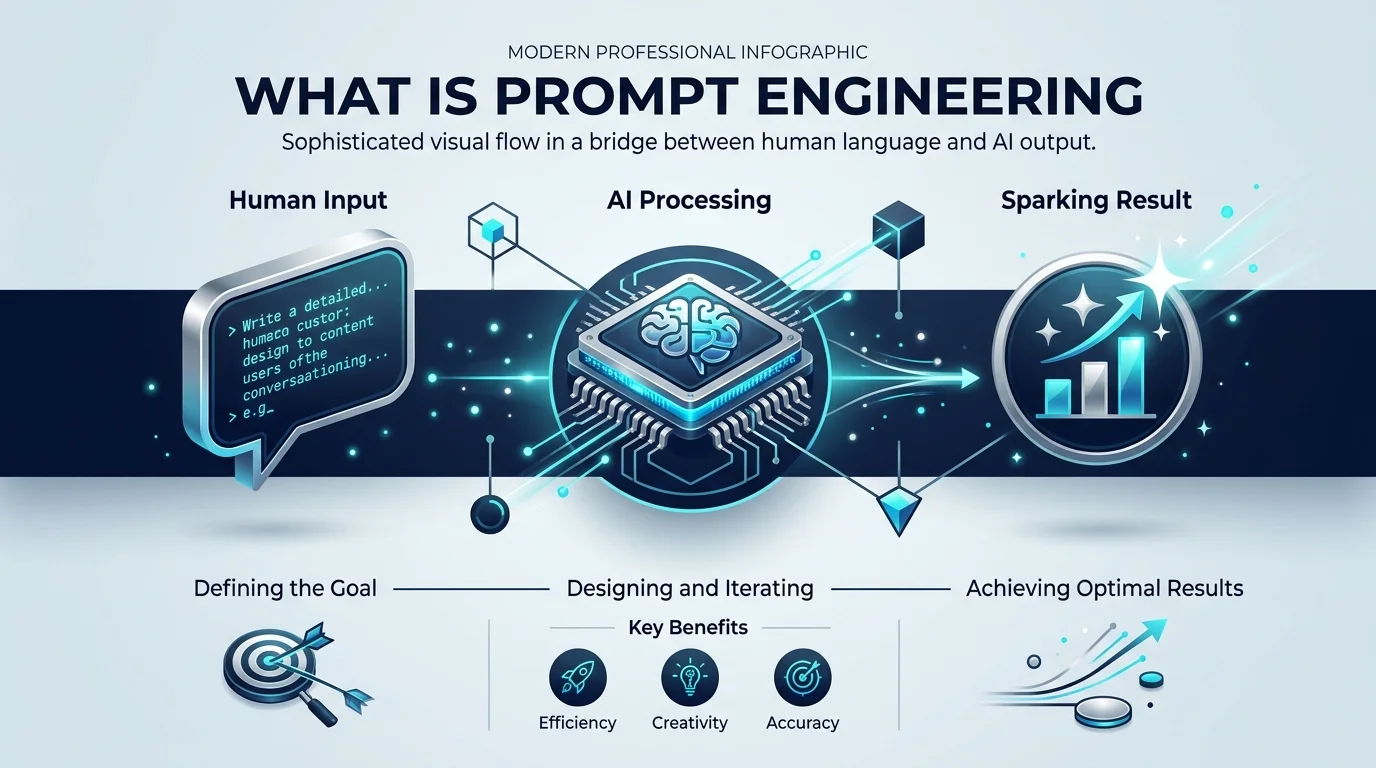
What Is Prompt Engineering, Really?
Here's the thing nobody tells you: prompt engineering isn't some mystical coding skill.
It's just... communication.
Specifically, it's the practice of designing and refining the inputs (called prompts) you give to generative AI tools so they give you back exactly what you need, not some generic, watered down answer.
Think about it this way. You've probably asked ChatGPT a question and gotten a vague, forgettable response. Then you watched someone else ask the same tool something and get a laser focused, genuinely useful answer.
The AI didn't change.
The prompt did.
And because these models respond probabilistically, even small wording tweaks shift which words the model reaches for next. Add a little context, a role, or a few constraints, and suddenly you're steering the output instead of just hoping for the best.
If you want to see prompting principles applied to a specific tool, our Gemini AI photo prompt guide is a great next read. It shows these exact ideas in action.
The Anatomy of a Killer Prompt
I want to make this dead simple for you.
A strong prompt usually includes:
Role and context: who should the AI "be" while answering?
Task definition: what exactly do you want it to produce?
Constraints: tone, format, length, rules
Examples: show, don't just tell
Evaluation instructions: ask it to double check its own work
Nail these five, and you'll outperform 90% of people who just type whatever pops into their head.
Why Prompt Engineering Actually Matters (Yes, Still)
You might be thinking: okay, but AI models keep getting smarter, won't this skill become useless?
Fair question. I asked it too.
Short answer? No.
Longer answer: prompt engineering has evolved, not disappeared. It now covers everything from hand written prompts to structured output schemas, tool definitions, and full blown automated optimization loops, according to a May 2026 report from FutureAGI.
And here's a stat worth remembering: according to Atlan's 2026 analysis, structured prompting can reduce AI errors by up to 76% compared to messy, unstructured inputs. That's not a small edge. That's the difference between an AI tool that wastes your time and one that becomes your unfair advantage.
Yes, Gartner made headlines in July 2025 declaring "context engineering is in, prompt engineering is out." But don't let that scare you off. It's not an elimination of the skill, it's a rebrand of where it lives. The fundamentals you learn now carry straight over. More on that distinction below.
Prompt Engineering vs. Context Engineering: What's the Difference?
This is one of the most asked questions right now, so let's clear it up.
Prompt engineering is about crafting a single, well structured instruction: the wording, role, and format of one request.
Context engineering is the bigger picture discipline: systematically assembling all the information an AI system needs (documents, memory, tool access, retrieved data) before a prompt ever gets sent.
Think of it this way: prompt engineering is writing one great sentence. Context engineering is building the entire library that sentence gets to pull from. You still need both. A perfectly engineered prompt with zero context won't get you far, and neither will rich context wrapped in a sloppy prompt.
Core Prompt Engineering Techniques You Need to Know
Alright, let's get practical. Here's your toolkit, and a quick comparison table so you can see how these stack up at a glance.
Technique | What It Does | Best Use Case |
|---|---|---|
Zero-shot prompting | Gives the model a task with no examples | Simple, well known tasks |
Few-shot prompting | Provides multiple examples to guide the pattern | Tasks needing consistency or a specific format |
Chain-of-thought (CoT) | Asks the model to reason step by step | Logic, math, multi step problems |
Self-consistency | Runs the same CoT prompt multiple times, picks the most common answer | High stakes accuracy needs |
Role prompting | Assigns the AI a persona or expertise | Tone specific or expert level output |
Retrieval-Augmented Generation (RAG) | Pulls in external, current data before answering | Fact heavy or up to date queries |
Let's walk through each one.
1. Zero Shot Prompting
You give the model a task with zero examples and just trust it to figure things out. Great for simple, well known tasks.
2. Few Shot Prompting
You hand the model a handful of examples so it can mimic the pattern. This is a massive upgrade when you need consistency, according to IBM's research on few shot prompting, this is one of the most effective ways to boost accuracy without retraining anything.
3. Chain of Thought (CoT) Prompting
This one's my favorite, honestly.
You literally ask the model to "think step by step" before answering. It sounds almost too simple. But Google Brain's original 2022 research showed this dramatically improves performance on anything involving logic or multi step reasoning.
4. Self Consistency
Run the same chain of thought prompt multiple times, then pick the most common answer. It's like asking three friends for advice instead of one, you catch the outliers.
5. Role Prompting
Tell the AI who to "be." A marketing expert. A blunt editor. A patient teacher. This single trick often does more heavy lifting than people expect.
6. Retrieval Augmented Generation (RAG)
This is where things get advanced. Instead of relying purely on what the model already "knows," RAG pulls in real, current information from an external knowledge base and feeds it into the prompt. The result? Fewer hallucinations, more grounded answers.
If you're experimenting with visual AI tools alongside text prompts, check out our roundup of the best AI art generators for beginners. The same prompting logic applies.
A Simple Step by Step Framework to Start Today
I don't want to just throw theory at you. Here's exactly what to do.
Step 1: Pick one AI model and stick with it. Don't bounce between five tools. Get to know how one responds.
Step 2: Write a rough prompt. Don't overthink it yet. Just get something down.
Step 3: Add role and context. "Act as a specific expert" changes everything.
Step 4: Define the format. Bullet points? A table? A 300 word summary? Say so.
Step 5: Add constraints. Tone, length, audience, spell it out.
Step 6: Review and refine. Treat it like a conversation, not a one shot lottery ticket. Point out what was wrong. Ask for a revision.
Step 7: Save what works. Build yourself a little prompt library. Future you will thank present you.
The Glossary You Actually Need (No Jargon Overload)
You don't need to memorize a textbook. But knowing these terms will instantly make you sound (and think) sharper:
Token: the small chunks of text a model reads and generates
Context window: how much text the model can "remember" at once
Temperature: controls how random or predictable the output is
Embedding: a numerical representation of meaning, used for search and retrieval
Hallucination: when the AI confidently makes something up
Grounding: anchoring AI output in real, verifiable data
System prompt: the behind the scenes instructions that shape the AI's personality and rules
Here's the deal, you don't need a computer science degree for any of this. According to a 2026 report from