A research dossier is a comprehensive document that compiles a company's financial performance, leadership, legal standing, and market position into one organized report, built to support a specific business decision like an acquisition, investment, or partnership. In this guide, I'll walk you through exactly what goes into one, how it differs from a due diligence report, and how you can build one yourself, step by step.
If you've ever tried to make sense of a company before signing a deal, investing your money, or even applying for a job there, you know the feeling: too many tabs open, too little clarity. That's exactly the gap a research dossier is built to close. If you want the deeper build out process for this exact scenario, I've covered that in detail in how to build a research dossier for a target company.
What Is a Dossier, Really?
Let's start simple, because honestly, this word gets thrown around a lot without much explanation. Before we talk about business dossiers specifically, it helps to understand where the term even comes from.
The word dossier originally comes from French, from dos, meaning "back," a nod to how bundles of documents used to be labeled along the spine so you could flip through a stack and instantly know what was inside. Over time, it came to mean any organized collection of information about a person, subject, or event. You've probably seen the word in spy movies: someone breaking into a vault to steal a secret file. That association isn't wrong, but it's only half the picture.
In business, a dossier isn't cloak and dagger. It's practical. According to Collins Dictionary, it's simply a collection of papers containing detailed information on a particular subject, nothing more mysterious than that. And per LSD.Law's legal dictionary, a dossier is often "organized for easy reference or analysis," which, honestly, is the whole point. It's not just a pile of documents. It's a structured pile.
So What Is a Research Dossier for a Target Company?
Here's where it gets specific to what you're probably here for.
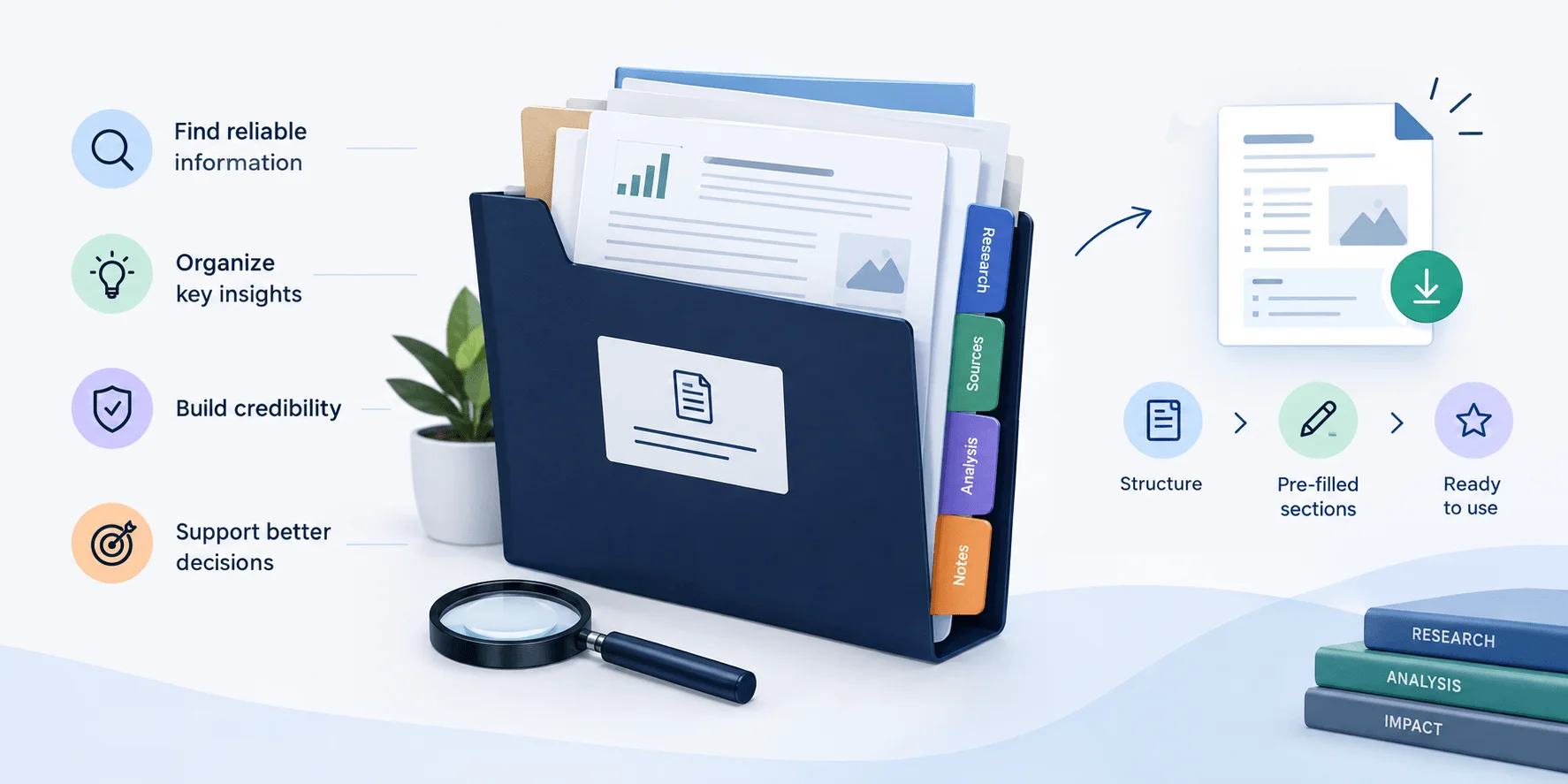
A research dossier for a target company is a comprehensive document that pulls together everything meaningful about a business: its financial performance, leadership team, market position, legal standing, and competitive landscape, into one organized report. You build it when you need to make an informed decision about that company, whether that's acquiring it, investing in it, partnering with it, or selling to it.
Think of it like this: a basic company profile tells you what a company is. A research dossier tells you whether you should do business with it.
This matters more than people realize. The numbers back this up, too. According to Bain's 2020 Global Corporate M&A Report, more than 60% of executives point to poor due diligence as the main reason a deal falls apart, and research cited by Harvard Business Review puts overall M&A failure rates somewhere between 70% and 90%. A well built dossier is one of the few things standing between you and becoming another statistic.
Research Dossier vs. Due Diligence Report vs. Company Profile
I get asked this a lot, and honestly, the terms do overlap. But they're not the same thing, and knowing the difference will save you a lot of confusion later.
Document | What It Is | When You Use It | Depth |
|---|---|---|---|
Company profile | A light overview: what the company does, founding date, leadership | Quick reference, first pass screening | Low |
Research dossier | Organized collection of findings across finance, legal, market, and ops | Ongoing evaluation of a target company | Medium to High |
Due diligence questionnaire | Standardized list of questions used to collect information | Early in the due diligence process | N/A (input tool) |
Due diligence report | Interpreted, structured document with a recommendation | Before signing a binding agreement | High |
A quick side note: if you search "dossier" broadly, you'll also stumble on things like teaching dossiers used in academia. Totally different use case; those focus on course evaluations and supervision history, not business research. Just wanted to clear that up so you don't go down the wrong rabbit hole.
Why Bother Building a Research Dossier At All?
You might be wondering, isn't this a lot of extra work? Fair question. But here's the thing: skipping this step is how deals go sideways.
Whether you're in M&A due diligence, investor due diligence, or even B2B sales prospecting, the underlying problem is the same: you're making a decision with incomplete information unless you actively go dig for it.
A few reasons a dossier earns its keep:
It surfaces risk factors you wouldn't catch from a five minute skim of a company's website
It gives you a clear executive summary to bring to stakeholders who don't have time to read 40 pages
It helps you compare a target company against your criteria objectively, not emotionally
It creates a paper trail, useful if anyone ever questions how a decision was made
It directly counters the exact failure mode Bain's research flagged: poor or rushed due diligence
What Goes Into a Solid Research Dossier? (The Core Sections)
Alright, let's get into the actual structure. This is the part you'll want to bookmark.
Section A: Company Background and Corporate Structure
Start with the fundamentals: history, ownership, subsidiaries, and how the business is legally structured. This is your foundation. Everything else builds on top of it.
Section B: Financial Performance
This is often the most scrutinized section, and for good reason. You're looking at revenue trends, profitability, debt load, and overall financial health. Per Slideworks, it's smart to prioritize "blue chip" sources first, think annual reports and official company filings, before relying on secondary commentary.
Section C: Leadership and Organizational Insight
Who's actually running the show? Leadership changes, executive turnover, and organizational stability all tell you something about where a company is headed.
Section D: Market Position and Competitive Landscape
How does this company stack up against its competitors? Is it gaining market share or losing it? This section is where competitive intelligence really earns its place in the dossier.
Section E: Legal and Regulatory Exposure
Litigation history, compliance issues, pending regulatory matters: you want to know about these before you're contractually committed, not after.
Section F: Technology and Operational Assessment
Increasingly important, especially for tech adjacent deals. This covers everything from technographic data (the tools and platforms a company already uses) to intellectual property and operational maturity.
Section G: Risk Summary and Recommendation
Finally, pull it all together. What are the biggest red flags? What's the overall recommendation? This section usually sits right at the front as an executive summary, even though you build it last.
How to Build a Research Dossier: A Step by Step Guide
Okay, here's the practical part: how you actually put one of these together without losing your mind.
Step 1: Define your objective first.
Before you collect a single data point, get clear on why you're building this dossier. Acquisition? Investment? Sales outreach? Your goal shapes what information actually matters.
Step 2: Start with firmographic basics.
Industry, headcount, revenue range, headquarters, funding stage: this is your first filter, and per Bitscale's prospect research guide, it's the foundation everything else builds on. If you need help tracking down the right web sources for a specific company, check out our guide on target company URL research.
Step 3: Layer in financial and legal data.
Pull public filings, news coverage, and legal records. This is the slower, more painstaking part, but skipping it is exactly how deals go wrong later, and it's the step Bain's research says over 60% of failed deal executives wish they'd done more thoroughly.
Step 4: Map the leadership and org structure.
LinkedIn, press releases, and company announcements are your friends here.
Step 5: Assess the competitive and market landscape.
Where does this company sit relative to its rivals? Growing? Shrinking? Under pressure?
Step 6: Compile, don't just collect.
This is the step people skip. Raw data isn't a dossier; you need to organize it into a coherent narrative with a clear executive summary up top.
Step 7: Keep a source log.
Per Slideworks' guidance, keep a running record of every source you used, because someone will ask you to back up a claim months later, guaranteed.
Manual Research vs. Automated Tools
You've got two paths here, and honestly, most people end up using a mix of both.
Factor | Manual Research | Automated Tools |
|---|---|---|
Speed | Slow: hours to days per company | Fast: minutes for structured data |
Accuracy | High on nuance, prone to human error on volume | High on structured facts, weak on context |
Scalability | Poor: doesn't scale across many targets | Strong: built for researching multiple companies at once |
Best for | Qualitative read (leadership tone, subtle red flags) | Firmographic and technographic groundwork |
My honest take? Use automation for the data heavy groundwork, then bring in a human eye for the interpretation. That's where the real judgment calls happen.
Common Use Cases for a Research Dossier
To make this more concrete, here's where you'll actually see these documents in the wild:
M&A and acquisitions: assessing whether a target company is worth the price tag
Investor due diligence: VCs and private equity firms vetting potential portfolio companies
B2B sales and account based research: reps building context before a big pitch, per Salesmotion's account research guide
Executive search: recruiters researching target companies to understand where to poach talent from
Competitive intelligence: tracking a rival's moves over time
Vendor and partner vetting: making sure a new supplier or partner isn't a liability waiting to happen
Frequently Asked Questions
Is a research dossier the same as a due diligence report?
Not quite. A dossier is the organized collection of findings. A due diligence report interprets those findings and adds recommendations.
How long does it take to build one?
It depends entirely on scope. A basic dossier might take a few hours. A full M&A grade dossier can take days or weeks, especially with legal and financial deep dives involved.
What sources should I trust most?
Start with primary sources: company filings, official websites, verified financial records, before layering in secondary commentary or news coverage.
Why do so many deals still fail despite due diligence?
Often because the due diligence was rushed or incomplete. Bain's research found poor due diligence to be the single most cited reason for deal failure among executives surveyed.
Final Thoughts
At the end of the day, a research dossier is really just a discipline: a habit of not making big decisions on gut feeling alone. Whether you're chasing an acquisition, sizing up an investment, or prepping for a sales call, the companies that win aren't the ones with the fanciest tools. They're the ones who actually did the homework. If your final step involves writing up findings formally for stakeholders, take a look at our guide on how to write a memorandum. So next time you're facing a target company you don't fully understand yet, you'll know exactly where to start.
Read more: How to Create a Research Dossier: 8-Step Process