A memorandum is a short, official internal document that informs a specific group about a problem, decision, or required action. To write one, you state your bottom line in the first sentence, add only the context your reader needs, and close with a named person and a deadline. A standard memo runs one to two pages and uses a fixed heading block: TO, FROM, DATE, SUBJECT.
That's the short answer. Now let me show you how to actually do it well.
Because here's the thing: most guides on how to write a memorandum stop at "fill in the header fields." That's not a guide. That's a form.
I dug through Purdue OWL, the Harvard Kennedy School policy memo archive, CUNY School of Law's legal writing resources, and the U.S. Army's correspondence regulation. And I found something interesting.
The rules that make a great business memo are the same rules that make a great legal memorandum, a great policy memo, and a great military memorandum for record. Only the labels change.
So I'll show you the shared skeleton first. Then the four variants. Then three copy-paste memo templates you can use today.
Let's dive in.
What Is a Memorandum? (And When You Should Actually Send One)
Before you write a single word, you need to know what this document is for. A memo is more formal than a Slack message and less formal than a letter, but it carries something neither of those does — a whiff of official record. Grammarly describes it as a way to inform a group of people about a specific problem, solution, or event. That "group" part matters. Memos are broadcast documents, not conversations.
Here's the mental model I use.
Letters go outside your organization. Memos stay inside it. That distinction shows up clearly on the Wikipedia entry for memorandum, which also notes that in law, "memorandum" means something else entirely — a record of terms, like a memorandum of understanding (MOU) or memorandum of agreement (MOA).
Now, the honest part.
Email ate most of the memo's job. Nobody's printing a holiday schedule and pinning it to a corkboard anymore.
But memos survived for messages where permanence matters. Policy changes. Disciplinary records. Confirmations of verbal agreements. Anything you might need to point at six months from now and say, "This was communicated, on this date, to these people."
That's your memo vs email test right there. Will someone need to reference this later? If yes, write a memo. (I go deeper on that call in my guide to how to end an email professionally.)
Memo vs. Email vs. Business Letter
People mix these three up constantly, and it makes them look sloppy. Each format signals something before your reader has processed a word. A memo about lunch orders reads as bureaucratic. An email about a layoff reads as careless. Choosing the right container is half the job. A clear workplace communication strategy can make these decisions easier by defining which channels employees should use for formal announcements, quick discussions, feedback, and other internal exchanges. The Open Oregon technical writing textbook notes that a memo may carry legal standing, because it so often reflects policies or procedures.
Factor | Memo | Business letter | |
|---|---|---|---|
Audience | Internal group | Internal or external | External |
Tone | Formal, direct | Flexible | Most formal |
Length | 1–2 pages | Any | 1 page |
Record value | High | Medium | High |
Best for | Policy updates, directives, confirmations | Quick back-and-forth | Clients, vendors, legal notices |
Response expected? | Usually no | Usually yes | Sometimes |
One clarification, since it trips people up: you can absolutely send a memo as a PDF attached to an email. The format is the document, not the delivery method.
The 7 Parts of a Memo (The Purdue OWL Standard)
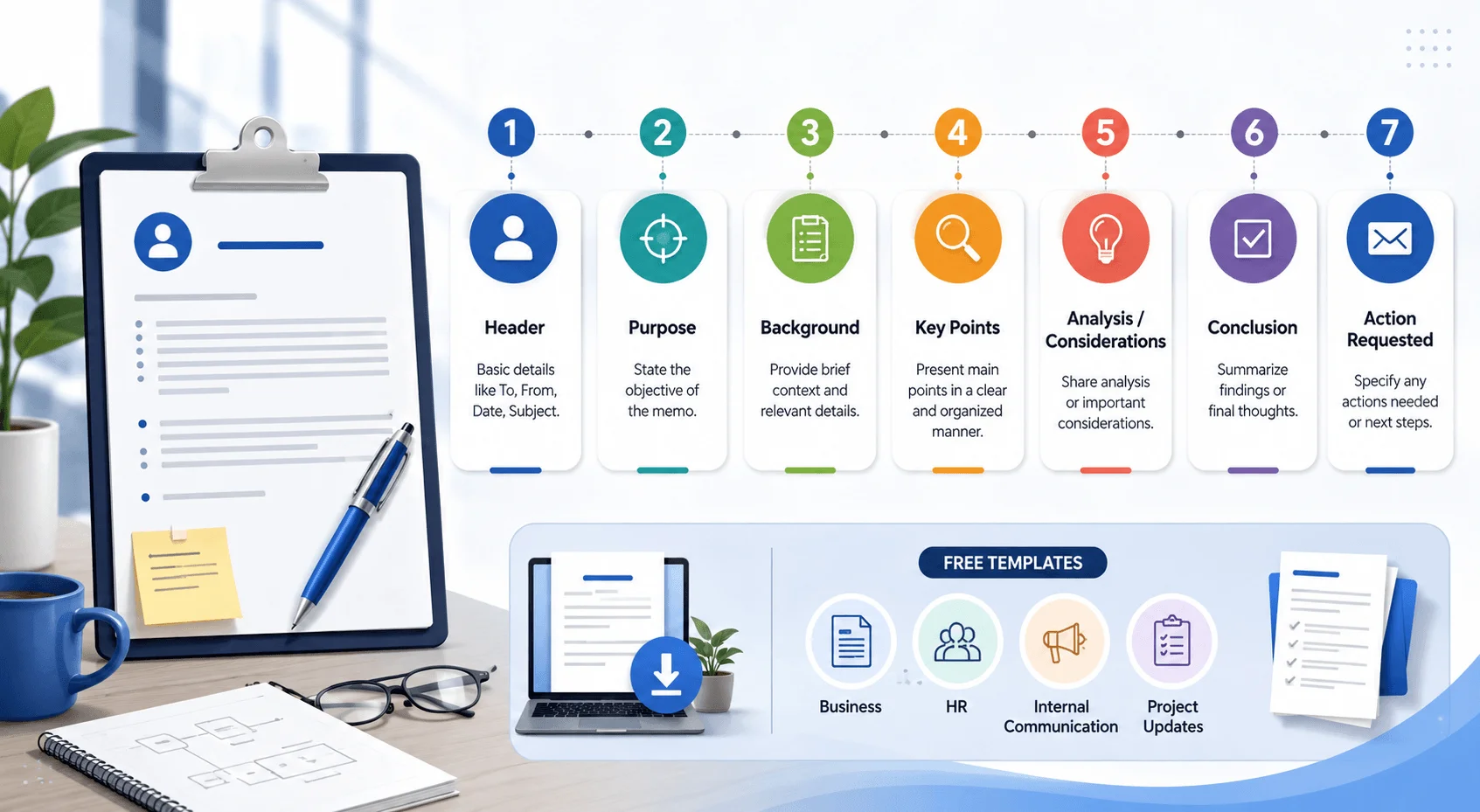
Every solid memo is built from the same segments, and once you know them, drafting gets fast. Purdue OWL is the source most university writing centers point to, and it divides the document into segments that organize information and serve the writer's purpose. I've used this skeleton for internal memos, project update memos, and client-facing briefs. It works because it front-loads meaning — your reader gets the point in ten seconds and the supporting detail only if they want it.
Here's the full anatomy.
1. Heading Segment
The block at the top. Purdue's standard format is:
TO: (readers' names and job titles) FROM: (your name and job title) DATE: (complete and current date) SUBJECT: (what the memo is about)
Small detail, big impact: use correct names and titles. You might call your CEO "Maxi" on the golf course. In a formal memo it's "Rita Maxwell, President."
2. The Subject Line (Where Most Memos Die)
I'm giving this its own section because it's the highest-leverage line in the document. A vague memo subject line guarantees your memo gets skimmed and forgotten. A specific one gets it opened and acted on. Adobe's guide makes the point cleanly: rather than "Personnel Update," name the person and the role. Purdue makes the same argument — "Clothes" could mean a dress code change or a production defect.
❌ SUBJECT: Schedule ✅ SUBJECT: Thanksgiving Weekend Office Closure, Nov 26–27
One is a category. The other is information.
3. Opening / Purpose Statement
Why this memo exists. First paragraph. Not the third.
4. Context
The event, circumstance, or problem you're addressing. A few sentences.
5. Task Statement
What you're doing about it — or what you need them to do.
6. Summary Segment (Optional)
Only if your memo runs past one page. A quick statement of key recommendations, so a busy reader gets the takeaway without the discussion.
7. Discussion + Closing
The discussion segment is the longest part and should open with your most important information. Then close with a specific call to action.
The BLUF Principle: The One Rule That Changes Everything
If you take one idea from this entire article, take this one. BLUF stands for bottom line up front — your recommendation, conclusion, or request goes in the first sentence, not buried in paragraph four. The U.S. Army formalized BLUF in Army Regulation 25-50 in 1988, which sets two non-negotiable standards for all Army correspondence: main point first, active voice throughout. Corporate, legal, and government writing all borrowed it.
Why does it work so well?
Because your reader is scanning. Always. Research from the Nielsen Norman Group found that roughly 79% of web users scan pages rather than read word by word — and a manager clearing thirty messages before lunch behaves exactly the same way.
Here's the distinction people miss.
A BLUF is not a topic sentence.
"This memo addresses the proposed budget revision" tells your reader what the document is about. Useless. As one breakdown of the BLUF technique explains, the fix is stating the actual decision: "I recommend cutting the Q3 marketing budget by $200,000 to cover the facilities overrun."
The second version gives your reader everything. The first gives them homework.
Pair BLUF With Active Voice
These two travel together for a reason. Passive voice hides who's responsible — and in a memo, responsibility is the content. The Federal Plain Language Guidelines call passive construction one of the biggest problems in government documents precisely because it obscures who does what. Those guidelines support the Plain Writing Act of 2010, which requires federal agencies to write clearly, concisely, and in a well-organized way.
❌ "The test was passed by Sgt. Jones." ✅ "Sgt. Jones passed the test."
Shorter. Clearer. Zero ambiguity. The same principle applies to any formal document you write — see how it plays out in a letter of recommendation template.
How to Write a Memorandum: Step-by-Step
Enough theory. Here's the workflow I follow, start to finish. Seven steps, about twenty minutes for a clean professional memo. I've deliberately front-loaded the thinking steps, because the writing gets easy once your problem is defined properly. Most bad memos aren't bad writing — they're unclear thinking wearing a template.
Step 1 — Define the problem, not the issue. Harvard Kennedy School teaches this brilliantly. "Overcrowding" is an issue. Their policy memo guide pushes you to quantify: where is it happening, and what does the data show?
Step 2 — Pick your audience carefully. Purdue's advice here is underrated — address only people who genuinely need it, and recognize that some material is too sensitive for a memo. Sometimes a conversation is the right channel.
Step 3 — Write your BLUF first. One sentence. Your recommendation.
Step 4 — Draft context and task. Background, then what happens next.
Step 5 — Build the discussion. Most important information first. Always.
Step 6 — Add a specific closing action. Deadline plus a name. "Please confirm headcount to Maria by Friday, March 14."
Step 7 — Cut ruthlessly. HKS suggests a test I love: hand your memo to a colleague, let them read only the first paragraph, then ask what the problem is. If they can't answer, your problem statement needs work.
3 Free Memo Templates You Can Copy
Templates beat theory every time, so here are three you can paste straight into a document and fill in. The first covers roughly 80% of workplace situations. The second is for law students and paralegals. The third is for public policy work. Each one follows the structural conventions the source institutions actually teach, so you're not guessing at what a grader or a partner expects to see.
Template 1 — Standard business memo
MEMORANDUM

TO:      [Name, Job Title]
FROM:    [Your Name, Your Job Title]
DATE:    [Month DD, YYYY]
SUBJECT: [Specific action + specific subject + date]

BLUF: [One sentence. Your recommendation, decision, or request.]

BACKGROUND
[2–4 sentences of context. Why now? What changed?]

DETAILS
• [Most important point first]
• [Second point]
• [Third point]

ACTION REQUIRED
[Who does what, by when. Name a person and a date.]

Questions? Contact [name] at [email/extension].
Template 2 — Legal memorandum (IRAC)
MEMORANDUM

TO:      [Supervising Attorney]
FROM:    [Your Name]
DATE:    [Month DD, YYYY]
RE:      [Client name / matter — legal question]

QUESTION PRESENTED
[Under (jurisdiction + law), does (legal question) when (key facts)?]

BRIEF ANSWER
[Probably yes/no. One paragraph. No equivocation.]

STATEMENT OF FACTS
[Legally significant facts only — but complete enough to stand alone.]

DISCUSSION
  Issue:       [State the precise legal issue]
  Rule:        [Constitutions → statutes → regulations → case law]
  Application: [Apply rule to your facts. Address counterarguments.]
  Conclusion:  [How a court would likely rule]

CONCLUSION
[Summary + recommended next steps]
Template 3 — Policy memo
MEMORANDUM

TO:      [Decision-maker, Title]
FROM:    [Your Name, Title]
DATE:    [Month DD, YYYY]
SUBJECT: [Recommendation on (policy problem)]

RECOMMENDATION
[One or two sentences: the problem, and the action you advise.]

PROBLEM
[Quantified. Not "overcrowding" — "412 students in space built for 300."]

OPTIONS CONSIDERED
| Option | Political | Operational | Financial |
|--------|-----------|-------------|-----------|
| 1      |           |             |           |
| 2      |           |             |           |
| 3      |           |             |           |

ANALYSIS
[Why the recommended option wins on your criteria.]

NEXT STEPS
[Concrete implementation actions.]
Target roughly 1,000 words for that last one — that's the standard HKS teaches for policy memos, which are a distillation for a decision-maker, explicitly not a research report or white paper.
Memo Formatting Rules That Make You Look Professional
Formatting isn't decoration — it's navigation. Get it wrong and even excellent content reads as amateur. The good news: the rules are few and they've barely changed in decades. Purdue's guidance is that a memo runs one to two pages, single spaced and left justified, with a blank line between paragraphs instead of indentation, and headings and lists to help readers pinpoint information.
My formatting checklist:
One to two pages. Never more.
Single spaced, left justified, no paragraph indents.
Blank line between paragraphs.
Bullet points for anything list-shaped.
Bold or underline for emphasis — sparingly.
White space. If you can't create it, cut words.
One last practical note. Most memos get distributed as PDFs rather than printed, which preserves your formatting across devices. If you're building yours from a scanned or image-based draft, you can convert JPG to PDF for free before sending.
And here's a move most people skip: make your headings descriptive, not generic. Purdue suggests replacing "Summary" with something like "New Advertising Recommendations." Your reader learns something from the heading itself.
Tone Rules
Keep it objective. The Open Oregon textbook notes memos are always direct format — the purpose is announced openly, with no personal bias on display. Also: avoid emotional language, ALL CAPS, and exclamation points, especially when the news might upset people. Nothing undermines authority faster.
The 5 Main Types of Memos
Not every memo does the same job, and using the wrong tone for the type is a common failure. A request memo needs to persuade. A confirmation memo needs to be neutral, because it's functioning as evidence. Mix those up and you sound either manipulative or indifferent. Lucid sorts them into informational, request, confirmation, and directive memos; classic business communication texts add a fifth.
Type | Purpose | Tone | Example subject line |
|---|---|---|---|
Informational memo | Announce updates, policy changes | Neutral, factual | "New Remote Work Policy, Effective Sept 1" |
Request memo | Ask for budget, resources, approval | Persuasive | "Request: $4,200 for Q4 Design Software Licenses" |
Confirmation memo | Record a verbal agreement | Neutral, precise | "Confirmation of Vendor Terms Agreed Aug 12" |
Directive memo | Give step-by-step instructions | Clear, imperative | "New Expense Submission Procedure, Steps 1–5" |
Report memo | Share findings or progress | Objective | "Q3 Customer Churn Findings and Recommendations" |
Traditional lists like the five main types of memos also include the periodic report memo, usually designed as a fill-in form.
Specialist Memorandums: Legal, Policy, and Military
Here's where this guide goes past the usual advice, because "memorandum" means three very different documents depending on which building you're standing in. The skeleton holds — heading, purpose, analysis, conclusion — but section names and expectations shift hard. If you're a law student, a policy student, or in uniform, this section is for you.
Legal memo | Policy memo | Army memo (AR 25-50) | |
|---|---|---|---|
Reader | Supervising attorney | Decision-maker | Commander |
Length | 3–10 pages | ~1,000 words | 1–2 pages |
Core structure | IRAC | Problem → options → recommendation | BLUF + supporting facts |
Key section | Application | Framework for analysis | Paragraph 1 |
Classic mistake | Skipping Application | Confusing issue with problem | Burying the point |
The Legal Memorandum (IRAC)
A legal memorandum follows a standard structure — heading, question presented, brief answer, statement of facts, discussion, conclusion — with the discussion built on IRAC: Issue, Rule, Application, Conclusion.
Two things separate a good one from a mediocre one.
First, facts. CUNY's guidance is to include only legally significant or clarifying facts — while keeping the memo self-contained enough that any colleague could read it cold and be fully informed.
Second, Application. It's where most points are won and where beginners bail. Guides on the IRAC method note that skipping Application is the classic 1L mistake: you state the rule, then jump to the conclusion, omitting the reasoning that connects them.
Worth knowing: CREAC, CRAC, and FIRAC are common variants. And when building your Rule section, work through authorities in hierarchical order — constitutions, statutes, administrative rules, then case law.
The Policy Memo
You define the problem, brainstorm options, then score them against criteria like political, operational, and financial feasibility in a framework for analysis grid. Then cut any data your audience already knows — space is your scarcest resource. For more examples, the University of Minnesota's policy writing guide aggregates resources from Duke, USC, and the Bush School.
The Army Memorandum (AR 25-50)
Military memos follow strict formatting: office symbol, subject line, enclosures, and a CF (copy furnished) line. As AR 25-50 guidance explains, continuation pages repeat the office symbol and subject at the top, with page numbers centered near the bottom. BLUF is non-negotiable here.
Common Memo Mistakes (And Quick Fixes)
Let's close with the errors I see most often, because avoiding these gets you 90% of the way to a strong memo. None are hard to fix — they're habits, not skill gaps. Run this list before you hit send and you'll catch nearly everything that would've made your memo forgettable, confusing, or quietly ignored by the exact person you needed to reach.
Burying the point → BLUF, first sentence.
Vague subject line → name the specific thing.
Passive voice everywhere → put the actor before the verb.
Filler words ("actually," "generally," "very," "moreover") → delete them.
No deadline → name a date and a person.
Over-distribution → send only to people who need it.
Wall of text → headings, bullets, white space.
Frequently Asked Questions
These are the questions I get asked most often about memo writing, pulled together in one place so you can grab a fast answer without scrolling. Each one is answered in more depth somewhere above, but if you just need the short version before sending something in the next ten minutes, start here.
What are the 7 parts of a memo?
Heading segment (TO, FROM, DATE, SUBJECT), opening or purpose statement, context, task statement, summary, discussion, and closing.
How long should a memo be?
One to two pages. Purdue OWL's standard is single spaced and left justified. If it's longer, add a summary segment near the top — or ask whether it should be a report instead.
What is the difference between a memo and a letter?
Memos are internal to an organization; letters are external and more formal. Memos skip salutations and sign-offs and jump straight to the subject.
What does BLUF mean in memo writing?
Bottom line up front. It means putting your recommendation, conclusion, or request in the first sentence. The U.S. Army formalized it in AR 25-50 in 1988.
What is the difference between an MOU and an MOA?
A memorandum of understanding records a shared intent between parties and is usually non-binding. A memorandum of agreement sets out specific obligations and is typically enforceable.
Should I send a memo or an email?
Send a memo when the message needs to exist as a record — policy changes, directives, confirmations of verbal agreements. Send an email for quick, conversational exchanges.
What is IRAC in a legal memorandum?
Issue, Rule, Application, Conclusion. It's the analytical structure used in the discussion section of a legal memo. Variants include CREAC, CRAC, and FIRAC.
Final Thoughts
The memorandum isn't dead — it just got specialized.
Use it when permanence matters. Lead with your bottom line. Write in active voice. Keep it under two pages. And make your subject line so specific that someone could act on it without opening the document.
Do those five things and you'll write better memos than almost anyone in your organization.
Now go write one.