A research dossier on a target company is a structured document that consolidates financial, legal, leadership, and reputational findings into one place to support a business decision. It's built through a defined due diligence process, not a random collection of search results. Buyers, investors, and vendors use it to confirm facts, surface risks, and reach a clear recommendation before signing anything. Diligence findings, not price or financing, are now the leading cause of failed M&A deals, responsible for roughly 46.6% of collapsed letters of intent in 2025. This guide walks you through building one, step by step.
Why a Research Dossier Matters More Than Ever
Skipping proper research on a target company is one of the costliest mistakes you can make in a deal, and the data backs that up.
Non-QoE diligence findings, things like legal exposure, customer concentration, and contract gaps, caused about 25.3% of failed deals in 2025, while quality-of-earnings discrepancies accounted for another 21.3%. Together, that's nearly half of every deal that died after the letter of intent stage.
It's not just M&A, either. Research places overall M&A failure rates at 70 to 90%, depending on how failure is measured, and inadequate due diligence sits among the top causes. A proper research dossier is how you avoid becoming part of that statistic.
Why Search Intent Matters Before You Start Researching
Search intent determines whether your research actually answers the question you're asking, instead of sending you down an unrelated rabbit hole.
Before opening a single browser tab, write down the exact question you're trying to answer. Not "tell me about this company." Something specific: "does this company have pending litigation" or "who actually owns this business."
Specific questions produce specific, usable results. Vague ones waste your afternoon.
What You Need Before You Start Building Your Dossier
Gather these five things before you begin. Skipping this step is the number one reason people end up researching the wrong entity entirely.
The company's full legal name, not just its brand name
Its registration jurisdiction or state of incorporation
Any known subsidiaries or parent companies
The names of key executives and board members
Your scope: are you checking finances only, or building a full dossier?
Step-by-Step: How to Build Your Company Research Dossier
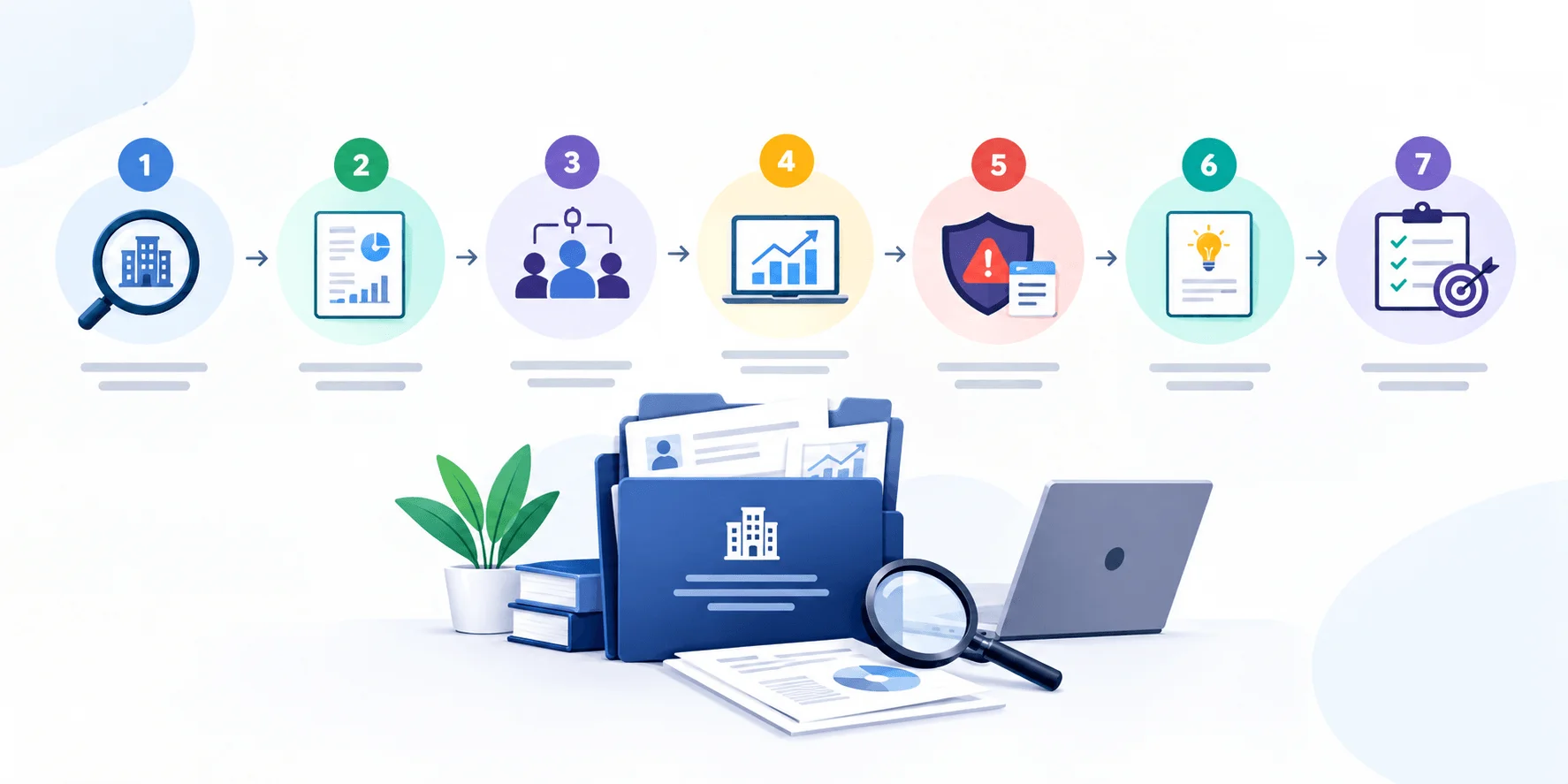
Follow these seven steps in order.
Step 1: Start With an Executive Summary Placeholder
Leave a blank header for your executive summary and fill it in last. Writing it after your research forces it to reflect actual findings instead of assumptions you started with. A finished summary should state your key risks, biggest opportunities, and a direct recommendation, structured the same way you'd approach writing a memorandum
Step 2: Pull Corporate and Legal Records
Confirm the company is actually what it claims to be. Check:
Business registration status: active, dissolved, or suspended
Corporate structure and listed subsidiaries
Public litigation records
Regulatory filings, if the company is publicly traded
Legal issues such as cap table problems, missing IP assignments, and unassignable contracts frequently kill deals outright and demand immediate fixes, so flag anything unusual here before you go further.
Step 3: Analyze Financial Health
You don't need a finance degree for this. Focus on revenue trends, profitability, and debt levels. For private companies, you're relying on estimates, industry reports, and a direct due diligence questionnaire.
Watch for these common red flags:
Customer concentration above 20-25% in a single account, which buyers treat as a material valuation risk
Revenue that's flat or shrinking year over year
Debt levels high relative to revenue
Recent write-downs or restated financials
Step 4: Review Leadership and Ownership
Search executive bios, board composition, and any beneficial ownership disclosures. A weak founder or leadership gap can undermine a deal regardless of how strong the financials look, so don't treat this section as a formality.
Step 5: Check for Reputational and Media Red Flags
Search news archives and industry publications for lawsuits, regulatory actions, or patterns of customer complaints. This step, known as adverse media screening, is what separates a basic background check from true enhanced due diligence: standard checks confirm what's known, enhanced ones surface what isn't being said.
Step 6: Assess Operations and Market Position
Look at how the company makes money, who its real competitors are, and whether its market is growing or shrinking. A simple competitive landscape analysis gives you enough context to judge whether the company is swimming with the current or against it. If you want to go deeper on the competitor side, researching a competitor's keyword strategy can reveal what markets or positioning the target company is chasing next
Step 7: Compile Everything Into Your Final Dossier
Return to your executive summary and fill it in. Organize findings into financial, legal, leadership, reputation, and operations sections, then close with a risks and synergies assessment and a direct recommendation.
Standard vs. Enhanced Due Diligence: Quick Comparison
Factor | Standard Due Diligence | Enhanced Due Diligence |
|---|---|---|
Goal | Confirm known facts | Surface hidden or undisclosed risk |
Typical use case | Vendor onboarding, routine partner renewals | High-risk deals, M&A, regulated industries |
Ownership check | Basic registration lookup | Full beneficial ownership tracing |
Media screening | ❌ Rarely included | ✅ Adverse media screening included |
Report length | A few pages (red-flag report) | Multi-section report with appendices |
Best for | Low-risk, low-value transactions | High-value or high-risk transactions |
Common Mistakes People Make Building a Company Dossier
Mistake #1: Researching the wrong legal entity. Common with companies that have multiple brands or subsidiaries.
Mistake #2: Treating a Google search as "research." A handful of blog posts is a starting point, not a research dossier.
Mistake #3: Skipping the reputational check. Financials can look clean while the company sits one lawsuit away from collapse.
Mistake #4: No clear recommendation at the end. A dossier that lists facts without a conclusion isn't finished.
Mistake #5: Ignoring your scope. A small vendor needs a red-flag report, not a full M&A due diligence dossier. Match effort to stakes.
FAQ: Research Dossier on a Target Company
What's the difference between a research dossier and a due diligence report?
A dossier is often the broader research collection; a due diligence report is typically the formal, structured version used to support a specific decision.
How long should a company research dossier be?
It depends on scope. A red-flag report on a small vendor might run a few pages. A full M&A due diligence dossier can run dozens of pages with appendices.
Do I need special tools to build one?
Not necessarily. Public records, filings, and news archives cover most of it. For deeper checks like know your business (KYB) or sanctions screening, dedicated platforms help but aren't required to get started.
What is enhanced due diligence, exactly?
A deeper layer of research applied to higher-risk situations. Rather than just confirming known facts, it actively looks for hidden ownership structures or connections a standard check would miss.
Can I build a research dossier on a private company?
Yes, though it's harder than for a public one. You'll lean more on industry reports, news coverage, and direct questionnaires since private companies don't file public financials.
Wrapping Up
Building a solid research dossier on a target company comes down to following a system, not working harder. Start with your scope, work through legal, financial, leadership, reputational, and operational checks in order, and save your executive summary for last.
With nearly half of failed deals traceable to diligence findings, the extra hour you spend on this process is cheap insurance against the deal that falls apart later.
Read more: What Is a Research Dossier? Full Guide + Free Template