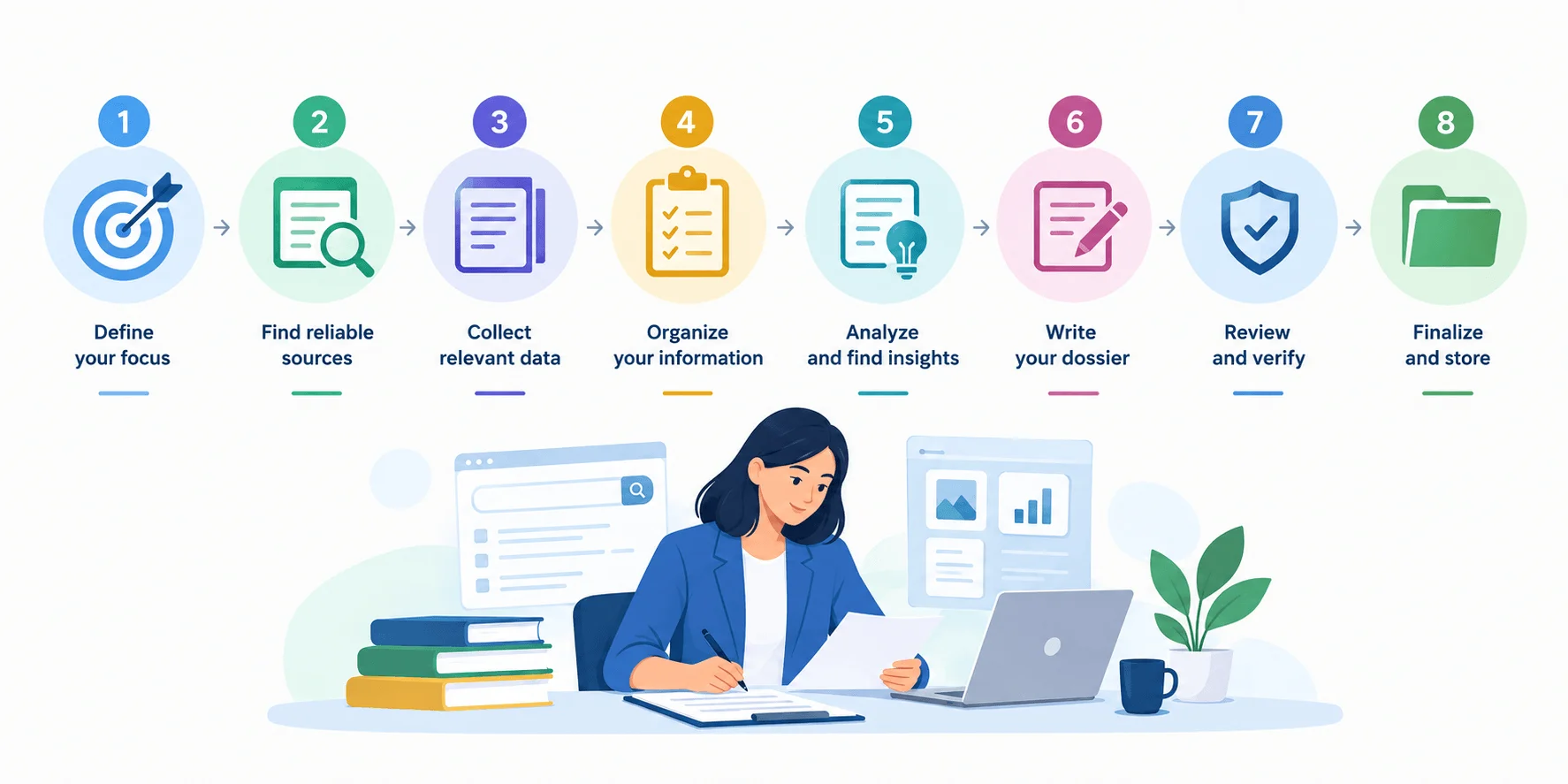
How to create a research dossier comes down to one shift in mindset: stop collecting information, and start answering a question. In this guide, I'll walk you through the exact 8 step process, from defining your objective to closing with an action plan, plus where to source your data and how to verify it before you rely on it.
If you've ever typed a company name into Google and just copied the first three paragraphs you found, I get it, we've all done it. But that produces a shallow overview, not a decision. So let's fix that.
Before we start, a quick pointer: if you haven't read what a research dossier actually is and how it differs from a due diligence report, that's worth a look first, this guide assumes you already know the destination and just need the map to get there.
Why Most Company Research Falls Flat
Before we get to the steps, I want to explain why so much company research ends up useless. Honestly, this is the part most guides skip, and it's the part that matters most.
Most people start researching by typing a company name into a search engine and copying the first three paragraphs they find. That gives you a shallow overview: dates, a mission statement, maybe a founder's name, but it doesn't actually tell you whether you should invest in this company, sell to it, partner with it, or work there. You end up with information, not insight.
The fix isn't "research harder." It's research with a purpose. And that's exactly what step one is about.
Step 1: Define Your Objective and Supporting Questions
Here's where almost every guide gets it wrong: they jump straight into "go find the company's revenue" without asking why you need that number in the first place.
Don't start with "find everything about Company X." That produces a long document and a weak decision. Instead, write one clear sentence describing your research objective. Something like:
"Should we pursue this company as a strategic partner?"
"Is this account worth enterprise sales effort this quarter?"
"What should we know before a first acquisition conversation?"
"Is this employer aligned with my next career move?"
Once you've got that sentence, list three to five supporting questions that would most affect your answer. This single step gives your research a stopping point, which, trust me, you'll thank yourself for later. Without it, research becomes an endless scroll of open tabs.
A dossier built for sales outreach won't look like one built for investment research, and that's fine, the purpose shapes everything downstream.
Step 2: Build a Company Identity Block
This step sounds almost too basic to mention, but skipping it is one of the most common, and costly, mistakes people make.
You'd be amazed how many people confuse two companies with similar names, or research a company's old domain after it rebranded or got acquired. That's exactly what an identity block prevents.
What to Include in Your Identity Block
Full legal name and trade name. Many companies operate under a different brand name than their registered legal entity.
Official website URL. Confirm it's current, especially post rebrand or acquisition.
Headquarters address and operating regions. Where is the company actually based, and where does it do business?
Parent company or subsidiary relationships. Is this company independent, or part of a larger group?
Jurisdiction. For a public US company, SEC filings establish the legal entity and ticker. In the UK, Companies House is your equivalent resource.
Lock this block in before you do anything else. It's the foundation everything else in your structured company profile gets built on.
Step 3: Start With Primary Sources
Okay, now we're actually gathering information. And here's a rule I'd stick to no matter what: start with primary sources first.
The company's own website should normally be your starting point because it provides first party information. Look specifically for:
Investor relations pages (for public companies)
"About the company" and mission statement pages
Leadership bios and executive team pages
Press releases and newsroom sections
Product or service pages
Why start here instead of jumping to news articles? Because primary sources tell you how the company wants to be understood, which is useful context even when you're digging for things they'd rather you not see later.
Step 4: Cross Check With Public Registries
This is where your research gets real teeth. Company websites are great, but they're also marketing. Public registries are not.
For US public companies, SEC EDGAR is the primary source: a 10 K annual filing will confirm whether a company is genuinely public and give you audited financials. For UK companies, Companies House maintains records for over 4 million companies, including officers, filings, and incorporation dates.
One honest caveat worth knowing: Companies House information isn't independently verified by the registry itself, it's self filed. So even "official" records benefit from a second source check, especially for anything decision critical. If you're building this out for M&A purposes specifically, our due diligence report guide goes deeper into what a formal verification pass looks like.
Other jurisdictions have their own equivalent registries, worth a quick search if you're researching an international target.
Step 5: Layer In Commercial Databases
Public registries give you the legal skeleton. Commercial business databases put muscle on it.
Platforms like Mergent, CB Insights, and Nexis Uni aggregate public records, financial filings, and news into a single synthesized profile, useful once you've already confirmed the basics through primary and public sources. These are especially valuable for:
Private company financials that aren't publicly filed
Funding and investor history
Executive contact information
Industry rankings and competitive positioning
This is also the stage where account based research tactics from B2B sales overlap heavily with dossier building, if you're researching for a sales or partnership angle specifically, check out our account research guide for source specific tips.
Think of this step as scaling what you've already verified manually, not replacing the verification itself.
Step 6: Verify, Date Stamp, and Log Your Sources
I can't stress this one enough, and it's the step people skip most often because it feels tedious.
Every piece of information you gather should get a date stamp. Company data changes: leadership moves on, funding rounds close, financials get restated. Upstream public records update at different speeds too, so what you pulled last week might already be stale.
Keep a simple source log: what you found, where you found it, and when. Someone, a colleague, a boss, a future version of yourself, will ask you to back up a claim months down the line. Guaranteed.
Step 7: Summarize Your Findings Into Something Usable
Raw data isn't a dossier. This is the step that actually turns your research into something someone can use.
A good research dossier should let someone understand the company quickly, without reading dozens of separate documents. So organize your findings into a structured template with clear sections:
Core Sections for Your Template
Company overview. Legal name, industry, location, founding year, business model.
Leadership. Key executives and any recent changes.
Financial snapshot. Revenue range, funding history, profitability signals.
Products and competitors. What they sell, who they compete with.
Culture and hiring signals. Growth trajectory, recent job postings, employee sentiment.
Contacts and sources. Who you'd reach out to, and where every fact came from.
This structure prevents information from staying scattered across browser tabs and random notes, which, if you've ever tried to reconstruct research from memory a month later, you know is a special kind of pain. If it helps to start from something pre built rather than a blank page, we've put together a free research dossier template you can copy and adapt to your own sections.
Step 8: Close With an Action Plan
Here's the part almost every guide forgets: a dossier isn't the finish line. It's supposed to lead somewhere.
Finish by identifying:
Your most important contact at the company
The strongest opportunity you've uncovered
The biggest risk or red flag
Your specific next step
This turns your research from "a document I made" into "a decision I can actually act on," which, honestly, was the whole point from step one.
Manual Research vs. Automated Tools
You've got two paths for actually doing this work, and most people end up blending both.
Factor | Manual Research | Automated Tools |
|---|---|---|
Speed | 2 to 4 hours for a thorough pre meeting brief | Around 5 minutes for a structured report |
Accuracy | High on nuance, prone to human error on volume | High on structured facts, weak on subtle context |
Scalability | Poor, doesn't scale across many targets | Strong, built for researching multiple companies at once |
Best for | Qualitative read (leadership tone, subtle red flags) | Firmographic and technographic groundwork |
That 2 to 4 hour figure isn't a guess, manually bouncing between LinkedIn, Crunchbase, news sites, and annual reports to assemble a complete picture genuinely takes that long, while an AI driven research pass can compress the same groundwork into a matter of minutes.
My honest take? Use automation to handle the volume: firmographics, technographics, basic public records, then bring your own judgment in for interpretation. That's where the real decisions get made, not in the data collection itself.
Frequently Asked Questions
What's the first step in building a research dossier?
Defining your objective: one clear sentence describing the decision this research needs to support, plus three to five supporting questions.
What sources are most reliable?
Start with primary sources (the company's own website), then cross check against public registries like SEC EDGAR or Companies House before layering in commercial databases.
How do I avoid researching the wrong company?
Build an identity block first: full legal name, trade name, official URL, jurisdiction, and headquarters, before you start pulling any other information.
How long should this process take?
It depends entirely on your objective. A quick sales outreach dossier might take an hour manually, or a few minutes with automated tools. A full acquisition grade dossier can take days, especially with financial and legal verification involved.
Final Thoughts
At the end of the day, learning how to create a research dossier properly comes down to one shift in mindset: stop collecting information, and start answering a question. Define your objective first, build your identity block, work from primary sources outward, verify everything you find, and close with an actual next step.
Do that, and you won't just have a document full of facts about a company, you'll have exactly what you need to make the call you were trying to make in the first place.
Read more: What Is a Research Dossier? Full Guide + Free Template