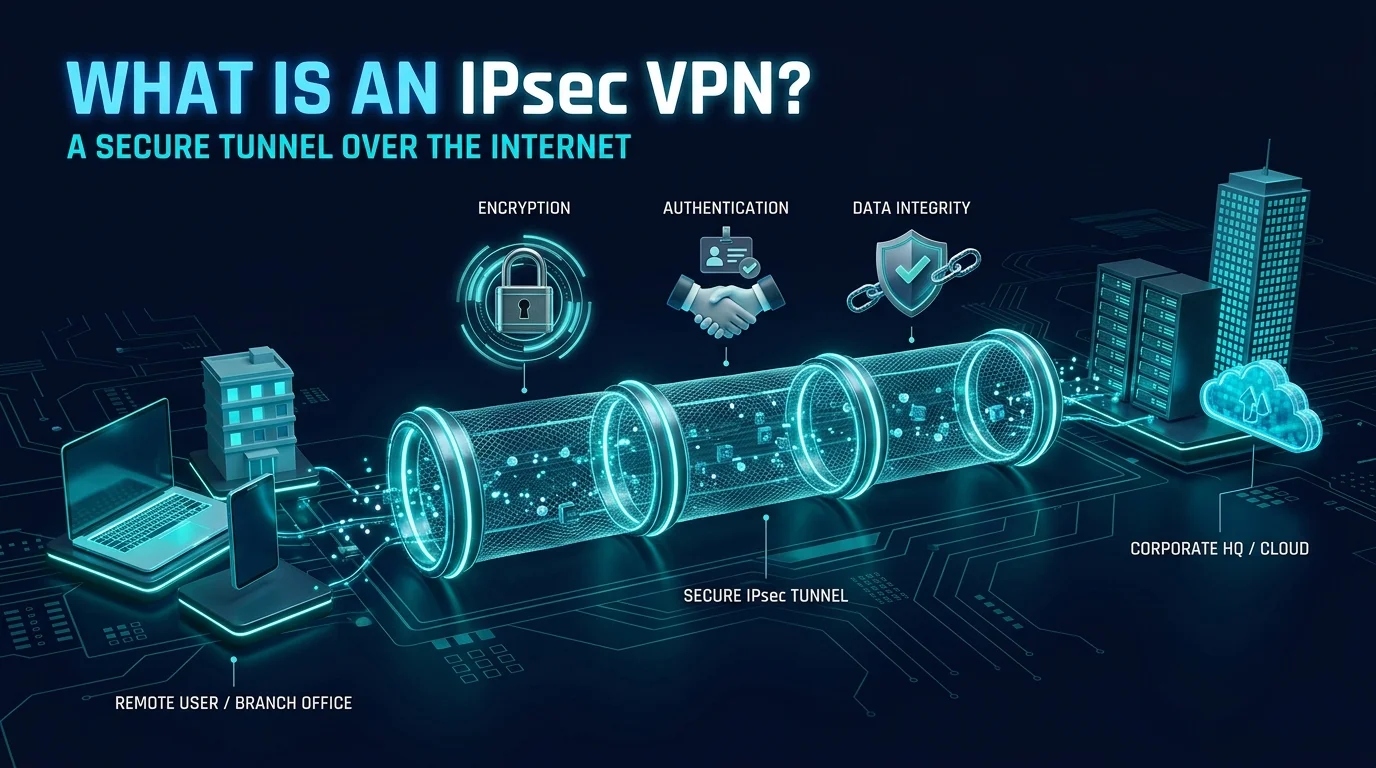
An IPsec VPN is a private, encrypted tunnel built with Internet Protocol Security (IPsec), a set of open standards that protects IP traffic at the network layer. It authenticates both ends, encrypts your data, and blocks tampering and replay. You'll mostly see it connecting offices (site-to-site VPN) or connecting one device to a company network (remote access VPN).
Let me be honest with you. The first time I read about this, my eyes glazed over. Acronyms everywhere! But once you see the big picture, it's simple. Stick with me, and you'll get it in ten minutes.
What Is an IPsec VPN, Really?
People mix up IPsec and VPNs constantly (I did too). Clearing this up first saves you from buying the wrong thing later. So here's the clean version, backed by the people who wrote the standards.
According to NIST's Guide to IPsec VPNs, IPsec is a network layer security control that protects communications over public networks, encrypts IP traffic between hosts, and creates virtual private networks.
Here's the twist. IPsec isn't a VPN on its own. It's the technology that powers many VPNs, as Megaport explains. And because it works below the application layer, it covers all IP based traffic, whatever app sends it.
You'll see two main use cases:
Site-to-site VPN: two gateways link entire networks, like a branch office and headquarters.
Remote access VPN: one device connects to your company gateway. If you want only some traffic to use the tunnel, read our guide to VPN split tunneling.
Cato Networks covers both in more detail.
How IPsec Works: The Three Core Components
Think of IPsec as a team of three players. One scrambles your data, one proves who sent it, and one sets up the secret handshake. Know these three, and every IPsec diagram you ever see will make sense. Let's go through them quickly.
Encapsulating Security Payload (ESP)
ESP is the workhorse. The ESP standard, RFC 4303, says it provides confidentiality, data origin authentication, connectionless integrity and an anti-replay service. In plain English, nobody can read your packets, fake them, or replay them.
Authentication Header (AH)
AH verifies packets but doesn't encrypt the payload, per Megaport. That's why everyday VPNs rarely use it.
Internet Key Exchange (IKE)
IKE is the handshake. RFC 7296 defines IKEv2 and says IKE handles mutual authentication and builds and maintains security associations (SAs). Think of an SA as the agreed rulebook for one secure connection. The full blueprint lives in the IPsec architecture, RFC 4301.
Tunnel Mode vs. Transport Mode
Here's where beginners trip up. IPsec runs in two modes, and the difference is how much of each packet gets protected. Pick wrong and you'll chase confusing errors for hours. So let's make it painless.
Tunnel mode encrypts the entire original IP packet and wraps it inside a new one. Transport mode protects only the payload and leaves the IP header exposed. Firewall.cx walks through both.
My rule of thumb comes from Cisco Press: transport mode for end to end sessions, tunnel mode for everything else.
Home routers love breaking things, so NAT traversal matters too. RFC 3948 wraps ESP packets in UDP so they can cross network address translators. AH was left out because it's inherently incompatible with NAT. If your router offers a related toggle, our explainer on VPN passthrough shows what it actually does.
IPsec vs. SSL VPN vs. WireGuard
"Should I just use something newer?" I get this question all the time. Fair! But newer isn't automatically better for your network. Here's an honest side by side, using vendor and standards sources.
Feature | IPsec VPN | SSL VPN | WireGuard |
|---|---|---|---|
What it protects | Entire network traffic | Individual web sessions | TCP, UDP and other IP traffic inside encrypted UDP packets |
Best for | Site-to-site links | Web app access | Simple private networks |
Client needed | Usually yes | Often just a browser | Yes |
Code base | Significantly larger | N/A | Smaller |
Setup effort | Higher | Lower | Lower |
One caution. Tailscale sells WireGuard based products, so I weigh its claims accordingly. Still, IPsec keeps three real advantages:
It's a mature open standard that nearly every firewall and router supports.
It's ideal for site-to-site links, since it operates at the network layer.
It's future ready: RFC 9370 lets IKEv2 combine classical and post-quantum key exchanges.
IPsec Standards Timeline
Freshness matters, so here's how the key documents line up. You can cite these dates in your own work.
December 2005: RFC 4301 and RFC 4303 define the architecture and ESP.
October 2014: RFC 7296 makes IKEv2 an Internet Standard.
June 30, 2020: NIST SP 800-77 Rev. 1 updates the original 2005 guide.
May 2023: RFC 9370 adds multiple key exchanges to IKEv2.
How to Set Up an IPsec VPN: Step by Step
Let's get practical. You don't need to be a network engineer. This is the order I use, and it skips most of the usual trial and error. Menus differ by vendor, but the logic never changes.
Pick your topology. Choose site-to-site or remote access.
Choose IKEv2. Use IKEv1 only if a legacy device forces it.
Pick authentication. Prefer digital certificates. A strong pre-shared key is the fallback. Not sure how certificates chain together? See what an SSL certificate chain is.
Set strong crypto. Use modern encryption like AES-GCM and a solid Diffie-Hellman group. NIST SP 800-77r1 is your checklist.
Match both gateways. Settings must be identical on each end.
Open your firewall. IKE typically uses UDP ports 500 and 4500.
Test and monitor. Send traffic, check your security associations, and read the logs.
Step 5 causes most failures. Double check it.
IPsec VPN FAQ
Here are quick answers to the questions I hear most.
Is IPsec the same as a VPN?
No. IPsec is the framework of protocols. A VPN is the private network you build with it, as Megaport notes.
What is the difference between IPsec and SSL VPN?
SSL VPNs secure individual web sessions, while IPsec encrypts entire network traffic, according to Palo Alto Networks.
Is IKEv2 better than IKEv1?
IKEv2 is the current Internet Standard (RFC 7296), so use it for new setups.
Does IPsec work behind NAT?
Yes, through UDP encapsulation of ESP, defined in RFC 3948.
Is IPsec safe against quantum computers?
Not by default. RFC 9370 adds hybrid key exchanges, so you can combine classical and post-quantum algorithms.
Why You Should Get an IPsec VPN Today
Look, you've seen how it works. Now let's talk about what it means for you. Every day your data crosses the open internet unprotected, you're gambling with it. An IPsec VPN fixes that, and I'd rather you act now than explain a breach later.
You get data confidentiality, data integrity and anti-replay protection across your whole network. It's built on open standards. It connects your offices and your remote team through one trusted framework.
And you don't have to build it from scratch. A managed IPsec VPN solution handles configuration, key management and monitoring for you. That means fewer mistakes, faster setup and real peace of mind.
So here's my advice. Pick a business grade IPsec VPN that supports IKEv2, certificate authentication and NAT traversal. Set it up this week. Your future self will thank you. Ready to lock your traffic down? Get your IPsec VPN today.