Doodle for Google is Google's annual art contest that invites K-12 students across the U.S. to design their own version of the Google Doodle homepage logo. Every year, tens of thousands of students submit original artwork built around a single creative theme. Five finalists get chosen. The public votes. And one national winner walks away with a $55,000 college scholarship and a $50,000 technology package for their school.
I know that sounds like a lot to unpack in one paragraph. So let's slow down and go through this properly.
Why Doodle for Google Matters (And Why People Search For It)
Here's the thing — most people land on this topic for one of three reasons. Maybe their kid just heard about it at school. Maybe they saw this year's winning Doodle for Google 2026 artwork trending online. Or maybe they're a teacher trying to figure out how to get their classroom involved.
Whatever brought you here, you're in the right place.
This contest isn't some small side-project Google runs quietly. It's now in its 17th year, which honestly says a lot about its staying power. Programs like this either fizzle out after a couple of seasons or they become a real institution — and Doodle for Google has clearly become the latter.
And there's a bigger reason this matters beyond the scholarship money. It's one of the few times a student art competition gets front-row placement on the single most-visited website on the planet. Think about that for a second. A twelve-year-old's drawing, sitting on the Google homepage, seen by literally hundreds of millions of people in a single day.
That's not a small thing. (Related: What Is a Content Pillar — see how a single standout piece of content can anchor an entire brand moment.)
How the Doodle for Google Contest Actually Works
Let me break this down step-by-step, because the process has a few moving parts and I don't want you getting lost halfway through.
Every year, Google announces a contest theme — a prompt students respond to through their artwork. For the 2025–2026 cycle, the theme was simply: "My superpower is …" Students had to interpret that however they wanted and turn it into original doodle art.
Here's the general flow:
Step 1: Google Announces the Theme
This usually happens in the fall. The theme is intentionally open-ended — broad enough that a kindergartner and a high school senior can both find their own angle.
Step 2: Students Submit Their Artwork
Any eligible K-12 student in the U.S. can enter, based on the official contest rules. Submissions have historically numbered in the tens of thousands, which tells you just how far this thing has spread across schools nationally.
Step 3: Judges Narrow It Down to Five Finalists
A panel — usually a mix of Google staff, artists, educators, and even celebrities — reviews every submission and picks five finalists. This year's panel, for example, included NBA All-Star Giannis Antetokounmpo and Ashlie Crosson, the 2025 National Teacher of the Year.
Step 4: The Public Votes
This is where you come in, if you want to participate. Once the five finalists are revealed, public voting opens for about two weeks. Anyone can vote for their favorite design.
Step 5: The National Winner Is Announced
The Doodle with the most votes — combined with final judge deliberations — becomes the national winner.
What Finalists and Winners Actually Receive
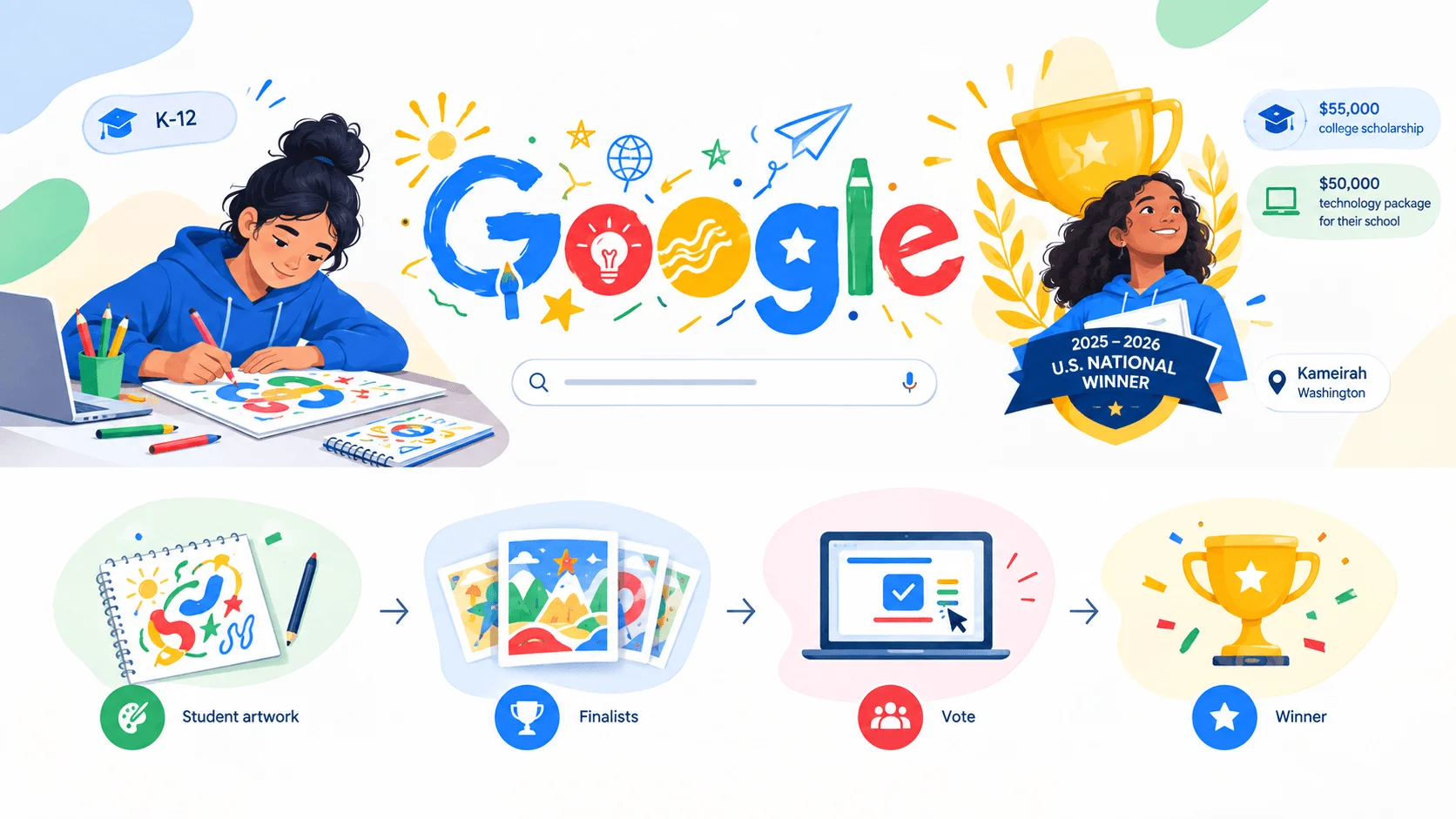
I want to make this crystal clear, because the prize structure has two tiers and people often mix them up. Here's how it breaks down:
Reward | Finalist (Top 5) | National Winner |
|---|---|---|
College scholarship | $10,000 | $55,000 total |
School tech package | Google swag/tech | $50,000 |
Homepage feature | Yes, for a day during finalist showcase | Yes, full day as the winning Doodle |
Hometown celebration | Yes | Yes |
Media appearance | Not guaranteed | Yes (e.g., national TV) |
Pretty generous, right? I think so too.
Meet the 2026 Doodle for Google Winner
I want to give you a real example here, because abstract descriptions only get you so far.
This year's winner was Kameirah Johnson, a senior at Lakeside School in Renton, Washington. Her winning piece, titled "Hair Power: The Crown that Grows From Us", depicts three young women lying in the grass with their hair forming a crown-like shape — inspired by Kameirah herself, her mother, and her sister.
In her own words, shared on the official Google Doodles page:
"My superpower is my hair, and the family it carries. Each texture and style holds culture, care, and survival passed down without words."
That's a genuinely moving concept for a teenager to translate into visual art. And it's a great example of what makes this contest special — it's not just about drawing skill. It's about storytelling through art, which is honestly a much harder thing to pull off.
Kameirah was revealed as the winner on NBC's TODAY show in early June 2026, beating out four other finalists after receiving the most public votes.
Doodle for Google Through the Years
To give you a sense of how long this contest has been running, here's a quick snapshot of its scale and evolution. This isn't an exhaustive archive — for that, check the official Google Doodles site — but it shows the pattern clearly.
Year/Edition | Theme (example) | Notable Detail |
|---|---|---|
2025–2026 (17th year) | "My superpower is …" | Kameirah Johnson (WA) won; judges included Giannis Antetokounmpo |
Prior years | Varies annually | Contest has run continuously for 17 consecutive years |
Canadian edition ("Doodle 4 Google") | "If I could invent anything I would invent …" | Judged in part by astronaut Chris Hadfield; $10,000 scholarship prize |
The consistency here is the real story — 17 straight years without the format changing dramatically tells you this program has staying power most brand-run contests never achieve. (Related: Google's Biggest Homepage Marketing Moments — internal link opportunity if your site covers Google/marketing topics.)
Who Can Enter Doodle for Google?
Let's talk eligibility, since this trips people up more than you'd expect.
According to the official contest rules page, the basic eligibility framework looks like this:
You must be a K-12 student enrolled in a public, private, or home school in the U.S.
Submissions must be original artwork — no tracing, no AI-generated pieces, no copying existing designs.
Artwork must respond directly to that year's official theme.
Parental or guardian consent is required for entry, especially for minors submitting personal work.
If you're a parent or teacher reading this, I'd strongly recommend reading the full rules page before your student starts sketching. Contest requirements shift slightly year to year — things like submission format, file size, and deadline windows — so don't rely on last year's memory of how it worked.
What Makes a Winning Doodle Stand Out?
Now here's the part people actually want to know. What separates a top-five finalist from the tens of thousands of other entries?
A quick disclaimer before I list these — the points below are my own analysis based on patterns across past winners and finalists, not an official checklist from Google. Google hasn't published a formal scoring rubric, so treat this as informed observation rather than fact.
With that said, a few things consistently show up in winning entries:
A personal, specific story — not a generic idea. "Hair Power" worked because it was rooted in Kameirah's actual family, not a vague concept of "strength."
A clear connection to the theme — judges are explicitly evaluating how well the piece answers that year's prompt.
Strong visual composition — color balance, use of space, and how well the Google logo integrates into the scene.
Emotional resonance — the pieces that go viral tend to be the ones that make people feel something in under three seconds of looking at them.
If you're helping a student prepare an entry, I'd honestly start with the story first and the drawing second. The art is the delivery mechanism — but the idea is what actually wins. (Related: How to Be a Content Creator if you want to explore how storytelling drives engagement more broadly.)
Doodle 4 Google: The International Version
One thing worth mentioning — this contest isn't exclusive to the United States.
Google has run international editions under the name "Doodle 4 Google" in countries like Canada, where judges have included figures like retired astronaut Chris Hadfield. The structure is nearly identical: regional finalists, public voting, and a scholarship for the national winner. So if you're outside the U.S., it's worth checking whether your country has run its own version — the format tends to translate well internationally.
Frequently Asked Questions About Doodle for Google
Is Doodle for Google free to enter?
Yes. There's no entry fee. Submissions are free for all eligible K-12 students, and the only real "cost" is the time it takes to create original artwork.
How much is the Doodle for Google scholarship?
The national winner receives a $55,000 college scholarship total, plus a $50,000 technology package for their school. The four runner-up finalists each receive a $10,000 scholarship.
How long does the contest take from start to finish?
The full cycle typically runs from fall (theme announcement) through early summer (winner reveal) — roughly seven to eight months, including submission windows, judging, and public voting.
Can homeschooled students enter Doodle for Google?
Yes, based on the official contest rules, homeschooled students are eligible alongside public and private school students, as long as they meet the K-12 age and grade requirements.
Who picks the Doodle for Google finalists?
A panel of judges — often including Google employees, professional artists, educators, and occasional celebrity guests — reviews submissions and narrows them to five finalists before public voting opens.
Does the winning Doodle actually appear on
Google.com? Yes. This is genuinely one of the coolest parts. The national winner's artwork replaces the standard Google logo on the homepage for an entire day, seen by an enormous global audience.
What was the 2026 Doodle for Google theme?
The theme was "My superpower is …" — students were asked to illustrate what makes them uniquely powerful or special.
Where can I see past Doodle for Google winners?
You can browse the archive directly on the official Google Doodles site, which hosts winning artwork going back through the contest's full 17-year history.
Final Thoughts
So — what is Doodle for Google, really?
At its core, it's a student art contest. But if you zoom out, it's also one of the more genuine ways a massive tech company has found to spotlight young creativity on a global stage. You don't need to be an art expert or a Google insider to appreciate that a teenager's drawing about her family's hair can end up seen by hundreds of millions of people in a single day.
If you're a parent, teacher, or student thinking about entering, my honest advice is this: start with a story that actually matters to you. The technical polish matters less than you'd think — the emotional core is what gets remembered.
You can find full submission details, deadlines, and rules on the official Doodle for Google rules page whenever the next contest cycle opens.
Read Also: How to Enter Doodle for Google 2026: Rules & Deadlines