Doodle for Google is Google's annual K-12 art contest where students redesign the Google logo around a yearly theme, and the national winner gets featured on Google's homepage for 24 hours. To enter, you need to be a U.S. student in grades K-12, create an original design using the letters "G-o-o-g-l-e," write a short artist statement, get parent/guardian consent, and submit before the official deadline.
Quick facts:
Detail | Info |
|---|---|
Who can enter | U.S. citizens/permanent residents, grades K-12 |
Grade groups | K–3, 4–5, 6–7, 8–9, 10–12 |
Entry format | .png or .jpeg upload, or mail-in |
Judging criteria | Artistic merit, creativity, theme communication |
Top prize | $55,000 scholarship + $50,000 tech package for the school |
Runner-up prize | $5,000 scholarship each (5 winners) |
Where to apply | doodles.google.com/d4g |
I still remember the first time I saw a kid's Doodle splashed across the Google homepage, and honestly? I got a little emotional about it. There's something wild about a nine-year-old's crayon drawing reaching millions of people in a single day.
If you're a student, parent, or teacher trying to figure out how to enter Doodle for Google, you're in the right place. I'm going to walk you through the Doodle for Google rules, the Doodle for Google eligibility requirements, the Doodle for Google deadlines, and the exact steps to submit a winning entry.
No fluff. Just the stuff you actually need.
What Is Doodle for Google, Anyway?
Let's start from the top, because you can't win a game you don't understand.
Doodle for Google is an annual art contest hosted by Google that invites K-12 students across the United States to redesign the iconic Google logo. Every year, Google picks a fresh theme — something reflective, something personal — and asks students to interpret it through original artwork. The winning design gets featured on the actual Google homepage for 24 hours, seen by millions of people.
Pretty cool, right?
The contest has become one of the most recognized student art competitions in the country. Students are invited to create their own Google Doodle for the chance to have it featured on Google.com, plus walk away with a scholarship and a tech package for their school — that last part alone gets teachers very excited. → If you're new to the concept entirely, check out our full breakdown of what Doodle for Google actually is before diving into the entry process.
Doodle for Google Eligibility: Who Can Actually Enter?
Before you even pick up a crayon, you need to know if you qualify. This part trips people up more than you'd think, so let's slow down here.
To be eligible, a student must be a U.S. citizen or permanent U.S. legal resident at the time of entering, and must be enrolled in a U.S.-based school. That includes public schools, private schools, homeschools, and schools in Puerto Rico, other U.S. territories, freely associated states, or the District of Columbia. Children of military personnel stationed abroad are also allowed to participate — a genuinely thoughtful inclusion.
Here's the eligibility snapshot:
Grade requirement: Kindergarten through 12th grade
Residency: U.S. citizen or permanent legal resident (green card holders qualify)
School type: Public, private, homeschool, or eligible territory schools
Who can submit on the student's behalf: Parents, teachers, nonprofits, and after-school programs
One thing worth flagging — if a teacher or program submits a Doodle for a student, a parent or guardian consent form is required. Teachers can send in multiple student Doodles at once, but only one original entry per student is allowed.
Grade Divisions You Should Know About
The contest doesn't judge a kindergartner against a high school senior — that wouldn't be fair. Entries are separated into five distinct grade groups:
Grades K–3
Grades 4–5
Grades 6–7
Grades 8–9
Grades 10–12
A panel selects finalists from each group individually, so a student is only really competing against peers at a similar developmental stage.
How to Enter Doodle for Google: The Step-by-Step Process
Here's the part you actually came for — the Doodle for Google entry form process and how the submission pipeline works.
Step 1: Wait for the Contest to Open
Google opens the contest window once a year and announces a fresh contest theme at that point. Check the official Doodle for Google site for the current year's theme, dates, and forms.
Step 2: Understand the Theme
Every year comes with a new prompt. Past themes have included "My wish for the next 25 years…" and "My superpower is…" — reflective, open-ended prompts that push students to think about identity, hope, and self-expression.
Take your time here. The theme isn't a box to check it's the emotional core of your submission. → Want inspiration? Browse our roundup of past Doodle for Google winners to see how previous students interpreted their themes.
Step 3: Create Your Doodle
This is the fun part, and there's a lot of creative freedom baked in.
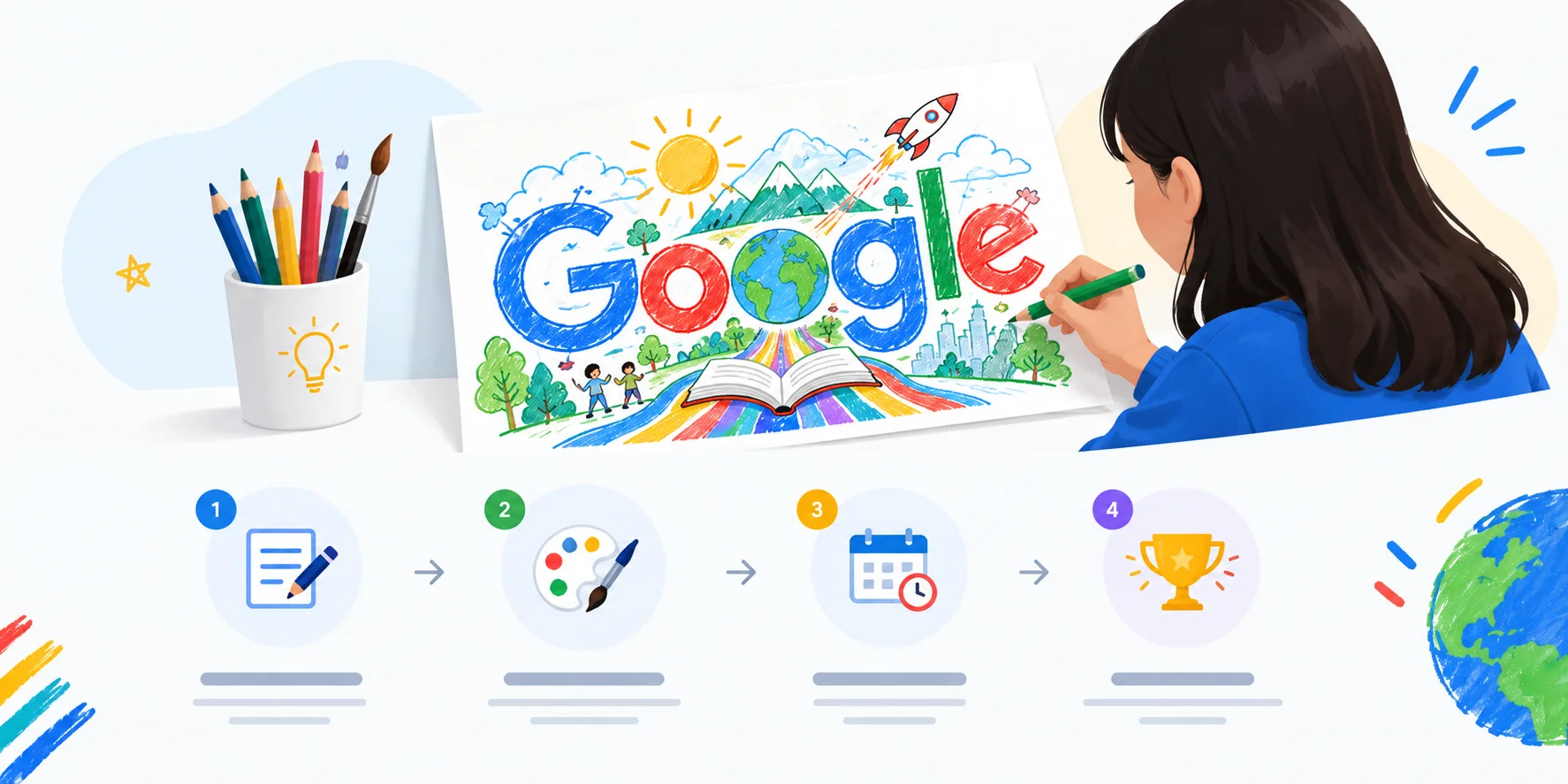
Students are free to design their Doodles however they want, as long as they incorporate the letters "G-o-o-g-l-e" somewhere in the artwork. You can trace the standard Google logo shape on the official entry template, or go completely freehand.
Materials are wide open:
Crayons and colored pencils
Paint (watercolor, acrylic, whatever you've got)
Digital art tools — if you're exploring this route, our guide to best AI art generators for beginners can help you get started
Digital art tools
Clay or 3D materials
Found objects like rocks, paper, or fabric
One catch — Doodles are reviewed in a flat, two-dimensional format. If you build something 3D, snap a clear, well-lit photograph and submit that image instead of the physical object.
Step 4: Write Your Artist Statement
Here's where strong drawings often lose points. The artist statement is a short written explanation — usually around 50 words — describing what the artwork means and how it connects to the theme.
Don't treat this as an afterthought. Judges use it to evaluate theme communication, one of three official scoring categories. A gorgeous drawing with a weak explanation can genuinely underperform against a simpler drawing with a sharp, thoughtful statement.
Step 5: Get Parental or Guardian Consent
If you're under 18, a parent or legal guardian needs to sign the entry form. This isn't optional — it's baked directly into the official contest rules.
Step 6: Submit Before the Deadline
Entries are typically submitted electronically as .png or .jpeg files through the official portal, or mailed in physically depending on the year's instructions. Always confirm the exact current-year deadline on the official rules page before you finalize your plan, since dates shift slightly year to year.
Set a reminder. Don't be the family scrambling at 11:58 PM.
Doodle for Google Deadlines: What You Need to Track
This contest runs in phases — it's not a one-and-done submission. Here's the typical calendar:
Phase | What Happens |
|---|---|
Contest opens | Theme announced, entry window begins |
Submission deadline | Final date entries are accepted |
Judging period | Google's panel and guest judges review entries |
Finalist announcement | Five finalists selected, one per grade group |
Public voting | The public votes online for their favorite finalist |
National winner announced | Grand prize winner revealed |
Once the entry period closes and judges select the five finalist Doodles, the public is invited to vote online to help determine the ultimate winner.
How Doodle for Google Judging Actually Works
Understanding the judging criteria genuinely changes how you should approach your Doodle.
Judges evaluate entries across three categories:
Artistic merit — skill in applying the chosen art form, judged relative to age-appropriate expectations
Creativity — how well the piece represents the theme, incorporates the Google letters, and stands out as original
Theme communication — how clearly the theme comes through in both the visual artwork and the written statement
Each year, Google brings in a rotating panel of guest judges — sometimes artists, sometimes public figures — announced once the contest opens for entries.
My honest take? Don't chase "technical perfection." Judges explicitly weigh age-appropriate skill. A confident, honest, theme-driven drawing from a second grader will almost always beat a technically stiff copy of something seen online.
Doodle for Google Prizes: What's Actually on the Line
Recent national winner prizes have included a $55,000 college scholarship along with a $50,000 technology package awarded to the winner's school or nonprofit. The five runners-up typically receive scholarships valued at $5,000 each, and state or territory-level winners often walk away with Google hardware and branded swag.
That tech package matters more than people realize — it goes straight to the school, not the student's pocket. Even students who don't win personally contribute something tangible to their classroom community if they place.
Prize amounts can shift slightly year to year, so confirm current numbers through Scholarships.com's contest listing or the official rules.
Frequently Asked Questions
Is there a fee to enter Doodle for Google?
No. Entry is completely free, and no purchase is necessary to enter or win.
Can homeschooled students apply?
Yes. Homeschooled students are explicitly eligible, along with public, private, and territory-based school students.
Can I submit more than one Doodle?
No. Only one original Doodle per student is allowed, even when a teacher submits on behalf of multiple students.
What happens if I miss the deadline?
Late entries are not accepted. Set a personal reminder at least a week before the official cutoff to avoid last-minute technical issues.
Do I need parent or guardian consent?
Yes, if you're a minor. A parent or legal guardian must sign the entry form regardless of who submits it.
Can I use digital art tools instead of drawing by hand?
Yes. Computer-generated graphics are allowed alongside traditional materials like crayons, paint, and clay.
Final Thoughts
At the end of the day, Doodle for Google is one of the more meaningful creative outlets available to K-12 students in the U.S. It's a structured opportunity that rewards genuine self-expression, offers real scholarship money, and puts a kid's artwork in front of the entire internet for a day.
If you're a parent or teacher reading this, encourage the student in your life to treat this seriously but stay playful about it. The best Doodles aren't the most technically polished — they're the most honest.
Good luck out there. I hope your Doodle ends up on that homepage.
Read more: What Is Doodle for Google? 2026 Winner & Full Guide