Quick answer: The Google Maps Android Auto speedometer is rolling out gradually as a small badge next to the speed limit. Turn it on in Maps under Settings → Navigation → Driving options, then start navigation. If it disappears, set a destination. Google confirmed on September 14, 2026 that an always-on version is still rolling out.
Let me be blunt.
The Google Maps Android Auto speedometer took years to show up. Years.
Meanwhile, iPhone owners had a live speedometer on CarPlay since July 2024, and you were stuck glancing at your dashboard like it was 2009.
The good news? It's finally arriving.
The bad news? It's showing up for some drivers, vanishing for others, and Google hasn't exactly thrown a launch party.
So I dug through Google's help pages, fresh news reports, and a laser-based accuracy test. Below, I'll show you who has it, how to turn it on, and how to fix it when it disappears.
Let's dive in.
What Is the Google Maps Android Auto Speedometer?
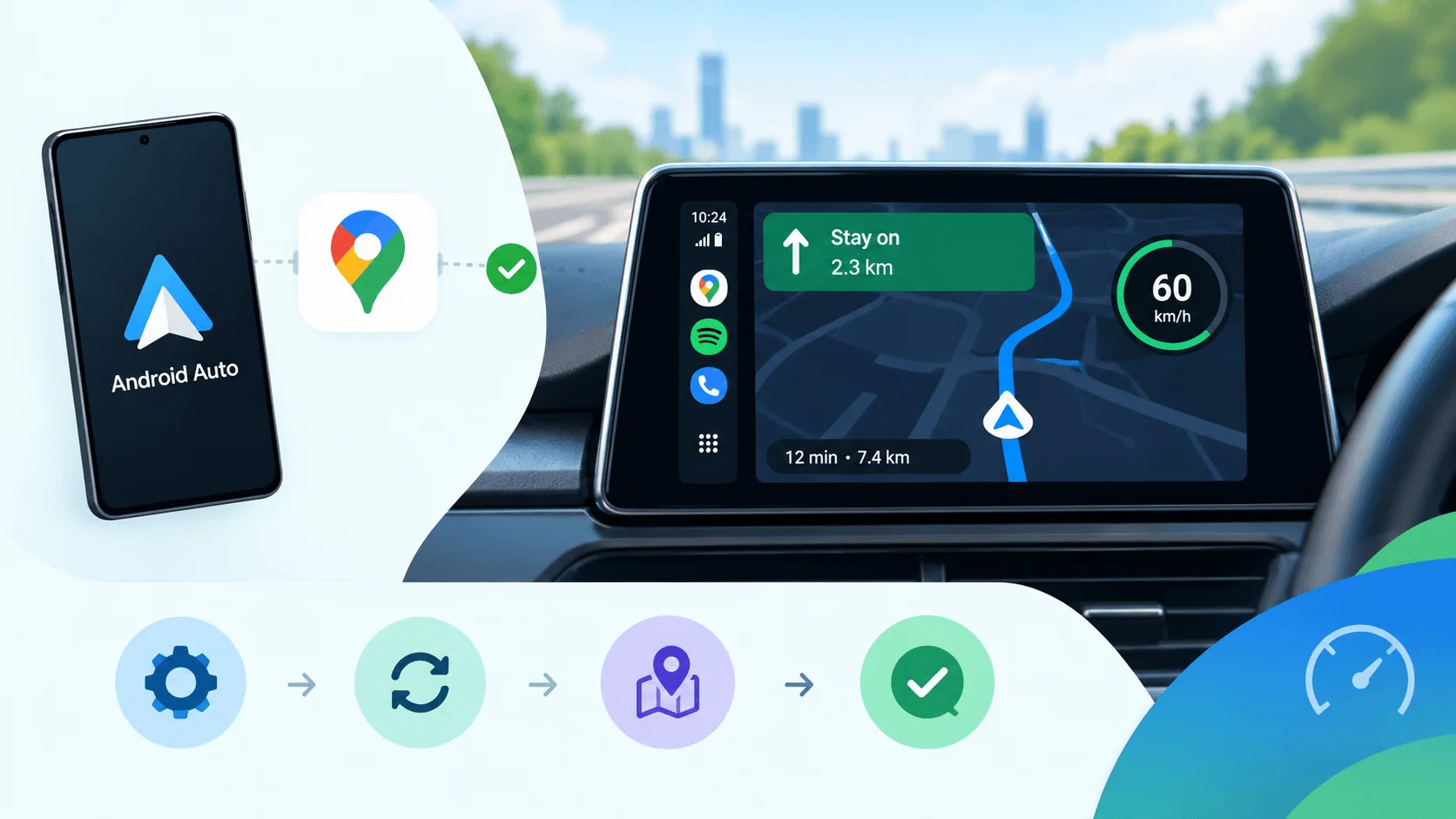
First things first: what are we actually talking about?
It's a small indicator on your car's screen that shows how fast you're driving while Google Maps is open. Simple idea. Surprisingly hard to get.
Below, I'll break down what it looks like and why the rollout has been so strange.
What the Android Auto Speedometer Actually Shows
Picture a small badge floating on your map.
It's not fancy, but it's useful. According to Android Authority, the floating icon shows your current speed right next to the posted speed limit. It turns yellow or red when you go over.
That color shift matters more than you'd think.
You catch it in your peripheral vision. No staring. No fumbling. Just a quick "oops" and an easy tap on the brake.
It also runs on the Coolwalk dashboard, so you get it in full-screen or multi-pane mode.
[Insert your own screenshot or photo of the badge on a head unit here. Original images are the strongest way to earn citations.]
Google Maps Speedometer Timeline: 2019 to 2026
Why did this take so long?
Honestly? Nobody outside Google knows. But the timeline below shows just how long Android Auto was left waiting.
Date | What happened |
|---|---|
2019 | Speed limits and the speedometer launch on Android phones, expanding to 40+ countries that May |
July 2024 | iPhone and CarPlay users get it globally |
July 19, 2026 | First Android Auto sightings on Reddit, mostly beta users |
Sept 8, 2026 | Reports of the speedometer vanishing for some users |
Sept 11, 2026 | Google says setting a destination brings it back |
Sept 14, 2026 | Google confirms a no-destination version is still rolling out |
Wild, right?
Who Has the Android Auto Speedometer Right Now?
Here's where it gets messy.
Google hasn't published a schedule. There's no official "available in your country" list. So you're left guessing, and that's frustrating.
But I can tell you what the reporting shows, and what that means for you.
A Gradual Server-Side Rollout
This isn't a normal app update.
The feature spread through a server-side rollout, which means Google flips a switch on its end. Updating your app won't necessarily help. Early reports pointed to beta users first, including a Canadian driver on an Android Auto beta build.
Later, Gadget Hacks reported it reaching more devices, including some on stable versions.
The catch? Two people with near-identical phones can see different results.
How to Check If You Have It
Not sure whether you've got it? Here's the quick test.
Connect your phone to your car.
Open Google Maps on the car display.
Start navigation to any destination.
Look for the small speed badge near the speed limit.
See it? Congrats.
Don't see it? Don't panic. Move on to the setup steps below, because the phone-side toggle matters.
How to Turn On the Google Maps Speedometer on Android Auto (Step-by-Step)
Let's get practical.
The control for this feature lives on your phone, not in the car. That trips up a lot of people. I've laid out the exact path below so you can follow along without guessing.
Grab your phone and let's go.
Step 1: Update Google Maps and Android Auto
Boring, I know.
But outdated apps cause weirdly specific problems. Open the Play Store, search for Google Maps, and tap update if you see the button. Then do the same for Android Auto.
Two minutes. Big difference.
Step 2: Open the Driving Options
Now for the real work.
Open Google Maps on your phone. Tap your profile picture. Then head to Settings, choose Navigation, and scroll down to driving options.
You'll see a toggle labeled Speedometer. Turn it on.
Google's help page confirms this path, and adds that the speedometer works alongside speed limit information wherever that feature is available in your area.
Step 3: Start Navigation on Your Car Screen
Here's the part people skip.
Plug in your phone or connect wirelessly. Open Maps on the car display and start a route.
Why does this matter? Because the feature was originally described as showing up when navigation is active. Without a route, you may see nothing at all.
Set a destination, even a fake one, and watch for the badge.
Customize Your Speed Limit Alerts
Want extra protection?
On the phone, Google lets you choose when alerts appear, and you can turn on a sound alert too. That beep is annoying. It's also the point.
Just remember: these settings live on the phone, not the car screen.
Why Your Android Auto Speedometer Disappeared (and How to Fix It)
Okay, deep breath.
If your Google Maps speedometer is not showing, you're not alone. In early September, plenty of drivers reported the exact same thing, and it created a mini panic across Reddit.
Here's what actually happened, plus the fixes that worked.
What Went Wrong in September 2026
Something odd happened.
On September 8, 9to5Google reported that the speedometer was randomly vanishing for some users. TechRadar added that real-time traffic data was missing for some people, too.
Stop signs and traffic signals went missing for others.
Naturally, everyone assumed Google had pulled the feature. But that turned out to be only part of the story.
The Set-a-Destination Fix
This one is almost too easy.
On September 11, Android Authority reported that Google replied in a Reddit thread. Users could get the speedometer back by simply setting a destination in Maps.
So try this:
Open Google Maps on your car screen.
Type in any destination.
Tap Start.
Check for the speed badge.
That's it. No reinstalling. No drama.
Speedometer Without a Destination: What Google Confirmed
Then came the twist.
According to 9to5Google, Google confirmed it's rolling out the speedometer, speed limit, and stop signs and traffic signals without a destination set. Not everyone has that version yet.
Translation? Your speedometer probably didn't break. You may simply be on the older behavior.
Sammy Fans reached the same conclusion after checking with the Android Auto team.
Still Not Working? Try These
Sometimes you need a bigger hammer.
Restart your phone and reconnect to the car.
Clear the Google Maps cache in your phone's app settings.
Try switching between wired and wireless Android Auto. If wireless keeps dropping, these tips to improve your Wi-Fi signal may help rule out interference.
Check your phone's connection. Real-time traffic data needs mobile data, and if your signal is weak, a mobile hotspot from another device can serve as a temporary backup.
Check whether you recently switched between beta and stable builds, since some users linked the bug to that.
I can't promise any of these work for you. But they cost nothing to try.
How Accurate Is the Google Maps Speedometer on Android Auto?
Now let's talk trust.
A speedometer that lies is worse than no speedometer. And since many of us use this feature to dodge tickets, GPS speed accuracy matters a lot.
So I looked for real data instead of guessing.
Google's Own Warning
Let me start with the fine print.
Google itself says external factors can make the Maps speedometer differ from your actual speed. And TechCrunch noted Google calls it informational only, so your car's gauge should confirm your real speed.
Read that again.
That's not me being cautious. That's Google telling you not to bet a speeding ticket on it.
What a Laser Test Found
Here's where it gets interesting.
CarExpert tested speed readouts against a police-style laser. The results are below.
Source | Indicated speed | Actual speed (laser) |
|---|---|---|
Car speedometer | 80 km/h | 76 km/h |
Car speedometer | 100 km/h | 95 km/h |
Waze | 80 km/h | 80 km/h |
Waze | 100 km/h | 100 km/h |
Google Maps | 80 km/h | 82 km/h |
Google Maps | 100 km/h | 102 km/h |
The Google Maps display also jumped around by 3 to 5 km/h at steady speeds.
One big caveat, though: this was a single 2024 test in one Mustang Mach-E, using an iPhone over CarPlay, not Android Auto. So treat it as a hint, not gospel.
Why Your Car's Gauge Isn't Perfect Either
Plot twist.
Your dashboard isn't perfect. In the same test, the car's own speedometer read 4 to 5 km/h high, and CarExpert notes tyre wear or size changes can shift accuracy over time.
GPS also struggles in tunnels and bad weather.
So use the Maps badge as a second opinion. Not a judge and jury.
Google Maps vs Waze Speedometer: Which Should You Use?
Let's settle the debate.
Both apps are owned by Google, yet they behave very differently on the road. If the speedometer is your main reason for choosing a navigation app, this comparison matters.
Here's the side-by-side.
Feature | Google Maps | Waze |
|---|---|---|
Android Auto speedometer | Gradual rollout since July 2026 | Available for years |
Over-limit warning | Indicator changes color | Turns red plus an alert |
Laser test (CarPlay) | Read 2 km/h low | Exact match |
Speed camera alerts | Available in many countries | Driver-reported, real-time |
Works without a destination | Rolling out, not everyone yet | Not confirmed in sources I found |
Where Waze Still Wins
Waze has been doing this for ages.
Its speedometer turns red and alerts you when you exceed the limit. It also leans on community reports for speed camera alerts and hazards, which many drivers love.
Plus, in the CarExpert test, its readout matched the laser.
Not bad, right?
Where Google Maps Wins
Still, Google Maps has its own charm.
You get familiar routing, strong real-time traffic coverage, and features like incident reporting now on the car screen. If you already live in the Maps ecosystem, switching apps can feel like a chore.
One reader on 9to5Google even complained that the badge is too small to read. Fair point.
Bottom line: pick the app that fits how you drive.
Other Ways to See Your Speed on Android Auto
Maybe you don't want to wait.
If the Android Auto speedometer hasn't reached you yet, you still have options. Some are free. Some need a quick download.
Here's what I'd try first.
Switch to Waze Temporarily
Simple, but effective.
Waze shows your speed next to the limit, and it works on Android Auto. You can flip back to Google Maps later once the feature reaches you.
Just adjust Waze's settings on your phone first. Its help page says to disconnect from the car while you do it.
Try a Third-Party Speedometer App
There are plenty out there.
Android Police rounded up several GPS speedometer apps, including ones with an odometer, speed limit alerts, and a HUD mode. Just check privacy policies before installing anything that tracks your location.
Also, most of these apps aren't built for the car display itself.
Glance at Your Instrument Cluster
Yeah, I know. Obvious.
But it's also the most reliable option, since Google says the phone reading is informational only. Every car already has one, and it works even when your phone loses signal.
Sometimes the old way is still the best way.
Android Auto Speedometer FAQ
Quick answers, coming up.
These are the questions I kept seeing while researching. Each answer is short, so you can find what you need and get back on the road.
Is the Android Auto speedometer available everywhere?
Not yet.
Google hasn't published a full country list, and the feature spread gradually. Early sightings included Canada and India, but availability keeps changing, so check again in a few weeks.
Why is my Google Maps speedometer not showing on Android Auto?
Usually, it's the rollout.
Google is enabling the dashboard feature separately from the phone setting. Make sure the toggle is on, start navigation, and set a destination. If it's still missing, your account may simply not have it yet.
Do I need the Google Maps beta?
Probably not anymore.
It first showed up for beta users, but later reports found it on stable builds too. Joining the beta might speed things up. No guarantees.
Why does my speedometer only show during navigation?
That's how many users experienced it.
Google confirmed it's rolling out an always-on version that works without a destination, but not everyone has it yet.
Does it work on wireless Android Auto?
I found no official statement either way.
Reports haven't tied the feature to connection type. Since it's a server-side rollout, trying both wired and wireless is a cheap troubleshooting step.
Can I make the speedometer bigger?
Not that I could find.
Google's help pages list no size option. One reader asked for exactly this, so it may come later.
Does it work with the Coolwalk dashboard?
Yes.
Reports say it appears in full-screen mode and on Coolwalk.
Can I trust it for avoiding speeding tickets?
I wouldn't.
Google calls it informational, and one laser test found small errors. Use it as a helpful hint, then confirm with your car's gauge.
Is the Maps speedometer reading legal proof of my speed?
No.
Google says the reading is for informational use only. It can also differ from your true speed.
Final Thoughts on the Google Maps Android Auto Speedometer
So, where does that leave you?
The Google Maps Android Auto speedometer is real, it's rolling out, and it's genuinely useful once you have it. It's also patchy, a bit small, and not something to trust blindly.
Here's my advice:
Turn on the speedometer in your phone's driving options.
Set a destination if it goes missing.
Keep an eye on your real dashboard.
Check back often, because Google keeps changing things.
And if you've already got it? Nice. Enjoy the little yellow warning.
Now it's your turn. Open Maps, flip that toggle, and see what shows up.