The best AI agent video editors in 2026 are invideo Editor, which pairs a full professional timeline with agents that assemble, grade, mix, and dub raw footage; Loopdesk, built agent-first around its Aura agent; Selects by Cutback, which automates pre-editing before handoff to Premiere or Resolve; Adobe's Creative Agent inside Firefly, which orchestrates across the whole Adobe app suite; and Mobbi AI, focused on narrative and emotional pacing in long-form edits.
"AI video editing" has become a catch-all term for anything from a one-click auto-caption feature to a system that genuinely plans and executes a multi-step edit on its own. This list is specifically about the second kind: agents that perceive footage, decide what to do with it, and act on a timeline, not just apply a filter when you click a button.
What actually makes an editor "agentic," not just assistive
It plans, not just executes one action. An agent chains analysis, cutting, captioning, and export together from one instruction, rather than requiring a separate click for each step.
It makes editorial decisions. Selecting the best take among several repeats, or deciding where a scene should end, is a judgment call, not a fixed rule.
It works from raw, unstructured footage. Rule-based automation needs footage that's already organized; an agent can start from a folder of unsorted clips.
The result stays editable. A genuinely agentic tool hands back a project you can still take apart by hand, not a rendered, locked output.
The 5 Best AI Agent Video Editors at a Glance
# | Tool | Best For | Agent Approach | Starting Price |
|---|---|---|---|---|
1 | invideo Editor | Full agentic editing plus a pro timeline | Agents assemble, grade, mix, and dub on a timeline you keep control of | Basic $9/seat/mo |
2 | Loopdesk | Agent-first browser editing | A single agent (Aura) executes full workflows from one prompt | ~$19/mo |
3 | Selects (Cutback) | Pre-editing for professional teams | Agent handles sync, transcription, and rough cuts before Premiere/Resolve | ~$80/mo (Max tier) |
4 | Adobe Creative Agent (Firefly) | Orchestrating across the whole Adobe suite | Agent coordinates Premiere, Photoshop, and Firefly from one conversation | Included with Firefly plans |
5 | Mobbi AI | Narrative and emotional pacing | Agent reads narrative structure and "vibe" to cut long-form footage | Verify current pricing |
1. Invideo Editor
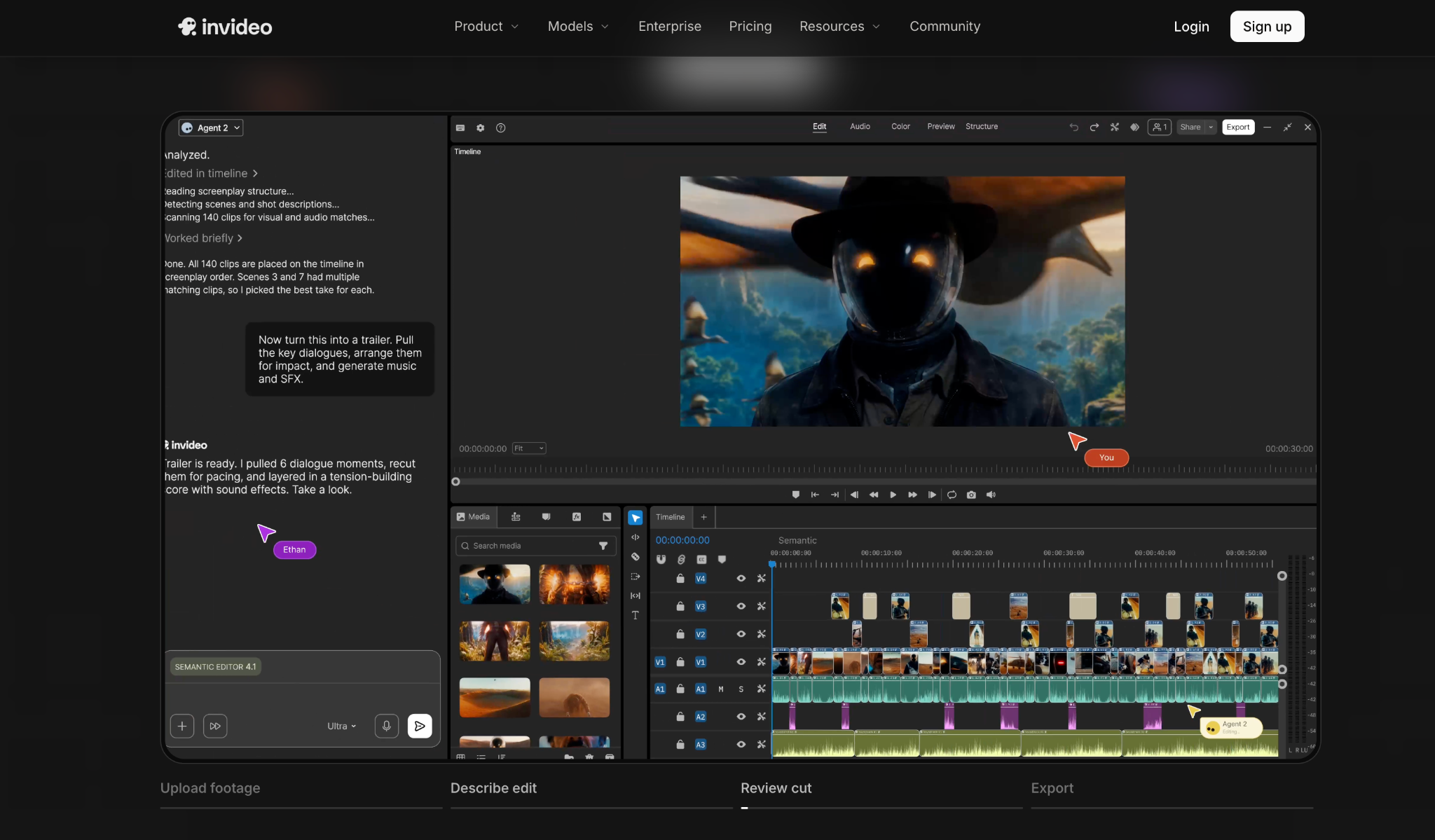
Invideo Editor doesn't just cut footage, it's briefed the way a real assistant editor would be: given a project's context, a look, a tone, a set of references, and left to carry that understanding across every clip it touches rather than starting fresh each time. That's the distinction that separates it from most of the tools on this list, which automate one job well. Ask it to build a base cut from a folder of raw takes, then keep going, sync multicam angles, find a moment by describing what happens in it, restructure the pacing, grade the color, mix the audio, or dub the whole thing into another language, and it works from the same understanding of the project throughout.
None of that locks the project down. Every agent action lands on a real, frame-accurate timeline with keyframes and a full color and audio suite, so a human editor can pick up exactly where the agent left off, or override any single decision by hand.
Strengths: context carries across every task instead of resetting per action; the manual timeline stays a genuine professional tool, not a simplified view of what the agent did
Limitations: the free tier's agent access is limited; full agent capability requires a paid plan
Pricing: Basic $9/seat/mo (limited agent access), Pro $25/seat/mo and Ultra $60/seat/mo (full agent access), billed annually
2. Loopdesk
Loopdesk was built agent-first from the ground up: its agent, Aura, takes a single natural-language instruction, something like "remove silences and filler words, caption it in our brand style, and give me five vertical clips", and executes the entire chain without further clicks. It runs fully in the browser and supports batch operations across dozens of videos at once, which suits a team producing high volume rather than one careful long-form edit.
Strengths: genuinely agent-first design, not AI features added to an existing editor; strong batch processing for volume production
Limitations: no free plan; deep manual keyframing and compositing still belong to traditional professional suites
Pricing: Creator Lite around $19/mo, or ~$15/mo billed annually.
3. Selects by Cutback
Selects is built specifically for the pre-editing stage of professional, long-form production. Point it at raw multicam footage and it syncs the angles, transcribes every word with speaker identification, detects topics and repeated scenes, and picks the best take among several repeats, producing an organized rough cut ready to hand off to Premiere, Final Cut, or DaVinci Resolve. Its newer Storyline feature goes further, generating a structured draft cut from a description of the target length, audience, and key message, rather than requiring the footage to already be roughly assembled.
Strengths: genuinely reduces the least creative part of a long-form edit, sorting and organizing raw footage; integrates cleanly with the professional NLEs teams already use
Limitations: it's a pre-editing specialist, not a finishing tool, the creative edit still happens in a separate NLE afterward
Pricing: Starter tier available; Max tier around $80/mo billed annually, Pro tier around $800/mo for production teams.
4. Adobe Creative Agent (Firefly)
Adobe's Creative Agent, introduced inside Firefly in 2026, lets a creator describe an outcome in plain language and has the agent orchestrate multi-step work across Premiere, Photoshop, Express, and Firefly itself from one conversational interface. Inside the Firefly Video Editor specifically, Quick Cut assembles raw footage into a structured first pass automatically, and a project can move from a generated storyboard straight into video without leaving the app. Firefly's model roster spans more than 30 third-party and Adobe-native models, including Kling 3.0 and Veo 3.1.
Strengths: deep integration across an entire professional creative suite, not just video; backed by Adobe's existing Premiere and color-grading tools
Limitations: most valuable to teams already working inside the Adobe ecosystem; less of a standalone pick for someone outside it
Pricing: Included with Firefly subscription plans; verify current tiers directly, as Adobe's packaging has changed more than once in 2026.
5. Mobbi AI
Mobbi AI positions its agents around narrative and emotional pacing specifically, aiming to understand a long-form video's story structure and mood well enough to cut, grade, and sound-design it with limited direction beyond a high-level creative brief. The pitch is less about mechanical prep work, sync, transcription, take selection, and more about an agent making the kind of pacing and tone calls a human editor would normally make by feel.
Strengths: a genuinely distinct angle among agentic tools, emotional and narrative pacing rather than pure mechanical automation
Limitations: a newer, less independently reviewed product than the others on this list; verify current claims and pricing directly before relying on them
Pricing: Verify current pricing directly, as public terms are still limited.
Which AI Agent Video Editor Should You Choose?
Want an agent that carries project context across every task, on a full professional timeline? invideo Editor.
Want one prompt to execute a complete editing workflow, browser-first? Loopdesk.
Working in Premiere, Final Cut, or Resolve and want the pre-editing grunt work automated first? Selects.
Already deep in the Adobe ecosystem? Adobe's Creative Agent.
Editing long-form content where narrative pacing matters most? Mobbi AI.
Frequently Asked Questions
What actually separates an "agentic" video editor from a regular AI-assisted one?
An agentic editor plans and executes a multi-step workflow from one instruction, cutting, captioning, grading, exporting, rather than requiring a separate manual click for each individual feature. It also makes editorial judgment calls, like which take is best among several repeats, instead of only applying fixed, rule-based automation.
Is invideo Editor a true agentic editor or just an AI-assisted one?
It's built agent-first: agents handle footage assembly, multicam sync, restructuring, grading, audio, and dubbing from plain-language direction, working from the same project context across every task rather than treating each action in isolation.
Which agentic editor is best for a team already using Premiere Pro or DaVinci Resolve?
Selects by Cutback is built specifically to automate the pre-editing stage before handing an organized rough cut off to those professional NLEs, rather than replacing them.
Do these tools replace a human editor entirely?
No. Every tool on this list still hands back a project a person can review and change. The agents handle preparation and mechanical execution; narrative judgment, tone, and final creative decisions still come from the person directing them.
Read Also: Set Up Two Monitors: Full Guide (2026)