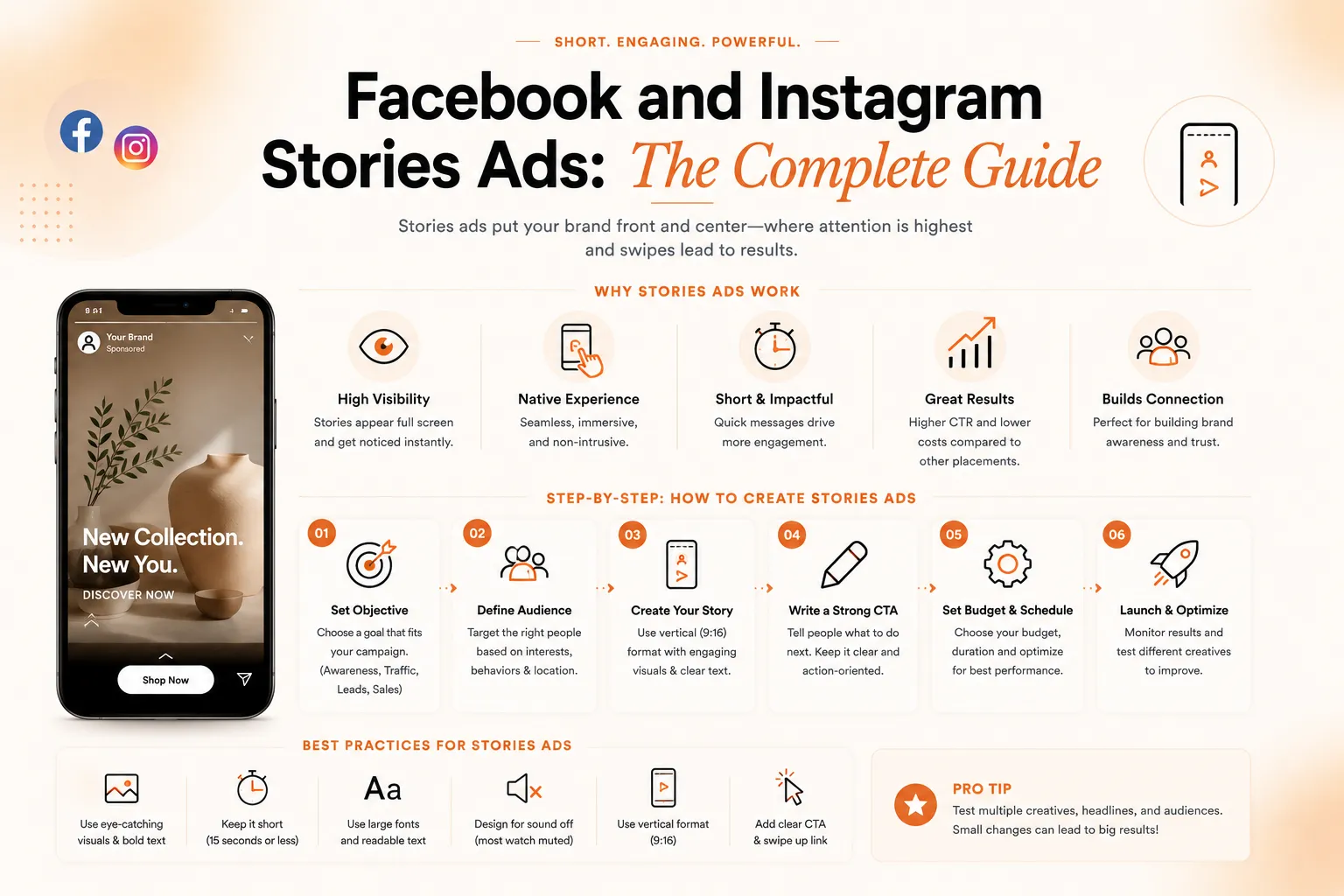
Facebook and Instagram Stories ads are short, full-screen vertical ads that show up between people's Stories on both apps, and I rely on them because they blend into content viewers already trust and swipe through in real time.
I have spent enough time running campaigns across Meta's platforms to know that Stories placements behave differently from a normal feed post. Attention is faster, swipes are quicker, and the format rewards creative that feels native rather than staged. In this guide, I am walking through what Facebook and Instagram Stories ads actually are, how they differ between the two apps, what specs to follow, and the mistakes I see marketers make most often when they set these campaigns up for the first time.
What Are These Ads, Exactly?
These ads are paid placements that appear full screen, in between the organic Stories people post from their own accounts. Unlike a feed ad, there is no scrolling involved. Viewers tap or swipe forward, which means the ad has roughly the same window of attention as any other Story on the screen.
I think of this format as borrowed attention. The ad sits inside a stream of content someone already chose to watch, so it needs to look like it belongs there rather than interrupting the experience. Both Facebook and Instagram pull from the same Meta ad system, so one campaign can run across both apps without building separate creative for each.
Why These Ads Work So Well
I keep coming back to Stories placements because they capture attention while it is still fresh. Someone opening Stories is actively watching content, not passively scrolling a feed, so a well-made ad has a real shot at holding their focus for the full few seconds it plays.
The format also rewards simplicity. A clear message, a strong opening frame, and a visible call to action tend to outperform anything overproduced. I have found that ads shot vertically from the start, rather than cropped from a horizontal video, almost always perform better because they fill the screen the way the platform intended.
Facebook vs Instagram Stories Ads: Key Differences
Facebook and Instagram Stories ads share the same underlying ad system, but the audiences behave differently on each app. I plan creative with both platforms in mind rather than assuming one version will work equally well everywhere.
Factor | Facebook Stories | Instagram Stories |
Typical audience | Slightly older, broader demographic | Younger, more visually driven |
Viewing behavior | Shorter average session per Story | Longer browsing sessions, more swiping |
Best content style | Direct offers, clear text overlays | Polished visuals, lifestyle framing |
Common use case | Retargeting and direct response | Brand awareness and product discovery |
Cross-posting | Can reuse Instagram creative with light edits | Can reuse Facebook creative with light edits |
I still test both placements separately before assuming performance will match, since even small differences in audience behavior can change results.
How to Set Up Your First Campaign
I always start in Meta Ads Manager rather than trying to boost a Story directly from the app, since Ads Manager gives me full control over targeting, budget, and placement. From there, I choose an objective that matches the goal, whether that is traffic, conversions, or awareness.
Next, I select Stories as a placement, either on its own or alongside Feed and Reels. Running Stories alongside other placements often lowers cost per result, since Meta can shift budget toward whichever placement is performing best. I then upload creative built specifically for the vertical format, write a short primary text, and set a clear call to action button before publishing.
I recommend starting with a modest daily budget and letting the campaign run for a few days before making changes. Meta's delivery system needs time to learn which audiences respond, and adjusting too early usually resets that learning.
Targeting That Actually Moves the Needle
I keep targeting simpler than most guides suggest. A broad audience with strong creative usually outperforms an overly narrow one, since Meta's delivery system does a lot of the heavy lifting once it has enough data to work with.
Retargeting is where I get the most out of this placement specifically. Someone who already visited a site or engaged with a page is far more likely to stop on a Story ad than a cold audience seeing the brand for the first time, so I weight budget toward warm audiences whenever the campaign goal allows it.
Story Ad Specs and Requirements
Getting the technical specs right matters more than people expect. A Facebook and Instagram Stories ad that is cropped or blurry loses credibility before the message even lands.
Spec | Requirement |
Aspect ratio | 9:16, full vertical screen |
Recommended resolution | 1080 x 1920 pixels |
Video format | MP4 or MOV, H.264 encoding |
Max file size | Up to 4GB |
Recommended video length | Around 15 seconds |
Primary text | Roughly 125 characters visible |
Safe zone | Keep key text and logos out of the top and bottom edges |
I keep this table pinned during creative reviews, since even one placement built at the wrong ratio can force awkward cropping across the whole campaign.
Common Mistakes to Avoid
The most common mistake I see is reusing a horizontal video without reshaping it for a vertical screen. It technically uploads, but it plays small in the middle of the frame with empty space on either side, which looks unfinished next to organic Stories.
Another mistake is placing important text or a logo too close to the top or bottom of the frame, where Meta's interface elements sit. I have watched otherwise strong creative get its call to action covered by the platform's own buttons simply because the safe zone was ignored.
The last one I see often is treating Stories like a smaller feed ad instead of its own format. A feed caption dropped onto a vertical frame rarely reads well. I write shorter, punchier copy specifically for this placement rather than trimming down feed copy after the fact.
I also see campaigns skip a clear call to action, assuming the visual alone will drive clicks. Even a strong opening frame needs a direct next step, whether that is a swipe up link, a shop button, or a simple line telling the viewer what to do. Without it, attention peaks and then fades without converting into anything measurable.
How Much Do These Campaigns Cost?
Cost varies a lot depending on industry, audience size, and how competitive the auction is at the time. Rather than fixating on a single number, I set a daily budget I am comfortable testing with and judge results against cost per result, not just cost per impression.
Stories placements often come in cheaper per impression than feed placements, simply because there is more inventory to fill. That does not always translate into a cheaper cost per conversion, though, so I track the full funnel rather than stopping at the ad platform's own metrics.
How I Measure Results
I look past click-through rate on its own, since a high click rate with no downstream action does not mean much. Cost per landing page view, cost per lead, and return on ad spend tell a more complete story about whether the campaign is actually working.
I also give campaigns enough runway before judging them. Meta's system needs a learning period to find the right audience, and pulling the plug after a day or two rarely gives an honest read on performance.
Tips to Get Better Results
I always lead with the strongest visual in the first frame, since Stories move fast and there is no second chance to earn attention. If the hook does not land in the first second or two, most viewers swipe past before the message even registers.
Sound matters more here than in feed placements, since a large share of Stories viewers watch with audio on. I write creative that still works with captions for the rest, but I do not treat sound as optional.
I also test more than one version of the same ad. Small changes, like a different opening frame or a shorter call to action, can shift performance more than a full creative overhaul.
How Stories Ads Fit Into a Bigger Growth Strategy
Running Facebook and Instagram Stories ads well gets people to a landing page, but what happens after that click matters just as much. If the page they land on has no authority behind it, even a perfect ad can underperform once traffic starts arriving.
This is where the work I do with BacklynkFlow comes in. Paid traffic and organic search authority are not separate problems, they support each other. A landing page backed by real editorial links tends to hold its ranking and convert better over time, which stretches every dollar spent on Stories ads further than paid traffic alone.
I have seen campaigns where the ad creative was strong but the destination page had no backlink profile to support it, and rankings stayed flat no matter how much traffic was sent. Pairing paid Stories campaigns with a steady link building effort through BacklynkFlow is one of the more reliable ways I have found to make that traffic compound instead of disappearing the moment the ad budget stops.
Frequently Asked Questions
Can I run the same ad on both Facebook and Instagram Stories at once?
Yes. Since both apps share the same Meta ad system, one campaign can serve creative across both placements without building two separate versions, though I still recommend checking how each performs individually.
Do I need a video, or can I use a static image?
Either works. Video tends to hold attention a bit longer because of the movement, but a well-designed static image with a clear message can perform just as well, especially for direct offers.
How long should a Story ad run before I judge performance?
I give most campaigns at least three to five days before drawing conclusions, since Meta's delivery system needs time to learn which audience segments respond best.
What is the biggest reason a Stories ad underperforms?
In my experience, it is almost always a mismatch between the creative and the format, whether that is a cropped horizontal video, cluttered text, or a call to action buried where the interface covers it.
Is Stories a good fit for a small budget?
Yes, and often a better fit than feed placements, since the format does not require a large production budget to feel native. A clear, well shot vertical video can compete with much bigger campaigns simply by respecting the format.
Wrapping Up
Facebook and Instagram Stories ads reward creative that respects the format, follows the specs, and gets in front of the right audience with a clear message. I treat every campaign as its own build rather than a copy-paste of what worked in the feed, and that alone tends to separate the ads that perform from the ones that get swiped past.
If you are running Stories ads and want the traffic they bring in to actually hold its ranking long term, that is exactly the kind of work BacklynkFlow focuses on. Reach out to BacklynkFlow when you are ready to back your campaigns with links that stick.
For the most current specs and placement guidelines, I recommend checking Meta's official Ads Guide and the Meta Business Help Center directly, since Meta updates these details periodically.