How to Optimize Your Google Business Profile for Local SEO
When someone searches "plumber near me" or "best dentist in [city]," Google shows three businesses at the top of the page before anything else the local pack and being one of those three matters more to most local businesses than ranking for any other keyword they could chase. Getting there isn't luck. Google's own documentation confirms local rankings run on three specific factors, and a recent survey of 47 local SEO experts found that Google Business Profile signals alone account for roughly a third of total ranking weight, with proximity and reviews making up most of the rest. This guide walks through exactly how to optimize every part of that profile, plus the off-page work citations and local link building that determines whether your business shows up at all once the on-profile basics are handled.
The Three Ranking Factors Everything Else Feeds Into
Google evaluates local results along three dimensions: relevance, distance, and prominence. Relevance measures how well your business matches what someone actually searched for, assessed through your GBP categories, your services, and your website content. Distance measures how close your business is to the searcher the one factor you can't directly optimize, short of opening a location physically closer to your target customers. Prominence measures how well-known and well-reviewed your business is across the entire web, not just on your Google profile this is where reviews, citations, and backlinks all come into play.
Every optimization covered in this guide feeds into one or more of these three dimensions. Relevance is where a complete, well-structured Google Business Profile does the most direct work. Prominence is where off-page signals reviews, citations, and local link building matter most, and it's the piece most local businesses under-invest in relative to its actual ranking weight.
Claim, Verify, and Complete the Foundation
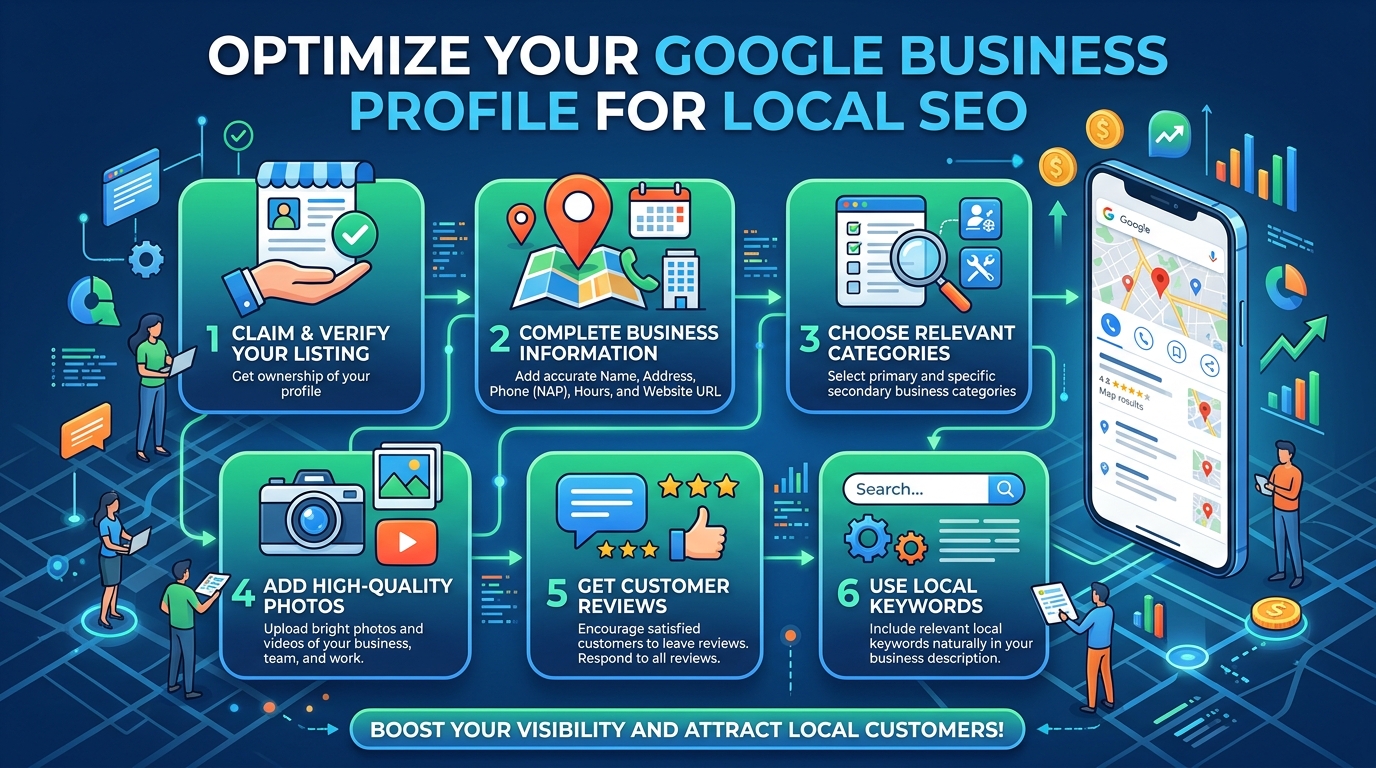
Before any optimization matters, your profile needs to be claimed, verified, and genuinely complete. Google explicitly rewards fully filled-out profiles over partial ones think of it as a resume: the more complete it is, the more trust signal it sends, and a half-filled profile reads to Google's algorithm as a weaker, less credible business entity than a genuinely complete one, independent of how good the underlying business actually is.
That means every available field filled in accurately: business hours (including holiday hours, which gets overlooked constantly), a complete address, phone number, website URL, and a business description that's specific rather than generic. Name, Address, and Phone number NAP for short need to be identical across your Google profile, your website, and every directory listing your business appears on. Even a minor discrepancy, like "St." on one listing and "Street" on another, can suppress rankings by introducing ambiguity into a signal Google otherwise treats as a strong trust indicator.
The Single Highest-Impact Field
If there's one field worth spending real time getting right, it's your primary category. Industry data consistently ranks primary category selection as the single most important controllable local ranking factor, and eight of the top ten signals feeding the local pack algorithm come directly from your Google Business Profile category selection sitting at the top of that list. Your primary category should describe your core business as specifically as possible rather than defaulting to a broad, generic option "Italian Restaurant" rather than just "Restaurant," "Family Dentist" rather than just "Dentist" since Google uses this field to determine which searches your business is even eligible to appear for in the first place.
Beyond the primary category, add every genuinely relevant secondary category covering the full range of what you actually offer. This is one of the simplest, most overlooked optimization tips available a business that only selects one category when it genuinely serves three or four distinct service types is leaving real search visibility on the table for no reason.
Business Description, Services, and Products: Feeding Both Search and AI Overviews
Your business description and Services section aren't just informational they're read directly by Google's structured data parser, and increasingly, they feed straight into AI Overview responses. AI Overviews now trigger for well over 40% of local queries, which makes this section considerably more important in 2026 than it was even two years ago. Write a description that naturally incorporates the specific services and location terms a real customer would search for, without stuffing keywords unnaturally the same principle that governs good on-page SEO applies directly here.
The Products and Services section is one of the most neglected optimization opportunities in local SEO specifically because it's easy to skip. Add every core service as its own entry with a keyword-aligned description and a price range where applicable these entries get parsed as structured data and directly inform how confidently Google (and increasingly, AI systems generating a local recommendation) can match your business to a specific, high-intent query.
Photos: Trust Signals That Do More Than Decorate
Photos aren't just aesthetic they function as verifiable trust signals Google's systems actively weigh. Interior and exterior shots build basic legitimacy and trust. Work-in-progress photos build relevance specifically for service-based keywords, showing Google (and a searching customer) tangible proof of the work you actually do. Team photos matter more than most businesses realize, since Google increasingly uses them as an E-E-A-T signal evidence that real humans are genuinely associated with the business entity behind the listing, not an automated or low-effort placeholder profile.
Posts: An Underused Weekly Habit
Google Business Profile Posts function similarly to a lightweight social feed attached directly to your listing, and businesses posting consistently show a measurably higher activity score than dormant profiles data from BrightLocal's Local Search Ranking Factors research found businesses with high activity scores rank in the top three local pack positions 1.4 times more often than dormant profiles carrying identical star ratings. A weekly cadence, mixing "What's New" updates, promotional Offer posts, and Event posts for anything happening in person, each linking back to a relevant page on your website, is a low-effort habit that compounds meaningfully over months.
Reviews: The Second-Most-Influential Ranking Factor
Reviews function as one of the strongest prominence signals Google's algorithm evaluates, and the evaluation goes well beyond simple star rating. Google's systems assess review quantity, rating quality, review freshness, and increasingly, the specific keywords appearing inside review text itself, alongside how consistently and thoughtfully the business owner responds. A business sitting on 200 reviews that stopped accumulating new ones two years ago is genuinely at risk of losing ground to a newer competitor with fewer total reviews but a steady, ongoing flow freshness and consistency matter as much as raw volume.
Review responses deserve real attention rather than a copy-pasted template. Search systems are increasingly able to identify low-effort, generic responses, and a thoughtful reply that references the specific thing a customer mentioned whether positive or negative reads as a genuine trust signal to both the platform's ranking algorithm and to every future reader browsing that review page before deciding whether to become a customer themselves.
NAP Consistency and the Citation Layer
Beyond your Google profile itself, prominence depends heavily on how consistently your business is represented across the rest of the web a discipline distinct from, but closely related to, traditional link building. Local citations are structured mentions of your business name, address, and phone number across directories, industry-specific listing sites, and data aggregators, and consistency across every one of them is a foundational trust signal Google actively cross-references when evaluating how legitimate and established a business genuinely is.
This is exactly where local seo link building Services diverges meaningfully from the editorial link building used in national or purely digital campaigns. A local link building service focuses specifically on citations, local press mentions, chamber of commerce listings, and location-relevant directory placements links and mentions that reinforce geographic relevance rather than pure topical authority. Understanding the local seo vs traditional seo link building google maps optimization distinction matters directly here: national editorial link building earns authority through topical relevance and content quality regardless of geography, while local link building earns trust specifically through consistent, verifiable presence across the local business ecosystem a real customer would encounter while researching in your specific area.
Off-Page Local SEO: Local Link Building Done Right
Traditional link building still plays a real role in local SEO, just with a narrower, more geographically focused target list than a national digital PR campaign would pursue. Off page seo link building for a local business typically prioritizes locally relevant sources: coverage in a regional newspaper or news site, a mention from a local blogger covering your specific area, sponsorship or partnership links from community organizations, and citations from location-specific business directories carrying real authority in your region.
Understanding how to build backlinks for a local business starts with the same principle governing any legitimate link building: earn placements because a local publisher or organization genuinely found your business worth mentioning, rather than manufacturing links through low-quality directories that exist purely to sell placements. Building backlinks SEO work for a local business benefits enormously from genuine community involvement sponsoring a local event, partnering with a complementary local business, or being featured in local press coverage since each of these produces exactly the kind of contextual, geographically relevant backlink that reinforces prominence most effectively.
Choosing a Link Building Partner for Local SEO
Not every seo link building service understands the specific mechanics of local prominence, and the fit matters here more than it might seem. A genuine white hat link building service working in the local space should be running citation audits, identifying NAP inconsistencies across existing directory listings, and pursuing genuinely relevant local press and community placements not simply repurposing a national link building playbook and applying it to a business that primarily needs local trust signals.
A manual link building service matters just as much in this category as in national campaigns, since personalized outreach to a local newspaper editor or a regional business association converts at a dramatically higher rate than a templated pitch. When evaluating a link building outreach service sometimes marketed as an outreach link building service for local SEO specifically, ask whether the provider has genuine experience with citation consistency work and local press relationships, not just national digital PR, since the skill sets and target lists differ meaningfully between the two.
Budget expectations differ too. Seo link building cost for a local-focused campaign is often considerably lower than a national editorial campaign, since citation building and local directory work require less content production than a full digital PR data study. Affordable seo link building services genuinely make sense in this category more often than in competitive national niches, provided the provider is doing real citation and NAP-consistency work rather than bulk-submitting your business to hundreds of low-quality directories that add no genuine trust signal. For agencies managing multiple local business clients at once, white label seo link building has become a common way to deliver this citation and local-outreach work under the agency's own branding without building that specific expertise in-house from scratch.
Seo link building packages built specifically for local businesses typically bundle citation cleanup, a defined number of local directory placements, and a smaller allotment of genuine local press or community outreach a meaningfully different structure than a national package built around DR-tiered editorial placements, and worth confirming explicitly before signing with any provider marketing a generic package across both categories.
On-Page Local SEO and Structured Data
Your website itself still matters directly to local rankings, not just your Google profile. Location-specific title tags, LocalBusiness schema markup embedded in your site's code, and dedicated landing pages for each service area or physical location all reinforce the same relevance signal your GBP categories establish. Page speed is a confirmed ranking factor across all of Google's search products, and it's especially critical for local search specifically, since local searchers are disproportionately on mobile devices, often looking for an immediate answer while out and about rather than researching at leisure on a desktop.
Behavioral Signals: What Happens After Someone Finds You
Once your profile appears in search results, what searchers actually do with it feeds back into your ranking. Click-through rate, phone calls initiated directly from your profile, and direction requests collectively account for a meaningful share of local pack ranking influence reasonable estimates put behavioral signals at roughly 9% of total ranking weight. A complete, visually compelling profile with strong photos and a clear, specific description directly improves these behavioral signals, which creates a genuine feedback loop: better optimization drives better engagement, which itself becomes an additional ranking signal reinforcing the improved position.
Tools for Tracking Local SEO and Link Building Performance
Measuring local rankings accurately requires different tooling than tracking national keyword rankings, since local pack results genuinely fluctuate based on a searcher's exact physical location grid-based rank tracking, which simulates searches from multiple points across your service area, is the only reliable way to understand your real local visibility rather than a single, potentially misleading rank check from one location.
For the off-page side of this work, the best link building and backlink analysis tools for SEO earn their value specifically in citation auditing flagging NAP inconsistencies across existing directory listings and surfacing where competitors in your specific local market are earning citations you haven't secured yet. When comparing seo link building tools and seo link building software for local SEO specifically, prioritize platforms with strong local citation tracking and NAP consistency monitoring over general-purpose national backlink tools, since the two disciplines look for meaningfully different signals. The best seo link building tools and best seo link building software for this category will surface both traditional backlinks and structured citation data in the same dashboard, since prominence for a local business depends on both working together rather than either one in isolation.
Tying It Together: A Local Keyword Ranking Strategy
As part of a broader keyword ranking strategy, local businesses get the strongest return by treating GBP optimization, review management, and local link building as one coordinated program rather than three separate initiatives. A complete, active profile with strong reviews improves relevance and prominence simultaneously; consistent citations and genuine local link building reinforce prominence further and support the geographic trust signals distance-based ranking depends on. Neglecting any single piece, a stale profile, an inconsistent NAP across directories, or a review strategy that went quiet after the first few months creates a real, measurable gap competitors who are handling all three consistently will move into.
Final Thoughts
Optimizing a Google Business Profile isn't a one-time setup task it's an ongoing discipline spanning your profile completeness, your review strategy, your citation consistency, and genuine local link building working together. Get the foundational fields right first category, description, services, photos then build the sustained habits around posting, review management, and off-page prominence that compound over months rather than delivering an overnight fix. The businesses winning local pack visibility in 2026 aren't doing anything mysterious; they're simply treating their profile as an active marketing channel rather than a listing they set up once and forgot about.
Frequently Asked Questions
What's the single most important thing to optimize on my Google Business Profile?
Primary category selection consistently ranks as the highest-impact controllable factor, since it determines which searches your business is even eligible to appear for.
How often should I post updates to my Google Business Profile?
Weekly is the cadence most local SEO data supports, mixing general updates, promotional offers, and event posts, each linking back to a relevant page on your website.
Do local citations still matter if I have a strong Google Business Profile?
Yes citations reinforce the prominence signal Google evaluates independently of your GBP completeness, and inconsistent NAP information across directories can actively suppress rankings regardless of how strong your profile itself looks.
Is local link building different from regular SEO link building?
Yes, meaningfully. Local link building focuses on geographically relevant citations, local press, and community placements, while national editorial link building prioritizes topical authority and content quality regardless of location.
How many reviews does my business need to rank well?
There's no fixed number consistency and freshness matter more than raw volume. A steady flow of new reviews over time outperforms a large historical total that's stopped growing.
Read more: affordable local link building services