The best language learning apps depends on your goal. Duolingo is best for a free daily habit, Babbel for structured speaking lessons, and Pimsleur for audio learners. Research suggests apps work best for beginners, so pair yours with speaking practice or a tutor.
I'll be honest with you.
I've watched people download five language learning apps in one weekend, then quit all five by Friday.
Don't be that person.
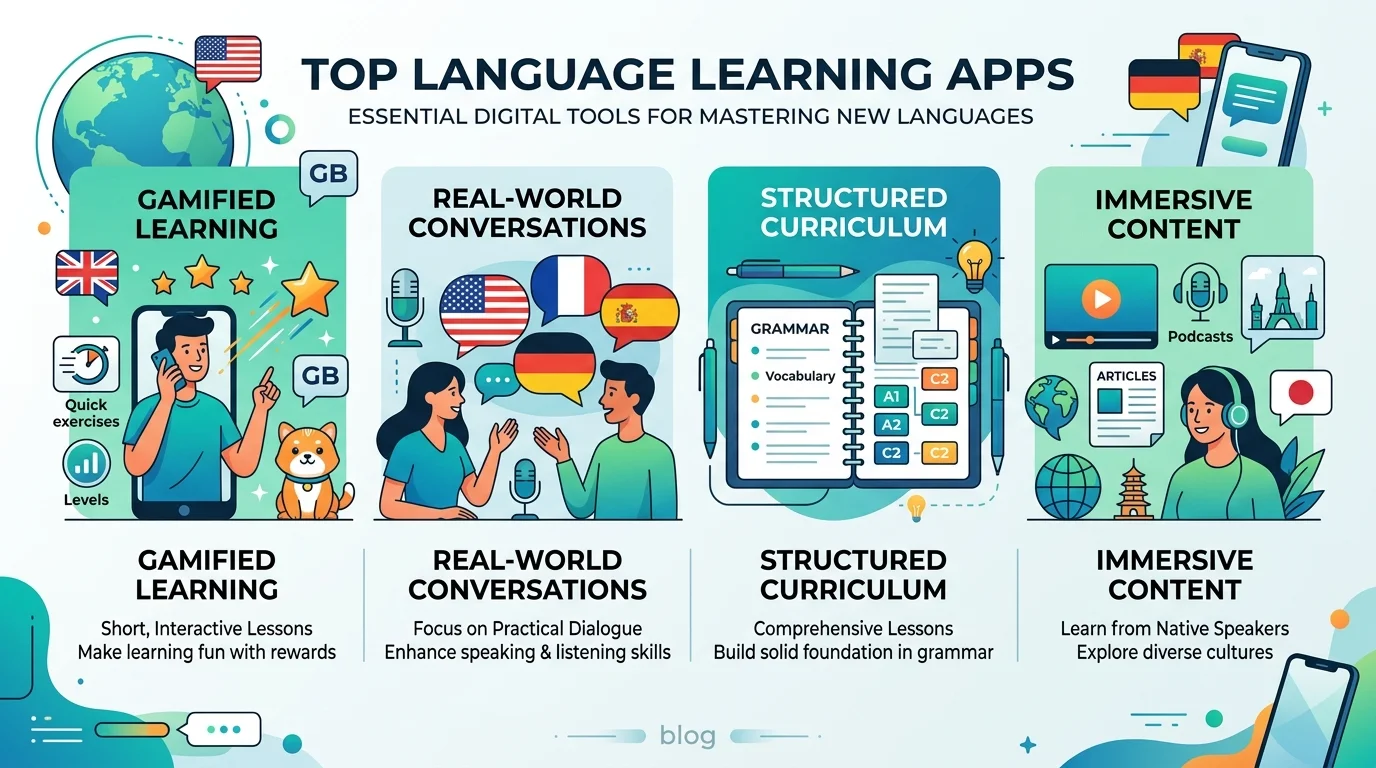
Why Even the Best Language Learning Apps Need a Plan
Picking an app feels like the hard part. It isn't. The hard part is showing up on day twelve, when the excitement is gone and your daily practice feels like homework. So before you compare anything, get clear on what you want.
Ask yourself three quick questions:
Are you learning for travel, work, or fun?
Do you have 10 minutes a day, or 45?
Do you need to speak, or mostly read?
Your answers decide everything. Seriously.
Language Learning Apps Compared: Quick Table
Here's the short version before I explain each app. This table sums up what each app does best, so you can match it to your goal instead of chasing the loudest ad. Language counts come from the sources linked below. Prices change often by country and platform, so confirm them on each official page before you buy.
App | Best for | Free option | Languages | Main weakness |
|---|---|---|---|---|
Duolingo | Daily habit | Yes, with ads | 40+ | Shallow speaking practice |
Babbel | Structured conversation | No free tier, trial available | 14 | Thins out after B2 |
Busuu | Grammar and corrections | Free tier | See app | Better with community input |
Pimsleur | Audio and pronunciation | Trial | 50+ | No reading or writing |
Memrise | Native speaker video | Free tier | 30+ | Loose curriculum |
italki | Live tutoring | Pay per lesson | 150+ | Costs more per hour |
The Top Language Learning Apps, One by One
Now the fun part. Each app below is good at one thing and terrible at pretending otherwise. I've kept these short so you can scan them fast, then decide which one fits the way you actually live.
Duolingo: Your Habit Builder
Duolingo is free, covers more than 40 languages, and uses gamified lessons with streaks to keep you coming back. That's its superpower. Most people can't stay consistent alone, and this app fixes that.
Its weakness is depth. Serious grammar and real conversation need backup.
Babbel: Your Structured Speaking Path
Babbel builds short 10 to 15 minute lessons around real world dialogues, with audio recorded by native speakers. That makes it great for conversational skills and travel phrases.
It has no free tier, and advanced content thins out. Still, for beginners who want a clear path, it's hard to beat.
Busuu, Pimsleur, and Memrise: Your Specialists
Think of these as add ons. Busuu adds community corrections and grammar work. Pimsleur runs 30 minute audio lessons for pronunciation and listening. Memrise uses spaced repetition and native speaker video clips, so you hear real slang.
Pick the one that fills your gap.
Do Language Learning Apps Actually Work?
Short answer: yes, with strings attached. I don't trust hype, so I checked the studies. What they show is encouraging, but it isn't the whole story, and I'd rather you hear the caveats from me now than discover them three months in.
Here's what stood out:
In a Michigan State University study, 83 undergraduates studied Spanish on Babbel for 10 minutes a day over 12 weeks. Of the 54 who finished, almost everyone improved on grammar and vocabulary, and almost 60 percent improved in oral proficiency.
The same researcher, Shawn Loewen, said apps suit beginners to low intermediate learners best, especially for vocabulary and phrases.
A 2023 ACM paper compared studies on Busuu, Babbel, and Duolingo, and noted all three were funded or run by the vendors themselves.
The University of Sheffield describes apps as powerful complementary tools, not replacements for teaching.
So apps work. Just not alone.
Best AI Language Learning Apps in 2026
Here's where 2026 gets interesting. AI tutors now let you practice speaking at midnight, with zero embarrassment. That's a real shift, because speaking is exactly where most app learners stall. I'd treat these tools as a warm up for real humans, not a replacement.
Duolingo Max: AI Conversation Inside Your Favorite App
Duolingo Max adds two speaking features: Roleplay, a scripted real life scenario, and Video Call, an open chat with an AI character named Lily. Since January 2026, Explain My Answer is free for everyone, so Max now centers on those two.
Prices vary by account and country. Check your app before deciding.
Speak, Pimsleur AI, and Other AI Tutors
Other tools worth a look include Speak for live style conversation, Elsa Speak for pronunciation reports, and Clozemaster for sentence based vocabulary. This 2026 roundup compares them.
Want better answers from a general chatbot too? Learn the basics of prompt engineering so you can ask it to play a patient conversation partner at your exact level.
Try a free trial first. Then decide.
Step by Step: Build Your Language Learning Routine
Enough theory. Here's the routine I'd follow if I were starting from zero tomorrow. It follows a popular 2026 study stack that mixes an app, speaking practice, and real content. If your schedule is tight, shrink it, but keep every step.
Step 1: Start With One Core App
Choose Duolingo or Babbel. Commit for 30 days and finish every lesson. Resist the urge to install a second app when things get boring.
Step 2: Add Speaking Practice
This is where most people stall. Add an AI conversation tool or a language exchange partner so you're forced to talk, even badly.
Step 3: Feed Your Ears With Real Content
Listen to a podcast or watch a show in your target language. You'll pick up rhythm and listening comprehension faster than any drill teaches it.
Step 4: Review With Spaced Repetition
Use Anki for 10 minutes a day. It shows you words right before you'd forget them, which locks in vocabulary for the long term. Keep a running list of new words and phrases too, and one of the best iPad note taking apps makes that easy to search later.
Step 5: Book a Human Tutor
Even one session a week helps. A marketplace like italki offers one on one lessons, and a real person catches mistakes that apps miss.
How Long Does It Take to Reach Fluency?
People love asking this, so let's be direct. The CEFR sorts proficiency into six levels, A1 to C2, grouped as Basic, Independent, and Proficient User. Most apps are strongest at A1 to B1.
One 2026 guide claims 45 to 60 daily minutes can reach B1 to B2 in 12 to 18 months for motivated adults. Treat that as a rough estimate, not a promise. Your language, schedule, and speaking time change everything.
Which Paid Plan Should You Buy?
Free apps are a great start, but let's talk about what happens next. If you're serious, paying is a strength, not a weakness. Money on the table makes you show up, and paid tiers unlock the features that move you from beginner to conversational.
Here's my honest advice:
Casual learner? Stay on Duolingo's free tier and upgrade only if ads bother you.
Want a structured path? Try Babbel. You get clear CEFR aligned lessons and visible progress.
Learning with family? Look at Duolingo's family plan, which lowers the per person cost.
Commuter? Pimsleur's audio lessons turn dead time into study time.
Want fast speaking gains? Pair any app with a paid tutor on italki.
Do you need to spend a lot? No. Do you need to spend something? I'd say yes. A small subscription plus a routine beats a folder of forgotten free apps.
My pick by learner type:
Total beginner on a budget: Duolingo, then upgrade later.
Travel or work in 3 months: Babbel plus one weekly tutor.
Audio learner: Pimsleur.
Pick one. Start the free trial tonight.
Frequently Asked Questions
Below are the questions readers ask me most, answered briefly so you can skim.
Is Duolingo enough to become fluent?
No. Duolingo builds a strong daily habit and basic vocabulary, but fluency needs speaking practice and real conversation. Pair it with a tutor, a language exchange, or an AI speaking tool.
What is the best free language learning app?
Duolingo is the best fully free option. Its core course is free with ads and covers more than 40 languages. Memrise and Busuu also have free tiers, but their strongest features are paid.
Do language learning apps really work?
Yes, especially for beginners. Michigan State research found almost 60 percent of Babbel learners improved oral proficiency. Results depend on how often you practice and whether you add speaking.
Which app is best for speaking?
For live style practice, use an AI speaking tool or a human tutor. Pimsleur is strong for pronunciation through audio, and italki gives you real conversation with teachers.
How long does it take to reach B1?
It varies by language and effort. Around 45 to 60 minutes a day is a common guideline, but you should expect months to over a year.
Final Thoughts: Pick One and Start Tonight
Here's what I want you to take away. The best language learning app is the one you'll still open in three months. Everything else is noise.
Choose one core app. Add speaking. Track your progress against a CEFR level so you can see real movement.
Then start tonight, not Monday.
Your future self, ordering coffee in fluent Spanish, will thank you.