Every SEO professional knows that backlinks still matter. Despite every algorithm update, every new ranking factor, and every prediction that links would eventually become irrelevant, the data in 2026 is unambiguous: pages with strong, authoritative backlink profiles consistently outrank pages without them, regardless of how good the content is.
What has changed dramatically is how you earn those links. The backlink outreach strategy that worked in 2020 mass email blasts, templated pitches, link exchange schemes not only fails to produce results in 2026 but actively signals to Google that your link building is manipulative, triggering algorithmic discounting of every link you acquire that way.
The backlink outreach campaigns that are generating real results in 2026 look fundamentally different. They are built on genuine relationships, powered by content that actually deserves to be linked to, executed with personalization that makes recipients feel individually valued rather than mass-processed, and sustained with the patience and consistency that separates professionals who build lasting domain authority from those who chase short-term ranking spikes.
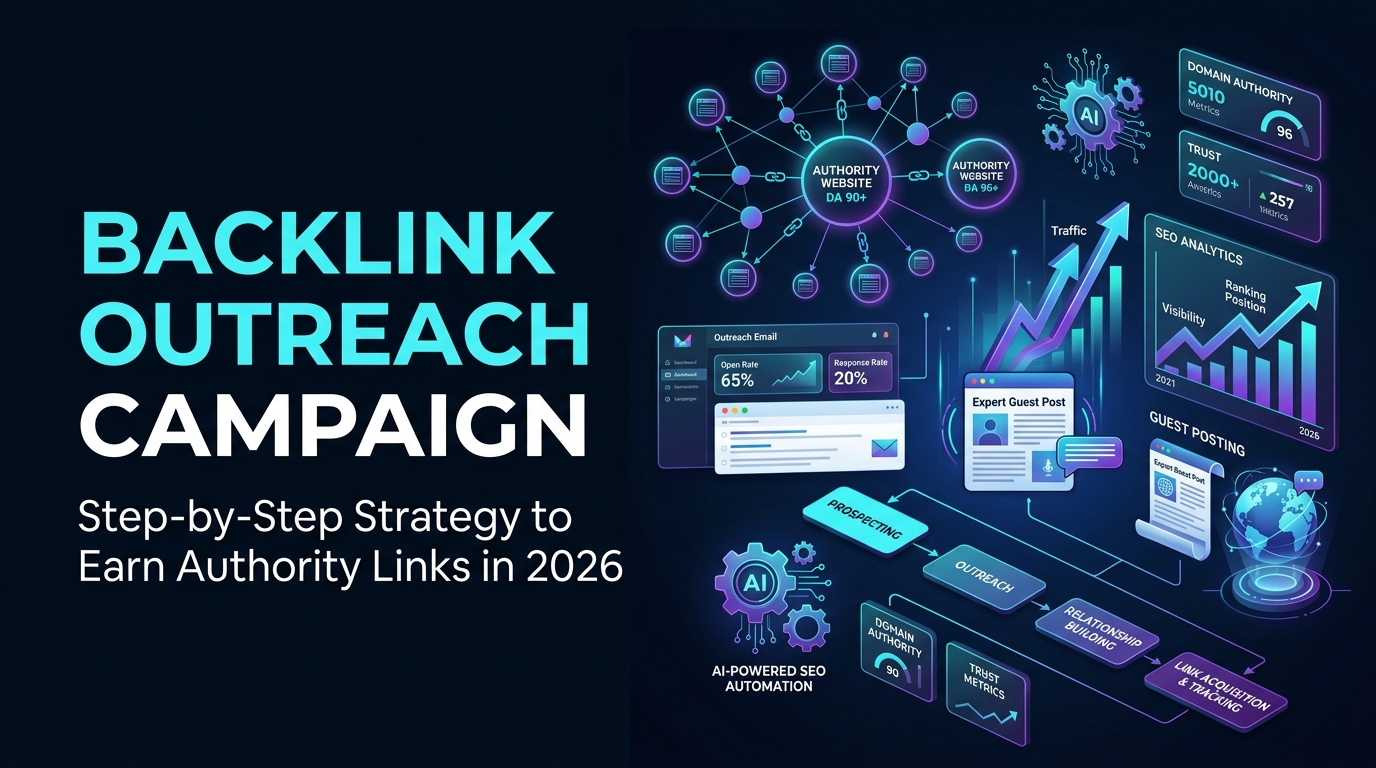
Why Most Backlink Outreach Campaigns Fail Before They Start
Before diving into the strategy, it is worth understanding why the overwhelming majority of outreach campaigns fail because most failures are preventable and trace back to the same foundational mistakes.
The first mistake is launching outreach before the content deserves links. Backlink acquisition strategy is a distribution mechanism for content that has intrinsic value. If the page you are building links to contains the same information as fifty other pages already ranking for the same keywords, outreach recipients have no reason to link to yours over any alternative. No amount of outreach excellence compensates for content that does not merit the link being requested.
The second mistake is treating outreach as a numbers game. Sending five hundred templated emails and hoping that two percent respond is not an SEO outreach campaign it is spam. The professionals generating the best results from link building outreach services send significantly fewer emails that are significantly more personalized and significantly more targeted, and they generate response rates that are ten to twenty times higher than mass-email approaches.
The third mistake is focusing on domain authority metrics rather than genuine relevance. A link from a DA 70 site in a completely unrelated niche contributes far less to your rankings than a link from a DA 40 site with a deeply relevant audience and genuine topical authority in your space. Niche relevant outreach is not just a best practice it is the single most important targeting principle in modern link building.
Understanding these failure modes before you begin is the foundation of a campaign that actually works.
Step 1: Build the Content That Earns Links Before You Pitch Anyone
The most common mistake in backlink outreach campaigns is separating the content creation phase from the outreach planning phase building content first and then figuring out how to promote it, rather than creating content specifically designed to attract links from the sources you want.
What Makes Content Linkable in 2026
The content that generates the most responses to email outreach for backlinks in 2026 shares specific characteristics that distinguish it from the commodity content that fills most blogs and resource sections.
Original data and research is the most reliable linkable content format available. When you conduct a survey, analyze proprietary data, run an experiment, or compile statistics from primary sources that no one else has aggregated, you create a resource that every writer covering your topic needs to cite. Original research generates passive links from people who find it through search, active links from outreach recipients who immediately see why they would want to link to something exclusive, and press coverage that compounds both.
Comprehensive definitive resources the most thorough, most accurate, most regularly updated treatment of a specific topic that exists anywhere online attract links over time because they become the go-to reference that writers default to when they need to cite an authority on that subject. These "skyscraper" resources require significant upfront investment but generate returns indefinitely.
Original tools, calculators, and templates attract links because they provide direct, recurring utility rather than just information. A free ROI calculator, a content audit template, a pricing comparison tool, a process checklist anything that saves people time or effort becomes a naturally linkable resource that outreach recipients are genuinely motivated to share with their audiences.
Contrarian, data-backed perspectives content that challenges established wisdom with specific evidence generate links and discussion because they give other writers something to engage with, either agreeing and citing your data or disagreeing and referencing your argument. Strong takes backed by evidence perform dramatically better in outreach than content that carefully avoids taking any clear position.
Preparing Your Content for Maximum Linkability
Before a single outreach email goes out, your target content should pass these specific checks. Is the title compelling enough that your target outreach recipient would want to share it with their audience? Is there a specific, citable claim or data point on the page that writers would want to reference? Is the page visually well-designed and credibility-signaling, since the first impression of the page directly affects how outreach recipients evaluate your pitch? Is there a clear, logical reason why this page would serve the audiences of the sites you are targeting?
If the answer to any of these questions is no, improve the content before you begin outreach. Every hour spent improving the content before outreach starts is worth ten hours of outreach execution on content that does not merit the links you are requesting.
Step 2: Build Your Target List with Surgical Precision
The quality of your backlink outreach campaign is determined more by the quality of your target list than by any other single variable. A perfectly executed pitch to the wrong target produces nothing. A good pitch to the right target at the right moment, about content that genuinely serves their audience produces a link, a relationship, and often additional links down the road.
The Backlink Gap Method Your Highest-Quality Targets
The most reliable source of high-quality outreach targets is your competitors' backlink profiles. Sites that have already linked to content similar to yours have demonstrated three things simultaneously: they are open to linking to content in your space, they publish content in a context where your link would be relevant, and they have an audience that overlaps with yours.
Use Ahrefs, Semrush, or Majestic to pull the backlink profiles of your three to five closest competitors. Export the domains linking to their relevant content. Filter for domains that link to two or more competitors but not to you these are your highest-priority targets because they are clearly receptive to linking in your niche and have an obvious gap you can fill.
This backlink gap approach is the foundation of effective SEO outreach campaigns because it eliminates the guesswork about whether a target is open to linking in your space. The evidence is already there.
Resource Page Outreach High-Value, Lower Competition
Resource pages pages specifically dedicated to listing useful links and tools in a specific niche are ideal targets for organic link building process outreach. They exist specifically to link out, the editors are by definition open to adding new links, and a single addition to a well-maintained resource page often generates referral traffic alongside the SEO benefit.
Search for resource pages in your niche using queries like "[your niche] + useful resources," "[your topic] + recommended reading," or "[your industry] + tools and resources." Evaluate each page for topical relevance, domain authority, and apparent maintenance frequency a resource page that has not been updated in three years is unlikely to respond to outreach.
Broken Link Building Helping While Building
The broken link building technique remains one of the most consistently effective high authority backlink acquisition strategies in 2026 because it positions your outreach as a service to the recipient rather than a request. You identify broken links on relevant pages links pointing to resources that no longer exist and offer your content as a replacement.
This approach works because it gives the site owner a concrete problem-and-solution pair rather than just a link request. The activation energy required to say yes is dramatically lower when the recipient understands they are fixing something broken rather than just doing you a favor.
Tools like Ahrefs' Site Explorer, Check My Links browser extension, and Semrush's backlink audit feature all help identify broken link opportunities at scale.
Digital PR Targets Journalists and Publications
For digital PR outreach specifically reaching journalists, editors, and publications rather than independent site owners and bloggers target selection requires additional research. Identify the publications that consistently cover your industry and the specific writers within those publications who cover your specific topic area.
Journalist-focused outreach is the most scalable high authority backlink acquisition channel because a single placement in a major publication can generate dozens of secondary links as other sites pick up the story. But it requires the most tailored, newsworthy pitch journalists receive hundreds of pitches per day and have extremely low tolerance for anything that feels like a generic link request dressed up as a press release.
Step 3: Find the Right Contact and Verify Their Information
Sending a beautifully personalized pitch to the wrong person is a wasted effort. Identifying the specific individual most likely to be interested in your content and able to make the linking decision is a prerequisite for any effective blogger outreach campaign.
For independent blogs and smaller publications, the right contact is typically the site owner or editor-in-chief the person who both creates content and makes decisions about what gets published and linked to. For larger publications, you want the specific writer or section editor who covers your topic, not a generic editorial contact.
Use Hunter.io, Voila Norbert, or LinkedIn to find and verify contact information for your targets. Confirmed email addresses that you have tested for deliverability dramatically outperform guessed or pattern-matched addresses in both delivery rate and response rate.
Build your contact information into your outreach CRM Pitchbox, BuzzStream, or a custom setup in Airtable or Notion alongside your notes about the specific angle you will use in your pitch to that person. This contact-level customization is what enables genuine personalization at scale.
Step 4: Craft Outreach Emails That People Actually Want to Read
The outreach email is where most SEO link outreach campaigns succeed or fail. The difference between a 5% response rate and a 25% response rate is almost entirely determined by the quality of the email and the quality of the email is almost entirely determined by how specifically it speaks to the individual recipient rather than a generic target audience.
The Anatomy of a High-Converting Outreach Email
Every high-performing outreach email in 2026 contains five elements, all working together.
The subject line determines whether the email gets opened. The most effective subject lines for email outreach for backlinks reference something specific to the recipient a specific post they wrote, a specific claim you want to comment on, or a specific opportunity you have identified on their site. Generic subject lines like "Quick link building opportunity" are deleted without being opened. Specific subject lines like "Broken link on your [specific page title]" or "Your post on [specific topic] wanted to share something relevant" get opened because they signal immediately that this is not a mass email.
The opening line is read in the first two seconds and determines whether the email is read further or closed. Open with something that proves you know the person's work specifically a specific post they wrote that you genuinely found valuable, a specific point they made that resonated, or a specific problem you noticed on their site. This is not flattery it is proof of research.
The value proposition is the core of the email and should be expressed in one to two sentences maximum. What is the specific thing you are offering or proposing, and why does it benefit the recipient rather than just you? The value proposition that works is always framed from the recipient's perspective: "I thought this would be useful for your readers who are trying to solve [specific problem]" outperforms "I would love a link from your site" by every measurable metric.
The specific ask should be clear, low-friction, and easy to evaluate. "Would it make sense to add this as an additional resource in your [specific section]?" is better than "Could you link to my content?" because it is specific, shows you have actually read their page, and makes it easy for them to say yes or no without ambiguity.
The closing should be warm, brief, and without pressure. Expressing genuine appreciation for their time and leaving the door open for a relationship regardless of whether they respond positively to the specific request maintains the relational quality that relationship-based link building requires.
Personalization That Moves the Needle
The personalization that actually produces higher response rates goes significantly beyond inserting the recipient's name and site URL. Genuine personalization that makes recipients feel individually valued includes referencing a specific post or page they published and mentioning something specific about it, noting a specific point in their existing content where your resource would enhance value, mentioning a specific broken link, outdated resource, or content gap you noticed on their site, or referencing a recent event, publication, or development in their area that makes your pitch timely.
This level of personalization requires reading the target's content before you pitch which sounds obvious but is skipped by the vast majority of outreach practitioners. The time investment is real, but the response rate improvement is dramatic.
For link building outreach services at scale, the solution is not to skip personalization but to create a personalization workflow spending two to three minutes per target reading enough of their content to write one genuinely specific observation, then using that observation as the foundation for a customized pitch.
Step 5: Build Your Follow-Up Sequence
The majority of positive responses to backlink outreach campaigns come from follow-up emails, not first contacts. Most people who would genuinely benefit from your content and would happily link to it simply miss your first email their inbox is busy, your email arrived at the wrong moment, or it got buried before they had time to act on it.
A well-designed follow-up sequence for SEO outreach campaigns typically includes two to three follow-up messages spaced three to five business days apart. Each follow-up should add value rather than simply repeating the original ask a relevant piece of information, a different angle on why the content is useful, or a new resource that complements the original pitch.
The tone throughout the sequence should remain warm and professional never desperate, never aggressive, never guilt-inducing. You are a professional offering something genuinely valuable, following up to ensure it did not get lost. The moment the follow-up sequence starts feeling like pressure rather than service, you have crossed a line that damages both your response rate and your professional reputation.
Stop after three follow-ups. Continuing beyond that point crosses from persistence into harassment, and it permanently poisons any future relationship with that contact and publication.
Step 6: Execute Relationship-Based Outreach for Editorial Links
The most valuable links you can earn through backlink outreach campaigns are editorial links links placed voluntarily by editors and writers who genuinely value your content rather than links placed in response to a transactional outreach request. Editorial link placements are more trustworthy in Google's eyes, more durable over time, and more likely to generate referral traffic alongside their SEO benefit.
Earning editorial links consistently requires investing in relationships before you need links from them. Follow your target writers and editors on LinkedIn and Twitter. Engage thoughtfully with their content not with generic compliments but with substantive responses that add to the conversation. Share their work with genuine context when it is relevant to your audience. Comment on their articles with specific, valuable additions to the discussion.
When someone whose work you have been genuinely engaging with for weeks or months receives an outreach email from you, it is not a cold pitch it is a message from someone they recognize as a thoughtful voice in their space. That recognition dramatically changes the probability and speed of a positive response.
Relationship-based link building requires patience that most marketing practitioners resist because the returns are not immediate. The relationships you build this month produce links next month and the month after. The links you earn this quarter through relationship-based outreach are more durable and more authoritative than links earned through transactional outreach at any scale.
Step 7: Leverage Digital PR for High-Authority Placements
Digital PR outreach is the most powerful lever available for high authority backlink acquisition at scale and it is consistently underutilized by businesses that have already mastered basic link building outreach.
The core of digital PR link building is creating content that is genuinely newsworthy a research report with surprising findings, a data-driven analysis of an industry trend, a study that challenges conventional wisdom, or a resource that provides significant utility to journalists covering your space.
Platforms like HARO (Help a Reporter Out), Qwoted, and SourceBottle connect journalists seeking expert sources with businesses and practitioners who can provide them. Regular monitoring of these platforms and rapid, expert-quality responses to relevant journalist queries is one of the most efficient SEO link outreach activities available generating links from major publications that would be nearly impossible to acquire through standard outreach.
For content promotion strategy purposes, digital PR and blogger outreach are complementary rather than competing approaches. Digital PR targets journalists and major publications for high-authority, high-profile placements. Blogger outreach targets niche creators and independent site owners for topically relevant, community-specific links. Running both in parallel produces a backlink profile with both the authority signals from major placements and the topical relevance signals from niche placements which is the profile that produces the most durable ranking improvements.
Step 8: Track, Measure, and Optimize Your Campaign
A backlink outreach campaign without rigorous tracking is flying blind. The data you collect from one campaign should directly inform the improvements you make to the next and without measurement, improvement is impossible.
The Metrics That Actually Matter
Outreach-to-response rate measures what percentage of your initial emails receive any reply. A response rate below 10% signals a fundamental problem with your targeting, your email quality, or both. A response rate above 20% indicates a well-targeted, well-crafted campaign. Track this metric per campaign and per outreach angle to identify what is working.
Response-to-link rate measures what percentage of positive responses result in an actual placed link. This metric reveals issues in the conversation-to-placement stage follow-up timing, content quality issues raised during the conversation, or misalignment between the link request and what the site owner is willing to place.
Link quality distribution tracks the domain authority, topical relevance, and traffic metrics of the links you earn. If your campaign is producing large numbers of low-quality links alongside a few high-quality ones, your targeting criteria need tightening. If you are earning mostly high-quality placements, your targeting process is working and should be scaled.
Ranking movement correlation is the ultimate measure of whether your link building is having the intended effect on search visibility. Track ranking positions for your target keywords at least weekly during and after an outreach campaign, and correlate ranking changes with link acquisition timing to understand which types of links are producing the most measurable ranking impact.
Using Outreach CRM Tools for Campaign Management
Link building outreach services at any significant scale require dedicated campaign management tools. Pitchbox, BuzzStream, and Respona all provide workflow automation for the mechanical parts of outreach management email sequencing, follow-up scheduling, response tracking, and campaign reporting while preserving the human personalization that makes outreach effective.
The right tool reduces the administrative overhead of running an outreach campaign by 60 to 70%, freeing the time that would otherwise go to inbox management for the higher-value activities of content research, personalization, and relationship development.
Step 9: Nurture Links That Compound Into Ongoing Relationships
The difference between a backlink outreach campaign that produces a one-time link acquisition and a campaign that produces an ongoing relationship generating multiple links over time is how you treat the relationship after the link is placed.
When a link goes live, acknowledge it specifically and graciously not with a generic "thanks for the link" but with a specific note about what you appreciated about how they contextualized your content. Share the page that contains your link with your own audience, giving the linking site additional traffic and signal that their editorial decision was well-received.
Continue engaging with the linking site's content after the link is placed. Follow up several months later with a new resource that would serve their audience. Propose a collaboration a joint research project, a quoted expert feature, a co-written piece that would benefit both audiences. Refer them to other valuable sources in your network that they might want to cover.
These relationship maintenance activities cost relatively little time but dramatically change the lifetime value of each linking relationship. A site that has linked to you once and felt genuinely appreciated and valued by the interaction is far more likely to link to you again, to mention your brand in future coverage, and to introduce you to other relevant sites in their network.
Organic link building process at its most effective is not a series of individual outreach campaigns it is the construction of a network of mutually beneficial professional relationships that generate links, referrals, and collaborative opportunities continuously over time.
The 2026 Backlink Outreach Campaign Checklist
Before launching any outreach campaign in 2026, run through this complete checklist to ensure every element is in place.
Content Preparation: Target page contains something genuinely not found elsewhere. The specific linkable asset data, tool, comprehensive resource is immediately apparent. The page is visually professional and credibility-signaling. Load speed is under two seconds and mobile rendering is clean.
Target List Quality: Every target has been filtered for topical relevance, not just domain authority. Each target's actual organic traffic has been verified. Contact information has been confirmed rather than guessed. A specific personalization angle has been identified for each target.
Email Quality: Subject line references something specific to the recipient. Opening line proves you have read their content. Value proposition is framed from the recipient's perspective. The ask is specific, clear, and low-friction. Follow-up sequence is planned with value-adding content for each touchpoint.
Campaign Infrastructure: Outreach CRM is configured and tested. Email sending domain has been warmed up. Response tracking is in place. Link monitoring is set up in Ahrefs or Semrush to confirm placements.
Relationship Framework: Plan for post-placement acknowledgment is defined. Content calendar includes future linkable assets to pitch to established contacts. Engagement strategy with target publications is active before outreach begins.
Final Thoughts:
The backlink outreach campaigns that build lasting domain authority improvement in 2026 share a philosophical foundation that distinguishes them from campaigns built purely around extraction extracting links from sites, extracting ranking improvements from Google, extracting business value from relationships without contributing equivalent value in return.
The campaigns that work are built around earning. Earning the right to pitch by creating genuinely excellent content. Earning the attention of outreach recipients by demonstrating genuine knowledge of their work. Earning links by making it genuinely easy for recipients to see why their audience would benefit from the connection. And earning relationships by treating every interaction whether or not it results in a link as an investment in a professional connection worth maintaining.
Niche relevant outreach, executed with patience, personalization, and genuine respect for the professionals you are reaching out to, produces backlink profiles that outperform any volume of lower-quality link acquisition. It produces editorial link placements that are trusted by Google, valued by users, and durable through algorithm updates. And it produces a network of professional relationships that generate opportunities in the form of links, referrals, collaborations, and visibility long after the initial campaign has ended.
That is what a great backlink outreach strategy looks like in 2026. Not a faster spray-and-pray. Not a cleverer way to automate mass outreach. A genuine commitment to earning, one relationship at a time, the authority that rankings in competitive markets require.
Read more: how we earned a backlink from HubSpot