Every year, a new wave of automated outreach tools promises to make link building faster, cheaper, and easier to scale. Every year, the businesses that actually win the top rankings in competitive niches are the ones that ignored that promise and invested in real, manual outreach instead. That gap has only widened heading into 2026, as Google's spam detection systems have gotten sharply better at spotting the exact patterns automated link building produces leaving manual link building as not just the safer choice, but the more effective one.
This guide walks through what manual link building actually looks like in practice, why it consistently outperforms automated alternatives, and how to build a real backlink strategy around it whether you're doing the outreach yourself or evaluating a link building service to handle it for you.
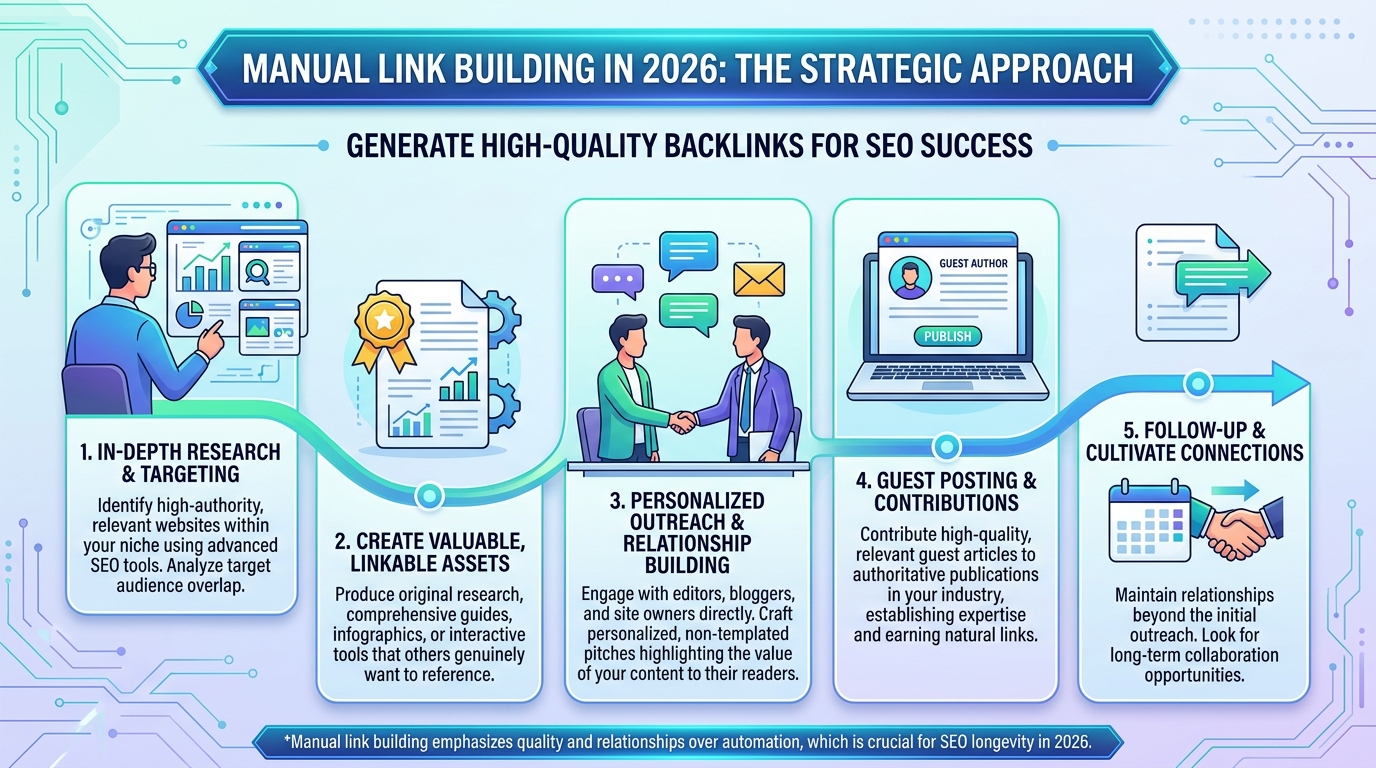
What Is Manual Link Building, Exactly?
Manual link building is the practice of earning backlinks through genuine, individualized human effort real research on each target site, personalized outreach written specifically for that site's audience and content, and a relationship-based approach to earning a placement rather than manufacturing one. It stands in direct contrast to automated link building, where software sends templated pitches to a purchased media list at volume, or worse, places links through private blog networks with no genuine editorial process behind them at all.
The distinction matters more than it might sound. A manual link building service researches a target publication's actual content before reaching out, tailors the pitch to reference something specific and real about that site, and treats each placement as a genuine relationship rather than a transaction. That difference shows up directly in results: personalized, manually researched outreach converts at multiples of the rate generic, templated pitches achieve, because publishers and editors can tell the difference almost immediately.
Why Manual Outreach Beats Automation in 2026
Three forces have converged to make manual link building the clear winner this year, and understanding all three helps explain why the gap keeps growing rather than closing.
Detection has gotten dramatically better. Google's SpamBrain system and related quality algorithms have become significantly more sophisticated at identifying the patterns automated and bulk link building leave behind near-identical anchor text distribution, links clustered on low-quality sites with no real traffic, and outreach patterns that show no genuine research behind them. Building backlinks SEO work that survives this scrutiny requires exactly the kind of natural, varied, genuinely earned profile that only manual outreach reliably produces.
Publishers have gotten better at spotting templated pitches. Editors and site owners receive a constant stream of generic link requests, and most have developed a fast instinct for recognizing one within the first sentence. A manual link building outreach service that references a target site's actual recent content, understands its audience, and offers something genuinely useful in return earns a response at a dramatically higher rate than a mail-merged template ever will.
The cost of getting caught has risen. A domain flagged for manipulative link signals doesn't just lose the value of the flagged links it can suffer broader ranking suppression that takes far longer to recover from than the original campaign took to run. That asymmetry modest short-term savings from automation versus a potentially severe, long-lasting penalty makes manual link building the financially rational choice for any business planning to compete in search for more than a single quarter.
The Manual Link Building Process, Step by Step
A properly run manual campaign follows a consistent structure, whether it's handled in-house or through a professional seo link building service.
Step 1: Audit and strategy. Before any outreach begins, a genuine manual process starts with a full backlink audit understanding your current referring domain profile, identifying gaps relative to competitors, and pinpointing exactly which pages need link equity most urgently based on their commercial value and current ranking position.
Step 2: Target research. This is where manual work diverges sharply from automation. Real research means identifying sites with genuine topical relevance and real organic traffic, then studying each one's actual content, tone, and recent coverage before ever drafting an outreach email not pulling from a generic media list sorted by domain rating alone.
Step 3: Asset development. Whether the goal is a guest post, a data study for digital PR, or a niche edit into an existing article, manual link building requires content genuinely worth linking to something that gives an editor a real reason to say yes, not just a favor to grant.
Step 4: Personalized outreach. Every pitch references the specific site and content it's being sent to, states clearly what's being offered and why it fits that particular publication, and asks for exactly one small, low-friction thing. This single step is where manual outreach earns its dramatically higher conversion rate over templated alternatives.
Step 5: Relationship follow-up. A single, genuinely useful follow-up offering additional value rather than just repeating the original ask measurably increases response rates, and manual campaigns are built to sustain this kind of ongoing, individualized relationship management rather than moving on after one unanswered email.
Step 6: Monitoring and reporting. Manual link building doesn't end once a placement goes live tracking whether links stay active, monitoring anchor text distribution for natural variation, and reporting real, verifiable placements rather than a vague count are all part of a legitimate, ongoing program.
How to Build Backlinks Manually: The Core Tactics
Understanding how to build backlinks the right way starts with a handful of proven, white hat tactics, each suited to slightly different goals and content types.
Guest posting remains effective when it's selective and genuinely valuable a real article placed on a site your actual audience reads, researched and pitched individually rather than blasted across a purchased list of guest-post-friendly domains.
Digital PR and original research has become the highest-performing manual tactic in the industry, since a genuinely newsworthy data study, pitched to a carefully researched list of relevant journalists, earns links because the underlying findings are worth covering, not because anyone asked for a favor.
Broken link building identifies dead links on relevant, high-authority pages and offers your own content as a working replacement a tactic publishers generally welcome, since it improves their own page while earning you a contextual, relevant backlink.
Niche edits add a link into an already-published, already-ranking article, requiring genuine relationship-building with the site owner or editor rather than new content production, and they remain one of the fastest legitimate paths to a relevant backlink when done through manual, individualized outreach.
Resource page link building targets existing curated lists of helpful tools or references, where manual research identifies pages a genuine addition would improve, followed by a pitch tailored specifically to that page's existing structure and audience.
Each of these tactics depends entirely on the manual research and personalization behind it the same tactic executed through automation at scale produces a fraction of the results, and carries real risk the manual version doesn't.
White Hat Manual Link Building vs. Automated Shortcuts
Every provider claims to be white hat; the real test is methodology. A genuine white hat link building service earns every placement through real value delivered to the publisher, never through paid link schemes, private blog networks, or reciprocal exchanges dressed up as organic outreach. White hat seo link building executed manually produces natural backlinks links that exist because they were earned which is precisely the pattern that survives algorithm updates rather than getting quietly neutralized by them.
The contrast with automated shortcuts is stark once you look past the sales pitch. Bulk seo link building packages promising dozens of guaranteed placements a month at a flat, low price are close to a mathematical impossibility if genuine manual research and editorial standards are actually involved real outreach takes real time, and that labor has a real cost that bulk automation simply can't replicate while still producing genuine placements.
Manual Link Building for Local SEO
The manual principle applies just as directly to local businesses, though the specific tactics shift. Local seo link building through a dedicated local link building service focuses on citation consistency, regional press relationships, and directory placements relevant to a specific service area work that depends on genuine local research just as much as national editorial outreach depends on understanding a target publication's audience.
Understanding local seo vs traditional seo link building google maps optimization matters directly here: national editorial link building earns authority through topical relevance and content quality regardless of geography, while local link building earns trust specifically through consistent, verifiable presence across the local business ecosystem a real customer would actually encounter while researching in a specific area. Both depend on manual, individualized outreach rather than bulk automation a local directory submission service blasting the same listing to hundreds of low-quality directories produces citation noise, not genuine local trust signals.
How to Tell Real Manual Outreach From Automation Wearing a Disguise
Because manual has become a marketing buzzword almost as overused as white hat, it's worth knowing exactly what to look for before trusting the label at face value. A few concrete signals separate genuine manual work from automation dressed up in manual language.
Response rate transparency. A real manual link building service can tell you approximately what percentage of outreach emails convert into a genuine reply, and that number should be meaningfully higher than what generic batch outreach typically achieves personalized, well-researched pitches routinely convert at several multiples of a templated campaign's rate. A provider who can't or won't discuss this metric honestly is a warning sign.
Specificity in sample pitches. Ask to see an actual outreach email template or a real, anonymized example. Genuine manual pitches reference something specific about the target site a recent article, a particular angle the site covers well, a genuine reason the fit makes sense. A template with a first-name merge field and generic praise about your great content is automation with a manual label attached.
Realistic volume expectations. Real manual research and outreach takes real time per target a provider promising an enormous number of placements per month at a low price is either not doing genuine research on each one, or is quietly supplementing manual work with bulk, lower-quality sources to hit the promised volume. A legitimate manual campaign produces fewer, higher-quality placements over the same period than an automated one claims to.
Willingness to explain a failed pitch. Manual outreach doesn't convert on every attempt that's expected and normal. A provider willing to walk through why a specific pitch didn't land, and what they'd adjust next time, is demonstrating a real, adaptive research process. A provider that only ever shows successes, with no visibility into the process behind them, is harder to trust at face value.
Setting Realistic Expectations for a Manual Campaign
One honest tradeoff worth naming directly: manual link building is slower to scale than automation, by design. A skilled outreach specialist can realistically manage genuine, individualized research and pitching for a limited number of targets per week, not hundreds. That's not a flaw in the approach it's the direct source of its effectiveness, since the personalization that drives higher conversion rates is exactly what caps how fast the process can run. Businesses expecting hundreds of links per month should recalibrate that expectation before starting a manual campaign; a realistic, well-run manual program typically delivers a modest, steady stream of high-quality placements each month rather than a large batch, and the quality difference is precisely what makes that trade worthwhile over any meaningful time horizon.
Choosing a Manual Link Building Service
Not every provider claiming manual outreach is actually delivering it, and the vetting process matters as much as the decision to hire outside help in the first place. Ask any prospective outreach link building service to describe, in specific detail, how they research target sites and personalize pitches a provider that can only describe a generic list-based process is running automation dressed up as manual work.
A trustworthy link building outreach service should show real, verifiable placement examples actual URLs, real domain metrics, genuine organic traffic rather than a vague promise of high authority sites. Ask directly whether you'll have approval rights over proposed placements before they go live, and how the provider handles a campaign that underperforms. A legitimate seo link building service welcomes this scrutiny rather than deflecting it.
Pricing varies meaningfully by scope and authority tier. Affordable seo link building services genuinely exist for early-stage businesses, provided affordable doesn't quietly mean automated a legitimate lower-tier offering still uses manual research and outreach, just at a lower monthly volume than a premium retainer. Seo link building cost for a properly run manual program typically reflects the real labor involved: expect meaningfully higher pricing than any bulk, automated alternative, since genuine research and relationship-building simply can't be compressed the way templated outreach can. For agencies managing multiple client accounts, white label seo link building has become a common way to deliver genuinely manual outreach work under an agency's own branding without building that specific research capability in-house from scratch.
Tools That Support (Not Replace) Manual Outreach
Manual link building doesn't mean working without software it means using tools to support genuine research rather than to bypass it entirely. The best link building and backlink analysis tools for SEO earn their value specifically at the research stage: identifying which sites already link to your competitors but not to you, verifying a proposed target's real organic traffic rather than trusting a domain rating alone, and flagging toxic or suspicious link patterns before they become your problem.
When comparing seo link building tools and seo link building software, prioritize platforms with genuinely comprehensive, frequently refreshed backlink indexes over ones that look polished but pull from thinner underlying data, since the entire manual research workflow described throughout this guide depends on how complete that index actually is. The best seo link building tools and best seo link building software available in 2026 support the human research process surfacing genuine opportunities for a real person to evaluate and pursue rather than attempting to automate outreach itself, which is exactly where automation stops adding value and starts introducing risk.
Tying Manual Link Building to Your Keyword Ranking Strategy
A sound keyword ranking strategy treats manual link building as a deliberate, targeted investment rather than a generic, evenly distributed effort. Concentrate manual outreach behind the specific pages carrying the most commercial weight your core service pages, comparison content, and highest-value landing pages rather than spreading limited research and outreach time thin across your entire site. A handful of genuinely relevant, manually earned backlinks pointed at your most important pages compounds into ranking improvement across every related keyword on your domain, not just the specific page that earned the link, which is exactly the kind of durable, compounding return automated, unfocused link acquisition rarely delivers.
Final Thoughts
Manual link building isn't the slower, more expensive alternative to automation in 2026 it's simply the only approach that reliably works anymore. As detection systems get sharper and publishers get better at spotting templated outreach on sight, the gap between manual and automated results keeps widening in favor of real, individualized human effort. Build your strategy around genuine research, genuinely valuable content, and personalized outreach, and the resulting backlink profile compounds in value for years rather than risking everything on a shortcut that stopped working.
Frequently Asked Questions
What's the difference between manual and automated link building?
Manual link building involves real, individualized research and personalized outreach for each target site. Automated link building relies on templated pitches sent at volume, or bulk placements through low-quality networks with no genuine editorial process behind them.
Is manual link building more expensive than automated alternatives?
Generally yes, since it reflects real research and outreach labor rather than software running at scale. That higher cost typically pays for itself through dramatically better conversion rates and a much lower risk of triggering a penalty.
How long does manual link building take to show results?
Most businesses see initial ranking movement within two to four months of acquiring strong, relevant links, with fuller domain-level authority gains building over six to twelve months of sustained, ongoing effort.
Can I do manual link building myself, or do I need an agency?
Either works, depending on available time and expertise. A solo founder or small team can run manual campaigns in-house with the right tools for research; larger programs or limited internal bandwidth often make hiring a dedicated manual link building service the more practical choice.
Does manual link building work for local businesses too?
Yes the same manual, research-driven principle applies, though the specific tactics shift toward citation consistency, regional press relationships, and local directory placements rather than national editorial outreach.
Read more: white label link building agency guide