Quick answer: Coyyn.com is a content platform covering digital finance, crypto, and the gig economy — not a licensed bank. As of August 2026, independent checker ScamAdviser rates it a medium-to-low trust score of 61/100. It hasn't been confirmed as a scam, but reviewers have flagged real transparency gaps, and the brand operates across several near-identical domains — a pattern worth understanding before you engage with it. Below, I'll walk you through exactly what the data shows and give you a repeatable framework for vetting it yourself.
I'll be honest with you — when I first heard about coyyn.com, I did what most of us do. I typed it into Google and expected a clean answer. I didn't get one. And that's exactly why I sat down to write this coyyn.com review — because you deserve more than recycled fluff.
So here's the deal.
This article breaks down what coyyn.com actually claims to be, what independent trust checkers say about it, and how you can evaluate any digital finance platform like this one before you trust it with your time, your data, or your money. If you're generally trying to separate legitimate platforms from risky ones, my breakdown of red flags to watch for with any online service covers similar warning signs, and if you're curious how other emerging tech platforms hold up under scrutiny, I did a similar deep-dive on Droven.io.
Let's dig in.
What Is Coyyn.com? (And Why People Are Searching For It)
Quick gut-check before we go further — you're probably here because you saw the name somewhere and wondered, "wait, is this thing real?" Totally fair. That's search intent 101, and I want to answer it directly before we go anywhere else.
According to its own homepage, coyyn.com positions itself as a content hub covering digital capital, digital finance, cryptocurrency, venture capital, and the gig economy. It's not a bank. It's not (as far as public information shows) a registered financial institution. It reads more like an editorial platform — think blog-meets-finance-explainer — aimed at freelancers, small business owners, and crypto-curious readers.
Here's the thing though.
The branding around coyyn.com has expanded fast. You'll find spin-off domains like businesscoyyn.com and even regional variants like coyyn.com.in. That's a pattern worth paying attention to, and I'll explain why in a second.
Core Topics Coyyn.com Covers
Digital banking trends and mobile-first finance
Blockchain business solutions and smart contracts
Cryptocurrency and government crypto regulation
Venture capital analysis
The gig economy and freelance income tools
If you're a freelancer trying to make sense of crypto wallets, peer-to-peer payments, or decentralized finance (DeFi), this is the kind of territory coyyn.com plays in. (If DeFi is new to you, I break it down in plain English in my DeFi explainer for beginners.)
Is Coyyn.com Legit? Here's What the Data Actually Shows (As of August 2026)
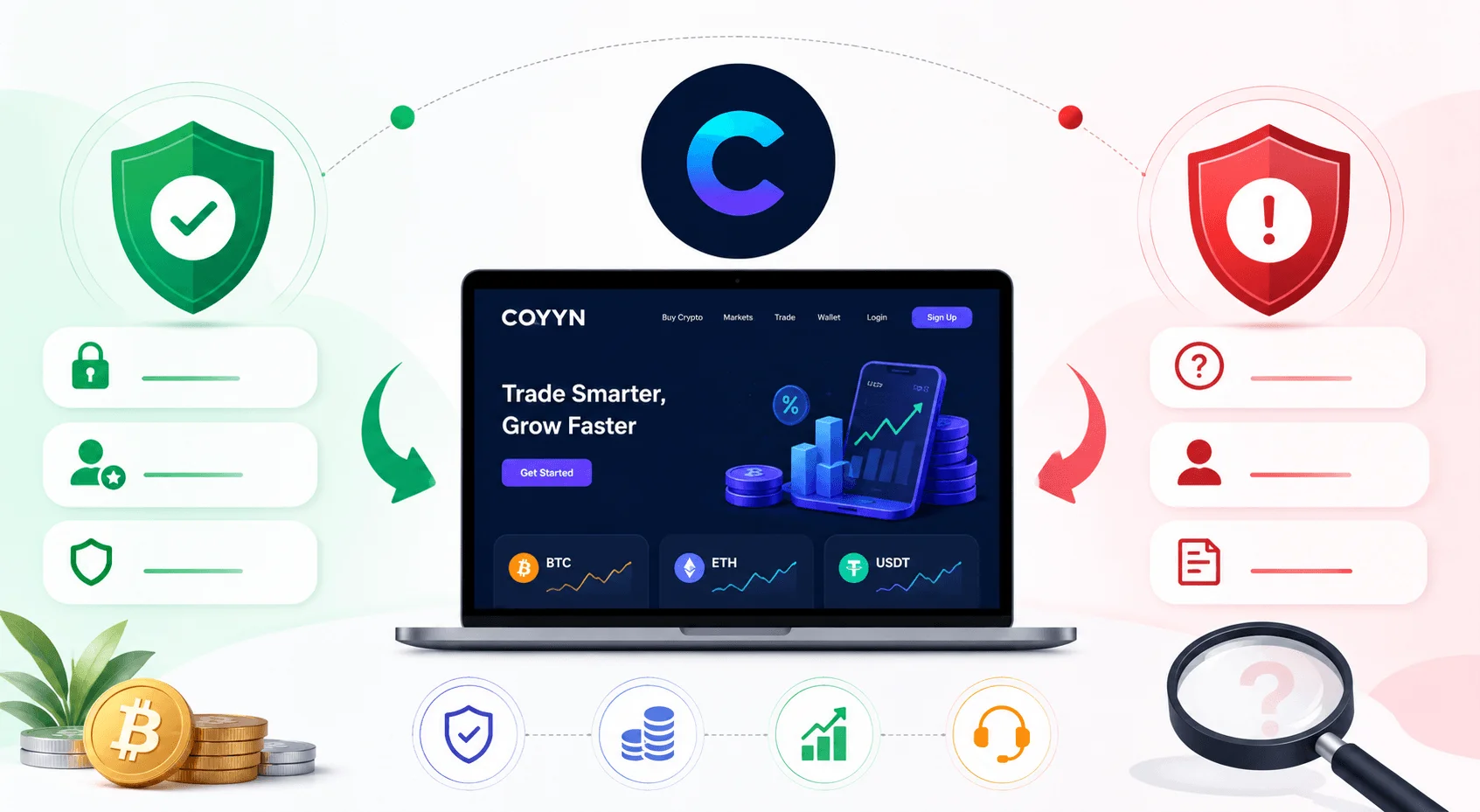
Okay, this is the part you really came for. Let's not dance around it.
I went digging through independent site-trust tools instead of just trusting the marketing copy, because — and I say this with love — you should never take a finance site's word for its own legitimacy. Ever.
The Trust Score Breakdown
ScamAdviser, one of the more widely used website trust score checkers, currently (as of August 2026) rates coyyn.com around 61 out of 100. That lands it in a "medium-to-low risk" zone — not a red flag exactly, but not a green light either. The score factors in things like WHOIS data, hosting provider, SSL certificate validity, and spam/phishing blacklist history. Since trust scores shift over time, I'd recommend re-checking the live score before you make any decisions.
Translation? It's not screaming scam. But it's also not proven safe.
That distinction matters more than people think.
Red Flags Worth Knowing About
Now here's where it gets a little more serious.
A few independent reviewers have flagged real concerns. One detailed business review pointed to a lack of transparency, missing regulatory oversight, reported withdrawal issues, and unrealistic profit claims — all classic high-risk indicators for unregulated fintech platforms.
Another analysis from WebDigitalTrends went even further, applying an E-E-A-T lens (that's Google's Experience, Expertise, Authoritativeness, Trustworthiness framework) and noting missing disclosures as a genuine credibility gap. That same piece mentioned that discussions on Reddit and Quora show real skepticism from users about the platform's overall legitimacy — with some commenters describing slow or unclear withdrawal processes, and others saying the interface itself felt polished but the "who's actually behind this" question went unanswered.
I want to pause here and say something important: none of this proves coyyn.com is a scam. It doesn't. But it does mean due diligence isn't optional — it's mandatory. The same core red flags apply across industries — whether you're vetting a fintech platform or a service provider, the warning signs of poor transparency look remarkably similar.
Multiple Mirror Domains — A Pattern Most Reviews Miss
Here's something that genuinely made me raise an eyebrow, and honestly, it's the angle most other coyyn.com reviews gloss over.
Coyyn-branded content shows up across several domains — coyyn.com, businesscoyyn.com, cooyyn.com, coyyn.com.in, and even coyyn.site, with the latter carrying its own separately low trust rating on ScamAdviser. That kind of domain sprawl is common with content farm networks trying to capture as much search traffic as possible around a trending phrase.
It's not automatically damning. Legitimate brands do build regional or topic-specific microsites too. But combined with the transparency gaps above, it's a pattern you shouldn't ignore — and it's the single biggest reason I'd urge extra caution here.
Coyyn.com vs. Established Fintech Platforms: Quick Comparison
Numbers are easier to trust than adjectives, so here's how coyyn.com stacks up against platforms with clearer regulatory footprints:
Criteria | Coyyn.com | Wise | Coinbase |
|---|---|---|---|
Regulatory status | Not publicly disclosed | Regulated (multiple jurisdictions) | Regulated, licensed exchange |
Trust score (ScamAdviser-type) | ~61/100 (medium-low) | High | High |
Named leadership/team | Not clearly disclosed | Publicly disclosed | Publicly disclosed |
Domain consistency | Multiple mirror domains | Single primary domain | Single primary domain |
Core function | Content/education site | Regulated money transfer | Regulated crypto exchange |
KYC/AML disclosed | Unclear | Yes | Yes |
The takeaway: coyyn.com functions more like a finance media brand than a regulated financial service — treat it accordingly.
How to Evaluate Any Digital Finance Platform (Step-by-Step)
Alright, let's make this actually useful for you — not just about coyyn.com, but as a repeatable framework you can use for literally any fintech or crypto site you stumble across.
I built this checklist the way I'd want someone to hand it to me before I trusted a platform with real money.
Step 1: Run a Trust Score Check
Start with a website trust score tool like ScamAdviser. Look at:
Domain age (younger domains carry more risk)
Hosting provider reputation
SSL certificate presence (necessary, but not sufficient on its own)
Blacklist or spam reports
Step 2: Search for Independent Reviews
Don't just read the first article that pops up. Go looking for user reports, forum threads, and third-party breakdowns. Reddit and Quora threads tend to surface real complaints faster than polished review sites.
Step 3: Check for Regulatory Transparency
Ask yourself: does this platform disclose its KYC verification and AML compliance processes clearly? Are there named executives, a registered business entity, or licensing information? If the answer is vague or missing, that's a signal — not proof of a scam, but a signal.
Step 4: Look for Withdrawal and Custody Clarity
If a platform touches your money or crypto assets, you need total clarity on private key security and self-managed crypto storage. Who actually controls the keys? What happens if you want to withdraw everything tomorrow?
Step 5: Cross-Reference Multiple Domains
If a brand operates several near-identical websites, check whether each one carries consistent trust signals. Inconsistency across domains — like we saw with the coyyn family of sites — deserves extra scrutiny.
Step 6: Trust Your Gut (But Verify It With Data)
Honestly? If something feels off, it probably is. But don't just rely on vibes — pair your instinct with the actual data from steps 1 through 5.
What Coyyn.com Gets Right
I don't want this to read as a hit piece, because that wouldn't be fair either.
Coyyn.com's content actually covers real, relevant ground for anyone navigating digital capital and the modern gig economy. Topics like mobile wallets, cashless payments, cross-border transactions, and blockchain technology adoption are genuinely useful things for freelancers and small business owners to understand right now.
The site also has a valid SSL certificate, which — while not a guarantee of safety — is table stakes for any legitimate site handling sensitive topics.
So there's value here. Just... read it with your eyes open.
What Coyyn.com Should Improve
If I were advising the team behind coyyn.com (and hey, maybe someone there is reading this), here's what I'd tell them:
Publish clear regulatory compliance disclosures
Name real people behind the platform — bios, credentials, LinkedIn profiles
Clarify whether coyyn.com is a media brand only, or if it also offers actual financial products
Address the mirror-domain confusion directly
Transparency isn't just good ethics. It's genuinely good SEO too, since Google's Helpful Content guidelines reward exactly this kind of E-E-A-T signal.
Frequently Asked Questions About Coyyn.com
Let's knock out the questions I know you're still holding onto.
Is coyyn.com a bank?
No. Based on publicly available information, coyyn.com functions as a content and education platform around digital finance, not a licensed banking institution.
Is coyyn.com safe to use?
It's not flagged outright as a scam, but its trust score sits at a medium-to-low 61 as of August 2026, and independent reviewers have raised real transparency concerns. Proceed carefully, and never share sensitive financial data without verifying the platform's legitimacy first.
Why are there so many coyyn domains?
Multiple domains (coyyn.com, businesscoyyn.com, coyyn.com.in, coyyn.site) suggest a broad content marketing or SEO strategy — though it can also be a red flag pattern seen in less transparent operations.
Should I invest through coyyn.com?
I can't give you financial advice, and honestly, neither should any blog post. What I can say is this: before putting money into any platform, verify licensing, read independent reviews, and never invest more than you're prepared to lose. That's just smart practice, full stop.
Final Thoughts: Should You Trust Coyyn.com?
Here's my honest, no-fluff takeaway.
Coyyn.com sits in a gray zone. It's not confirmed as a scam. It's also not confirmed as a fully transparent, regulated platform. The smartest move you can make — with coyyn.com or literally any fintech platform you come across — is to treat every claim as a starting point for your own research, not the final word.
Use the step-by-step framework above. Check the trust score. Read the independent reviews. Look for named humans behind the brand. And when in doubt, slow down.
Your money — and your data — are worth that extra ten minutes of digging.
If you found this breakdown useful, bookmark it — I'll keep this post updated as more information about coyyn.com's practices comes to light.